
Recently in Martial Arts Category

Wednesday, March 17, 2010

James Wesley:
On the palm stick topic -- I might add that a mountaineering carabiner -- the genuine load bearing kind, not the cheap copies -- would also work [as a self defense adjunct]. I routinely carry one -- and, when asked, say "Oh, I found that it makes carrying all those [full] plastic bags from the grocery store much easier. They don't bite into my hand." People see this as clever and never consider it has some alternative purpose [serving as a brass knuckle or palm stick type device]. And BTW, it also does make a great all purpose handle -- the weight rating is something like 4,000 pounds. Keep up the great work! - Karl B.


Jim,
Here are a few more references for the Koppo stick:

The Martialist on Pocket Sticks
The Martialist on Koppo Wraps
The Martialist - More Comments on Koppo Wraps
The FMA Blog on Pasaks

BTW, with a koppo, I recommend that you put both loose ends of the cord through the loop going in opposite directions to better hide the knot.

I carry my LED "flashlight" in a belt sheath on my weak side for easy access. - Rick H.

Monday, March 15, 2010

The palm stick, sometimes called a Yawara stick, or Kubotan, is an excellent and highly effective tool for self-defense. The tactical folding knife and the concealed pistol typically dominate the self-defense culture, especially when weapons are discussed. However, the palm stick has several advantages and applications that firearms and knives cannot match.

Typically a palm stick measure around six inches in length, and about a half inch in diameter. Six inches is a good length, in my opinion. This combines concealment with a length that is still practical for offensive moves. A half inch may be a tad skinny, but too much thicker and one starts to get into concealment issues again, as well as weight and gripping ability. On the whole, I have found that the commercial off-the-shelf palm stick to be sufficient for the average citizen.

Since most of our palm sticks are going to be key chains, it pays to be aware of everything else that is in your pocket, and not to keep your keys in a place that is not readily accessible. One of the things I do is typically grab onto the kubotan and hold onto it loosely if I think there may be any sort of confrontation. It’s important to practice pulling the stick from its place of concealment, and practice with a purpose.

By "practice with a purpose", I mean simply bring the palm stick out and strike a target, real or imaginary. Do it with speed. One of the things I do, with a palm stick or folding knife, is bring it out and thrust it straight towards the chin area of an imagined opponent. This is good in either provoking a flinch, or hitting a target that can cause a great deal of pain, allowing for a successful escape.

Once you have practiced drawing the palm stick, it’s time to practice swinging it, stick part first. Obviously, its length precludes one from swinging the palm stick like a baton. However, there are a great variety of other techniques that are surprisingly effective.

For starters, grip the stick in the center, with a closed fist wrapped all the way around, making sure that there is a sufficient striking surface sticking out of both sides of the fist. One can grip off-center, and use the palm stick in a similar fashion as a knife, but that is not a technique I would recommend for beginners.

Next, practice a hammerfist technique, with the outside portion of your fist, or the part made up by the pinky finger. This is quite possibly one of the simplest strikes to learn and practice. Practice an overhead strike, a backhand hammerfist, a low hammerfist, and a palm-up hammer fist. Try striking in a variety of angles, with the hand in different positions. The length and hardness of the palm stick will turn this simple technique into one that becomes devastating when applied to nearly any part of the body. Imagine slipping this hammerfist into someone’s ribs, head, cheek, neck, hand, forearm, and you begin to see my point. It is a simple way to cause pain and damage to an attacker.

The next thing to do is practice with the inside of the fist, the part along the thumb. This strike may take a little more practice and finesse, but it also can be quicker, and just as painful. Practice strikes from top, bottom, left and right. Aim high, low, face, stomach, ribs, anywhere you can think of to strike. Later on, I will list some of my favorite targets. The forward portion of the fist also requires a little bit of coordination. If you find yourself having trouble, try to imagine a hook punch or a haymaker punch. In essence, this is what you are throwing, only not with the knuckles of the fist. Also, do not neglect a palm up strike.

Now, you already have formed a fist. Might as well take advantage of the fist and the natural inclination to punch someone, and practice a few jabs and crosses, with the palm stick. Punching with the palm stick has many advantages over having an empty hand. For starters, there is a little added weight to the hand, making a punch have more impact. Secondly, if the punch itself misses, the palm stick may graze the person, or the keys that may be attached to the stick. Last, and probably most important, the palm stick provides a measure of support and reinforcement for the knuckles and finger bones in the fist. Many people can easily break their own bones by punching someone in the head, which is an instinctive place to punch. A palm stick is one method of reinforcing these fragile bones and preventing serious injury.

Once again, a boxer’s delivery will help the most for punching. If you have no prior experience, simply try to remember a couple things. Always keep your hands up, bring your hands right back to your guard, and don’t rear back for the punch. Most likely if you have internet access, you can find a couple videos that can get you started on learning how to punch properly. At the end of this article I will provide a list of references for more information on punching and weapons for self-defense.
Now, in the case of a key-chain palm stick, the keys themselves have tremendous advantage over just a palm stick without keys. Keys are sharp, somewhat heavy, and can be swung by that palm stick with a decent amount of force. Practice swinging the keys in an X-pattern, known as ikis in Kali. Swing diagonally from upper right, then from upper left. The goal is to not only hit the person, but also convince them that you mean business so that they may run off and find easier prey. If they decide to rush in, imagine the consequence of taking a set of keys to the face. The psychological impact alone of having sharp metal objects swung at one’s face cannot be overlooked. If the attacker puts their hands up in attempt to ward off an attack, then any low-line targets such as the thigh, knee, or groin are open for some other attack.

A couple of years ago, a friend introduced the idea of holding the keys and swinging the palm stick. This is not my favorite method, but that does not mean it should not be trained. The advantages of this are that the palm stick typically has more solid mass than the keys, and can be swing a little harder due to leverage. I think that the keys are a bit trickier to get a grip on, but that may be my personal opinion. In any event, swinging the palm stick can be used just like swinging the keys. Describe an X pattern in the air in front of you. Ideally, this X should start at about the enemy’s collar bone, and cross about the solar plexus.

Care must be taking to balance striking power with control. Take care not to over-swing, and over-commit. W. Hock Hocheim describes the “window of combat”, a rectangle loosely bordered by mid thigh, to about shoulder height, no wider than the shoulders. If your swings start getting outside of this window, you are over-swinging, and opening yourself up to an enemy being able to defeat your defenses.

The palm stick can also be applied to a variety of pain points. The middle of the back of the hand, the notch at the bottom of the throat, under the nose, under the mouth, and behind the ear are some of the ones that come to mind immediately. A quick strike to the carotid artery, no matter how lightly, can have literally stunning results on an opponent. A strike to the temple can be potentially fatal, as can a strike to the trachea.

Using a palm stick, it can be possibly to break an attacker’s collarbone with a hammerfist attack. If you are grabbed, in addition to a releasing technique, a quick strike to either the offending limb or the person’s solar plexus will loosen their grip, making it easier to get away.

If you double the person over, a hammerfist to the back of the neck can have potentially fatal consequences, and will at least leave the attacker stunned and lying on the ground, unable to continue the attack. The palm stick can be thrust into either the groin or the solar plexus, with devastatingly painful results. [JWR Adds: In many law enforcement circles, baton strikes to the neck or head are considered potentially lethal, and reserved only for life-threatening situations that are comparable to firing a gun.] If the groin seems protected, the inside of the leg can be struck, as this can strike or come close to striking the femoral artery, a painful and potentially stunning blow. If the hands are high, aim for the ribs with either the inside or outside edge of the hammerfist. Ribs are always a good target for causing maximum pain and damage.

If you know any throws or takedowns, the palm stick can assist. One simple judo throw, o-soto gari, calls for the fist to apply pressure to the collarbone. That same pressure can be applied with the palm stick, to the collarbone or the throat area, making this simple foot sweep even more effective.

Against edged weapons, the palm stick has somewhat less usefulness. As always, the best chance of success against and edged weapon is to catch the weapon bearing limb, preferably after hitting the attacker with a chair, brick, or a car. Once you have caught the weapon bearing limb, you can beat on the wrist, the fragile bones of the hand, the elbow, and the inside of the biceps. All areas are vulnerable to strikes, and have numerous pain receptors. In the case of the inside of the biceps, there is a nerve cluster there that tends to send a shooting pain down the arm, sometimes making it go numb. It is not a strike to count on, but a possible and worthwhile target nevertheless.

A palm stick can be homemade quite easily. One merely has to select a thickness of dowel, preferable at least a half inch thick, measure out enough so that there is a striking surface of at least a quarter inch on each side of the fist, and cut it to fit. Added options include placing a weight in the center of the stick, drilling two holes in the stick and tying a cord [to make it into a Koppo stick], or making one end slightly sharper, or at least more pointed than the other.

At least one martial art that I’ve seen, Goju-Ryu Karate, which is an Okinawan style, has a kata that uses two palm sticks, although they are considerably smaller than what I’ve described here. Many Filipino systems cover the palm stick, if not in precise detail.

Many tactical folding knives can double as a palm stick, if the user is not able to deploy the blade right away. However, some State [and local] laws may prohibit carry of knives [or even palm sticks]. But keep in mind that several tactical flashlights, such as Surefire [and Mini-MagLite], can be used as a palm stick. Surefire and a couple other companies make flashlights with beveled front edges, specifically for this purpose. [JWR Adds: These are generally legal to carry. Ditto for beefy pens that run the gamut from the very inexpensive Cold Steel Pocket Shark to the very expensive Mont Blanc Meisterstuck. If you opt for the Pocket Shark (which, BTW, is what I carry when I fly on commercial airplane flights), then I recommend scraping off all of the pen's exterior markings. Be sure to consult the laws for wherever you will travel!]

There is a great deal of martial arts instructional material available on sites like YouTube if one does a simple search. [JWR Adds: Try doing searches at YouTube that include "palm stick ", "Kubotan", and even the very common misspelling: "Kubaton".] Much of my own instruction has come from W. Hock Hocheim, and guru Marc Halleck. Both individuals have first rate instructional DVDs.

In summary, the palm stick is an overlooked and easily used piece of self-defense equipment. Useful for striking and grappling, it can cause a great deal of pain with a reduced risk to the user. It’s easily concealed, easily employed. Overlooked by the majority of law enforcement officers and civilians alike, it can be hidden in plain sight. You’ll never have to leave it in your house while you go to the bank or a school board meeting. With a little elbow grease one can be custom made for every member of the family. The principles of the palm stick can be taught to children and adults. It is not a tool that depends on the use of the right hand or left hand. It may not have the range of some other more conventional self-defense tools, but it is much more versatile than the average citizen realizes.

About the Author: Kent is an 11-year veteran of the U.S. Army's Infantry Corps, now serving his third tour in Iraq. He has been studying Filipino Martial Arts (Kali, Arnis, and Silat), for about seven years. In addition, he has been training in various military and civilian combatives programs since joining the Army. He has taught combatives and martial arts to his fellow soldiers, and civilians.

JWR Adds: A full line of inexpensive yet very well-made high impact American-made plastic palm sticks is available from Alpha Innovations. They also make "Letter Openers", and other other high density injection-molded goodies. Their "Stylus Kubaton" variant is ideal for anyone that carries a touchscreen PDA or an iPhone. (Consult your local laws before ordering!) OBTW, they also make some amazing custom products and sell training DVDs.

Wednesday, March 3, 2010

I will start this article with a question: What are you doing on a regular basis (i.e. daily) to prepare yourself mentally, physically, emotionally, and most of all, spiritually, to not just survive, but prevail during a violent encounter?

This is a question I ask myself on a regular basis.  I have also posed this same question to my hand-to-hand combat students.

There is no question that interpersonal violence will be fact of life for many in a post-societal collapse.  But, it is a reality in today’s society that many people (i.e. sheeple) choose to ignore.

Depending on your source for statistics, the number of instances of violent crime reported [in the US] in 2008 was more than 5,000,000.  Yes, there are six zeros after that 5!  That figure astounds and saddens me, but doesn't surprise me.

My full-time job is a police officer with a suburb of a major city that regularly meets or exceeds the number of violent acts from the previous year.  These acts of violence are prominently displayed in local newspapers and on radio and television.  Yet, for many, they refuse to accept this reality and thus refuse to prepare to for it.

Security Awareness

Security awareness needs to be a way of life for all of us because prevention is the best defense.  Now, I am not talking about paranoia, but preparation and practice.  One such example of being security minded is locking your doors once you are in your house or car.  How many times have you seen someone get into their car and talk on their cell phone or do some other task while being totally oblivious to what's going around them?  Maybe you have even done this yourself.

Speaking of locking your doors, how many of you consistently make sure that the door from the garage to your house is always locked?  I can't even begin to guess the number of burglaries that I have been on where the offender(s) found the victim's garage door open and the offender(s) then gained entry into the home via the unlocked man door.  As part of your daily OPSEC for your residence, make sure the garage door is shut and the man door is locked.

Let's take the last scenario one step further.  Just this past summer I saw several incidents in which the offender(s) pushed the center of the garage door back far enough to reach the disconnect cord for the electric garage door.  Once the opener is disconnected from the chain, they quietly lifted the garage door and stole valuable items from the garage.  Also, in one case they gained entry into the home because the man door to the garage from the house was unlocked.

A personal security tool that you can purchase for yourself and keep on you at all times is a small LED flashlight.  Streamlight, Surefire and Dorcy are just three of the quality brands that are out there.  You want a small metal one that’s not much longer than the width your hand so I am not talking about one of those big, 3 or 5 “D” cell Mag-Lites, even though those are good options for your vehicle and home. Having a flashlight already in your hand allows you to check in and around your car when you’re in dark parking lots or garages and performing OPSEC on your personal property.  You can also shine this light in the eyes of a potential assailant, causing temporary blurred vision and disorientation.  If you choose to get a flashlight, try to get one with a tail-activation switch option and that has replacement batteries and keep at least two extra batteries with you at all times.  Most people, even cops, forget to charge their lights and the lights don’t work when they need them the most.  Also, consider getting a light with the scalloped or serrated edges around the lens area.  It makes a great impact weapon should you need it.

Entire chapters can be written on personal and property security awareness.  But, suffice it say, security awareness needs to become a way life because, especially post-WTSHTF, your life may literally depend on it.

Hand-to-Hand Combat

As I mentioned earlier in the article, I am a Hand-to-Hand (H2H) practitioner and instructor.  My primary form is an Israeli H2H system that I have taught to both civilian and law enforcement.  I also teach security awareness and self defense seminars for women in the community.

I have studied several different styles of martial arts over the past 25+ years and have seen many drawbacks of traditional systems.  Most traditional systems are heavy on tradition but light in the area of combat applications.  This fact is well known and recently there has been a plethora of "new" systems out there that refer to themselves as reality-based martial arts (RBMA).

I personally believe that everyone should learn how to defend themselves with both empty hands and weapons.  Even now, depending on the size of your area, the number of officers on duty, and some other factors, our response to your 911 call could be anywhere from two minutes to an hour.  Even if our response is only two minutes, when fighting for your life that may seem like an hour.  Post-WTSHTF, police response may be non-existent. 

RBMAs have tried to step in and market themselves as the "answer" for your H2H needs.  But, there are some serious dangers involved that you need to be aware of.  First, it seems like most of the instructors or "creators" of these systems are former Navy SEALs, Green Berets, Special Forces etc.  Please take the time to learn the instructors true credentials, check references, and observe a few classes.  Also, be wary of the home study courses that claim that you will be able to defeat any attacker in seconds if you just purchase their products.

Another type of RBMA is one that relies heavily on ground fighting, such as Gracie or Brazilian Jiu-Jitsu, or on joint locks, such as traditional Japanese Jiu-Jitsu, Aikido, or some blend thereof.  The goal of these systems, especially in the beginning stages, is to learn to defeat and/or control another one-on-one.  There are too many variables in a violent encounter to justify spending time wrapped up tight with just one person. 

You should train in a system that teaches you to defend common attacks, encourages aggression when appropriate, limits ground work at the beginning levels, works in multiple attacker scenarios on a regular basis and teaches empty hand vs. weapons at the lower levels.  Some of the styles I mentioned do these same things but normally at a much higher rank level which translates to much longer training time.  At our school, you will see all of the above within the first 6 months of training.  I am not saying the system I train/teach in has all of the answers because such a system doesn't exist.  However, one comment I hear consistently is how the participant felt they were ready to defend themselves after the first lesson. This was how our system was designed and is why the Israeli military and police use it to this day.

I know that there are many proponents out there that believe mixed martial arts (MMA), judo, boxing, Thai boxing and wrestling are competent RBMAs, and they are for what they are designed for.  However, these specific RBMAs are limited by rules, safety equipment, number of opponents (which there is only 1), and lack of non-personal weapons.  Don’t get me wrong, these specific systems bring a lot of good training characteristics to the party and I have participated in several of them myself.  But, the point is that you need to train beyond the limitations of these systems. 

Now, some personal thoughts about your family members training in H2H.  If your budget allows, I believe each household member should receive competent H2H training.  Encourage your spouse/significant other to train but, when it comes to your children, especially younger ones, I think you should mandate it.  My wife has attended a womens' self defense seminar and we recently discussed her attending another one.  While she doesn't take formal classes on a regular basis, she likes Tae Bo so I encourage it.  Tae Bo done on a regular basis provides her with physical fitness, is fun for her, and allows her to practice some of the moves she had learned.

As far as children are concerned, I believe that quality self-defense training is a must.  According to a study I read a couple of years ago, there are more than 250,000 assaults in public schools every year.  Based on my experience, I believe that the actual number for this is about 25-50% higher.  I know many schools don't report these incidents because they believe that it will reflect negatively on them.  I know that the training my children have been through has greatly helped them.  One of my children has had issues with a bully and has had to defend himself from an attack where the other child was choking him with both hands on his throat.  This same child was also saved from a nasty fall on concrete when he executed a perfect break fall after he accidentally tripped over an object when playing.  A real good resource for preparing your children is the DVD titled, "I Am Not a Target".  We found a copy of it at our local library and I highly recommend it.

One key aspect of having you and your family trained in a quality H2H system is that everyone should be able to recognize pre-assault indicators.  This way, if one of you doesn’t see the indicators, someone else in your family may and then they warn the rest of the family and/or attack the assailants.  This especially vital in a post-WTSHTF period when it might just be your family against "the world".

Don't Cheat Fair!

I have a specific saying and philosophy when it comes to self-defense: The only fair fight is one that I win!  I have applied this saying to both my personal and professional life.

At the beginning of this article, I mentioned not just surviving, but prevailing during a violent encounter.  You must think and train with the understanding that you may be the only thing standing between your loved ones and their potential pain, suffering, or even death. 

What are you willing to do to stop a violent assault against you or loved one?  Are you willing to scratch, bite, or dig your thumb in someone's eye?  Are you willing to hit someone with a lamp, run them over with a car, plunge a butcher knife into them, or stab them in the neck with a pen?

These are questions you must ask yourself ahead of time and be mentally, physically, emotionally and spiritually prepared to do what is necessary to prevail.

One aspect of not cheating fair is using your environment.  Take a look around at the area you are in right now.  What items do you see that you could defend yourself or someone else with?  What could become a barrier between you and your attacker?  What could you strike or stab an attacker with?  Is there anything that you could throw on an attacker that could cause pain, like hot coffee?  If you are at home, how quickly could you get to a firearm should you have picked one out for home defense?  Knowing your environment is a security awareness concept that you should be practicing constantly.

Now, let's talk about biting and eye gouging.  How many of you have ever been bitten real hard?  I have and it was one of my children.  She was 18 months old and she sunk her teeth into my neck the first time I started to dunk her into a pool.  She bit me so hard that my girlfriend had to physically pry open her jaws to get her off of me.  I remember two distinct things: first, it was some of the worst pain I had ever experienced and secondly, it didn't bleed.  I know some people are scared that by biting another person, they may contract some kind of disease.  Yes, that is a valid concern.  But if you’re dead because you wouldn't cheat fair, does it really matter?  Also, if the attacker intends the attack to be a sexual assault, what are you most likely to get a disease from, the completed sexual assault or some blood from a bite?  When you bite, go for a major muscle area like the chest, shoulders, side of the neck, back and thighs.  Try to stay away from appendages such as fingers, ears, nose, or genitalia.  These areas, while being fairly sensitive, will separate from the body with enough force, which helps the attacker with the pain factor, and these areas have the tendency to bleed a lot more.  Why take the chance with blood if we don't have to?

As soon as you mention sticking your thumbs in someone’s eyes, you see people’s demeanor change.  It’s a gross thought that cause many to squirm.  When my wife was in her self defense class and the instructors mentioned eye gouges, she looked at me and said that she couldn’t think of any reason why she would do something like that to another person.  I quickly asked her what she would do if someone suddenly grabbed our son from her.  I immediate saw a physical change in her demeanor.  Her eyebrows furled, her shoulders raised and her fists clenched.  She just visualized a reason she absolutely would stick her thumb in someone’s eye.  A good account of someone doing this very thing in combat can be found in the book, “House to House”, which is about the Battle of Fallujah.

Weaponry Options

No discussion about interpersonal combat would be complete without talking about weapons.  I will focus this part on weapons that are used for close quarters combat.  These weapons will be classified as blunt, chemical sprays, edged, electric discharge, firearms (mainly handguns) and improvised weapons.

When I think of blunt weapons, I think of any object that can be swung fast and hard as to cause blunt force trauma.  Some common blunt weapons are ball bats, sticks, telescoping batons (ASP, Monodnock), kubotans and hammers.  If you carry or intend to carry a blunt weapon for personal defense, you need to practice regularly by striking fairly stiff objects such as a heavy bag or rolled-up carpet.  Many people are surprised how a blunt weapon feels in their hands when striking a hard object.  I know of several instances of where officers have had their batons go flying out of their hands when they have struck a suspect.

Chemical sprays seem to be a choice that many people, especially females, make.  Actually many chemical spray products are specifically marketed to women as self-defense tool.  Chemical sprays have their place but some things to keep in mind is that it is not instantly incapacitating to an attacker, you will likely be contaminated as well and you need to practice regularly to know your particular spray device works.  Several manufacturers sell an inert spray that can be used for training or you can buy a second can of the same kind so you can practice. 

Use of edged weapons is an area that I know I am weak in, and I continue to learn more about. It is also an area filled with many options, misconceptions and a plethora of experts.  Edged weapons are scary to face and personally, when empty-handed, I would rather be facing a pistol or other weapon in close quarters than an edged weapon.  When learning about edged weapons, make sure that sure that your training includes defense against and the offensive use of the weapon.  Spyderco and other manufactures make training knives that look just like a regular one but that don’t have a sharpened blade.  The first time that I trained with this knife it was intimidating to me because it looked so real.  Another training option I recommend is to take several pieces of heavy duty cardboard and glue them one on top of the other until it’s about 4-5” thick.  Now you can slash and stab the cardboard several times.  This will help you to decide if the knife you have chosen will work with the impact of combat.  Once you find one that can hold up to this kind of training and not tear your hand up, keep that one for training and buy a second one for everyday carry.

In my humble opinion, electric discharge devices such as stun guns, Tasers, and similar devices are the most over-hyped and misunderstood self-defense options out there.  Based on my experience and research, these devices don’t always work when needed and, especially stun guns don’t instantly incapacitate an attacker.  Add to the fact that these devices are battery and technologically-dependant, and I believe that they are very impractical, especially in a post-WTSHTF world.

For many people, the firearms option is an absolute must.  If you choose this option then you need to constantly train with it. Shooting is a very perishable skill.  Also, shooting a few rounds into a paper bull’s eye target is not training, it just helps you to get familiar with the gun. Try to shoot human silhouette or similar paper targets.  Shooting competitions, especially the IDPA, are good ways to work on your skills under the stress of competition.  Your training should include force-on-force scenario training with Airsoft, Simunitions, and/or paint ball.  Airsoft guns are a great basic training options for children and others that are not familiar with and/or are initially scared of guns.  You can work on grip, sight picture, sight alignment, trigger control, basic marksmanship and gun safety. While nothing replaces shooting real ammo, air-soft is a great option that I use myself at a mere fraction of the cost of shooting real ammo and I can do it in my home. Just make sure to get a CO2 or green gas operated gun and not a spring operated one that has to be cocked with every round.  You need to train different retention options with your gun, whether the gun is deployed or still in the holster.  You also need to train to shoot one handed with either hand and train to use your flashlight and your gun together for low-light situations.

I kind of glossed over improvised weapons in the “don’t cheat fair” section.  Use your environment to your advantage.  I have seen this done in both bar fights and by women who have defended themselves from domestic assaults.  I have seen people who have been hit with pool sticks, bottles, mugs, pool balls, 2x4s, chairs, and cooking pans.  In many cases the injuries were quite severe.  Some other options are pens, vehicles, screwdrivers, garden implements and household brooms or mops.  One great option is a small fire extinguisher that you keep in your home and/or vehicle.  These are fairly small and lightweight so they can be wielded as an effective impact weapon plus if you spray it an attackers face, it is hard for them to breath and see.  An option I hear touted a lot is putting a key between your fingers and strike that way.  For this to work, you must hit a vital area, which is very hard to do in a dynamic situation.  Plus, I believe that the impact will cause significant enough damage to your hand at impact that they keys will leave your hand and cause severe injury to you.  To see so for yourself, fold a towel over several times and put it over a small pillow that’s lying in the floor.  Now, slowly strike downwards into the towel/pillow combination.  I think you will find that just a soft strike like this can sting your hand.  A good option for your keys is keep a small chain or lanyard on it, like the ones that you see people wear around their necks.  In a self-defense situation, grab the lanyard and swing your keys in a circular motion towards the attacker like a mid-evil flail.  When choosing a lanyard or similar option, get one with as much metal as possible, especially the clip that attaches to the keys.  You want something that will hold up to the impact that will result from a strike.

A common theme for weapons is that you need to regularly train with whatever options you choose.  Consistent, quality training is must that will pay off when you need it.  Do a lot of research and networking to find competent instructors and training venues.  While nothing can equal the stress of actual combat, choose training options/venues that put you under stress, which helps prepare you for combat.  This is why force-on-force training is so critical.

Your Mind: Your Greatest Resource

Preparing your mind and your body for the realities of combat should be a constant journey, not a destination.  For average citizen, seriously hurting or killing another person is not a normal behavior and I thank God for this.  This is why we are able to have a somewhat “civilized “ society.

The military and law enforcement know that this is true and that’s why measures are taken in training to help soldiers and police officers overcome this normal resistance.  Humanoid 3-D targets, human-shaped steel or paper targets, video simulators and force-on-force training are just some of the methods used to help remove hesitation/resistance.

Along with previous mentioned training methods, you should be thinking of scenarios in your mind and how you would react to them.  We do this in law enforcement all of the time.  But, it is no longer referred to as “if/when” thinking.  This method is now referred to as “when this happens, this is what I will do”.  When you leave “if” in the equation, there seems to be room for doubt and many people are still surprised when a violent event occurs.  By using the “when/what” method of preparation, you are more likely to be surprised when a violent event doesn’t occur.

Also, you need to be thinking outside the box.  An example of such thinking is feigning compliance should someone get the drop on you and has a temporary advantage over you.  This is especially true in sexual assault situations.  Feigning compliance may cause the offender to lower his guard enough for you to launch a counter attack or it may cause him to take his eye off you long enough for you to grab an improvised weapon.  Another example in the area of sexual assault is that the attacker may get close enough for you to suddenly bite or scream into his ear.  How many of you have picked up a child who suddenly screams just about the time you get the child to your face level? It scares the heck out of you.  Screaming when in close to an attacker is a great force multiplier.

There are some great training books that will help you to prepare for the mental, emotional, and spiritual aspects of being involved in combat.  First and foremost on the list is the Bible.  One Biblical example is David, who was a great warrior who served God and protected His people.  The books "On Combat" , "On Killing" and “Sharpening the Warriors Edge ” are also great resources.

But, even with everything I have said previously, I believe that the strength to defend yourself or a loved shouldn’t come from just you because the human is a created being and thus has limitations.  The strength that you should rely on comes from God and the hope we have in His Son, Jesus, as our risen Lord and Savior.  As a Christian, I pray for God’s strength and protection on a regular basis and I hope that you do too.

I pray that this article is useful and informative to you.  I pray for our nation and our leaders.  I also pray for God’s blessing and protection for each of you and your families.

Sunday, February 28, 2010

Mr. Rawles,

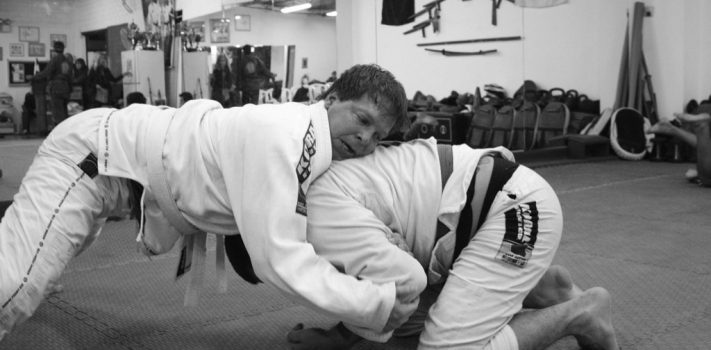
I have black belts in two different styles of martial arts: Okinawan Karate and a form of Japanese Jiu-jitsu. I can say without a doubt though that studying Brazilian Jiu-Jitsu/Grappling and Mixed Martial Arts (grappling and kickboxing) is bar none the best and most effective way to learn to fight and made my previous training largely irrelevant.

You don't need years to become effective in grappling styles as I've seen people with six months of training take down and submit much larger opponents who were fighting as hard as they could. In addition to this, the focus on competitive training builds reflexes, muscle, cardio endurance and the ability to take hits and keep on going. Martial arts that do not use competition and real life sparring to practice are not more deadly. Only those arts that actively encourage students to spar against others who are forcefully resisting have the proven track record of dealing with hostile opponents. In one former school we routinely had people from other styles come in to prove their mettle against our "sport" and our instructor would just make them spar a middle-rank student first and get beat. There was no need for a senior student or instructor to even get involved. Often these other systems do not focus on real-life sparring and as a result the students are out of shape, cannot react to spontaneous and unpredictable situations quickly, nor can they take a punch and have the wits about them to follow-up and take the fight back to the attacker. Virtually all of these other styles of fighting were helpless once they landed on the ground where a large number of fights eventually wind up.

It is my experience that those who do not train "sport" martial arts will quickly lose their steam inside of two minutes with a grappler and easily be submitted. Those that have never taken a strong hook to the jaw, likewise. Sport fighting is the most exhausting and intense activity most people will ever do. Whether it's grappling, judo, boxing, kickboxing or wrestling. Indeed, the most dangerous fighters I've sparred with have always been grapplers. Not only is grappling effective in dealing with single opponents, but it also trains you stay on your feet against multiples so you can make a quick exit if you need to. Not just this, but the cardio it develops means you can outrun your attackers which is the best way to deal with multiple opponents. As a side benefit, grappling arts like Brazilian Jiu-Jitsu can be done until a very old age as they are low impact. One of the founders of Brazilian Jiu-Jitsu, Helio Gracie, practiced grappling well into his 90s.

Those interested in learning martial arts should stick to those styles that have a proven track record in full-contact and full-resistance competitions and should not discount such activity as "sport." Those who dismiss a martial art because because it is a "sport" have obviously never been in a full-contact sparring match and wouldn't stand a chance against a trained fighter with rules or not. Yes, this is a challenge to anyone reading this who thinks otherwise to go into a Brazilian Jiu-Jitsu or Mixed Martial Arts school and prove what you're doing works better. I've yet to run across a "secret" martial art that can stand up to cold hard empirical testing that a cage fighter or experienced grappler can bring to the equation. - Craig


Jim,
While I agree with Joe G. on the utility of learning to fight empty handed, his reasoning is wrong. Humans have never relied upon empty handed technique unless they were forced to do so by a government who outlawed weapons. Unless you are caught off guard in the shower, I can't foresee a set of circumstances that wouldn't allow you to have an effective weapon of some kind. A bow, spear, club or knife is always going to be available, because you can make them. In fact, I can't imagine most of your readers ever running completely out of ammunition for their main battery.

I congratulate Joe on defeating 10 opponents with only his bare hands, but I question whether this would have worked against armed or resolved enemies. I too have studied several martial arts over the last 35 years and hold advanced belts in 3 of them, but I consider an unarmed fight against 10 resolved opponents pretty much hopeless. Bruce Lee and Jackie Chan together probably couldn't survive a street fight against 10 armed opponents. Don't get caught up in martial arts myths.

Combat skills are magnified by the weapon you use. A highly skilled man with pistol can beat several unskilled opponents because he has a tool capable of killing at a distance very quickly. His ability to shoot fast and accurately can really make a difference. Skill with a knife magnifies the natural lethality of the knife and allows you to kill very quickly. Any decent weapon can kill or disable in less than a second. Skill at punching, kicking and grappling don't make nearly as big a difference because they are not lethal enough to put someone away before their buddy can kill you. Killing with bare hands is much slower and even a skilled opponent can be overwhelmed by multiple opponents. Unarmed combat should always be considered a last resort. Any weapon is better than none at all, so why would anyone choose to fight unarmed?

Don't lose sight of the real threats. Real combat is not a schoolhouse brawl where you can yell "uncle" and they will let you up. Real combat lasts seconds, not minutes. It's fast and brutal and usually ends with somebody dying. Close combat is about killing your opponents as quickly as possible so you can escape. Always use the best weapon you can get.

About choosing a martial art: The newest ones that have been proven in combat are the only ones worth learning, period. All martial arts start out as a simple set of combat skills and progress into a martial art and then to a "martial way" like Tai Chi which is nothing more than a dance. This is because most of the instructors in the chain of tradition have never been in combat and don't fully understand the moves they are teaching. All martial arts lose effectiveness as they age. Many martial arts still teach techniques for unhorsing an enemy or bypassing a specific type of armor. When is the last time you have seen a street thug riding a horse? The oldest martial arts have become insanely ineffective and contain moves that will get you killed in real combat. Don't waste your money and time. Learn a new, effective set of combat techniques like the "Marine Corps Martial Arts Program" or army "Combatives" instead. You can learn enough technique to be very effective in less than 40 hours instruction. Any martial art that requires "years of dedication" to learn is bull. Here is an excellent book to guide your training program.

BTW, all the effective systems teach you how to use common weapons like clubs and knives (and bayonets sometimes). Learn those skills first!. Regards, - JIR


James:
In response to Joe G.’s article on taking up martial arts as a dedicated study to prepare for the possibility of life without the security of conventional weapons in the event that “the ammunition dwindles and ability to procure or even manufacture more is gone” I disagree that effort put forth in martial arts training is well spent in a survival context.

If one has a passion for martial arts of course nothing is wrong with working hard at it. It will keep you in great shape and it will give you a tremendous edge in bare handed combat . However, beyond a basic self defense course (in the event you are caught off guard or are dumb enough to be found unarmed) I don’t see the practicality of it in a true survival scenario.

The reason I say this is because of the amount of time needed maintain proficiency in any martial art. (daily practice as I understand it) I had a friend that had a passion for Wing Chun Kung Fu, a very practical and effective street fighting martial art. He worked very hard at it and was deadly with bare hands. In the space of a year or so he had occasion to use it several times. He was able to knock out a guy with a single blow that smashed a bottle over his head in a bar one night, another time he quickly put a road raged aggressor on the ground in a parking lot. Still, a single bullet fired from a gun in the hand of an 80 year old woman with one eye would have defeated him.

Rather than practicing a martial art daily to prepare for the possibility that ammo runs out I just stock pile ammo and experiment with making more from scratch. Reloading [used cartridge] primers is possible now. (See the YouTube videos on the subject.)

I also disagree with the opinion that “A true effective martial art will be just as effective for the 18 year old as well as the 80 year old.” That statement is not believable by anyone that is actually 45 years old let alone 80. I’m only 41 but I’ve got arthritis in both knees, one elbow and my strong side shoulder. I’d need a baseball bat at least to handle most 18 year old aggressors.

Still, there is nothing wrong with martial arts if that’s your passion. Just don’t count on it as a serious self defense system in a survival scenario. - Mark S.

Mr. Rawles:
I just have a couple of comments to add to Joe G’s.

There are various pros and cons to choosing a self-defense system versus a martial art, most notably, how long you must train before the method you choose is combat applicable. For example, Krav Maga, the official combat method of the Israeli military was designed and refined over time to bring recruits up to a functional skill level quickly and with a minimum of training time, whereas in some traditional martial arts it can take years just to make the art functional under survival stress.

The right self-defense system will not limit your responses to a few situations, and will typically have the added benefit of enabling one to use their skills in self-defense fairly quickly compared to a more traditional martial art, typically. However, many traditional martial arts can have benefits far beyond simple self-defense. Many comprehensive martial arts, such as the Russian art Systema, or Japanese Bujinkan Budo Taijutsu impart skills and strategies for avoiding danger in the environment and survival under myriad circumstances, though some may find the Buddhist symbolism imbedded in the Bujinkan not to their liking. Systema’s philosophical basis is rooted in Eastern Orthodox Christianity, which some may find more palatable.

The best way to choose, however, is to take stock in what your needs really are. What threats are you likely to face? There’s an excellent book written by Maj. Forrest E. Morgan called “Living the Martial Way” that has an excellent chapter on evaluating what your needs are in relation to your body type, and how to evaluate a combat system’s doctrine, strategy, and tactics in relation to your needs. I believe this book has been mentioned previously in your blog, and I can’t recommend it enough to your readers.

I would offer my own recommendations, in addition to Joe G.’s Chinese Kuntao, to include Russian Systema or SAMBO (the military version, not the civilian sport version), Filipino Martial Arts as taught and practiced by the Dog Brothers , Krav Maga (see www.kravmaga.com and www.krav-maga.com), Sammy Franco’s Contemporary Fighting Arts (his stuff is pretty brutal and he tends to use a lot of profanity in his materials, so be forewarned), and Combat Hapkido. This list is hardly comprehensive, but it provides, I think, a good overview of what’s out there and what might be useful to the community.

I would like to conclude by reiterating Joe’s advice to avoid martial sports in favor of non-competitive martial arts. This, regrettably, applies to most commercially taught martial arts in the United States, at least. Most commercial Ju Jitsu, Karate, Tae Kwon Do/Tang Soo Do, and Kung Fu schools tend to be geared towards competition first, and street survival as an afterthought, if it’s given any consideration at all, so let the buyer beware! - Scott B.

James,
Being fairly new to preparedness (only a year or two under my belt) I vary rarely write in, especially to criticize another contributor, but when I read empty handed survival it threw me for a loop. This article is very misleading when it comes to self defense in a survival situation. The author claims that for thousands of years man was able to flourish with open handed survival. This is just pure fluff and a very narrow view of developing societies throughout history. Every single culture had a method of hand fighting, that much is true, but every society also equipped their warriors with the absolute best weaponry available. Spears, clubs, swords, bow and arrow, what have you. Even in the far east where a lot of today's popular "martial arts" were developed they still carried swords, learned to shoot a bow and arrow, and developed some of the most intricate and deadly weaponry in ancient times.

Now I don't want to come off as totally against training to fight with your hands but I think that it needs to be approached with a realistic understanding of what hand fighting is all about. First off, the same guy that will tell you that your handgun is only used to fight your way back to your rifle will tell you how he can easily disarm three opponents barehanded without breaking a sweat. Fighting empty handed is the absolute last resort. If anyone, and I mean anyone, tries to fight an armed opponent empty handed then there is an almost absolute possibility that they will either be killed or severely wounded (a slow death in a TEOTWAWKI situation). There is a reason that every army that has ever walked the face of the earth carried weapons. The samurai didn't dominate Japan for as long as they did because they were good hand fighters. Second off, this authors encounter with 10 assailants reads like a Bruce Lee movie. There's no way on Gods green earth that any fighting "system" can teach anyone to handle 10 dedicated assailants at once. Oh sure, if they conveniently come at you one at a time then everything is gravy, but if even two of them decide to do a good old fashioned "prison rush" then its curtains (especially if you are unarmed).

There are hundreds of martial arts out there today and all of them have their merits, they will teach grace and balance, discipline, and will get everybody reasonably fit. However, for true self defense (I am no expert but I have been raised in a military family by WWII, Korea, and Vietnam vets and served in the Marines myself) things need to be simple, very quick, and effective (meaning deadly). Everybody should learn how to throw a couple basic of hand, elbow, knee, and foot strikes and practice them over and over and over again because in a high stress situation our bodies will revert to muscle memory and those of us without 30 years experience are going to be out of luck trying to remember the flying dragon claw in the moment. The truth is: A) there is no way to practice a real life or death struggle, they just happen, B) Winning is all about the will to win and the ability to adapt to given situations, C) If you have to fight remember to strike the soft parts of the body (face, neck, abdomen to include the low back, and the groin) and try to break the joints (specifically the knees and feet so you can run away) either by striking (kicking the knee, stomping the foot) or simply bending them the wrong way as aggressively as possible, and D) Learn to use weapons of opportunity (rocks, sticks, dirt, water, whatever) and learn to strike suddenly so that surprise is on your side.

I apologize that this is such a long response but it is unconscionable that someone would urge the use of empty handed methods or defense in a survival situation, especially those taught in a dojo (even one where the instructors work for free, you will probably get what you pay for). We must think as realistically as possible and look at what people in other times like we are headed for did. They fought dirty, they attacked from ambush, they never let their opponent get in the first blow, and they were always armed. I have included two links to a web page that should be required reading for anyone interested in hand to hand fighting, with or without weapons.

All in all its is best to forget choke holds, arm bars, ground fighting, flying kicks (any kick above waist high for that matter), and anything else you have seen on television or in the safety of a dojo or ring. Fighting in the situation we are addressing is about one thing only: kill or be killed. God help you if you are completely empty handed in a survival situation. Remember that even though King David had God on his side he still to weapons of war (that he was familiar with) into battle with Goliath.
See:
No Nonsense Self Defense - Traditional Martial Arts and No Nonsense Self Defense - Knife Lies

Regards, - Doug W.

Jim,
There is great merit in learning martial arts for self-defense as proposed by Joe G. However, time and budget constraints, competing self-reliance skills to learn, and age/health issues, many prep-minded folks may feel overwhelmed with the commitment required to master such a demanding discipline to be reasonably competent

As a second-best method, I would recommend preppers to learn effective pressure points and breaking away techniques. Regardless of one's strength or size, the use of tried and true techniques against various parts of the human anatomy will prove effective against the strongest foe. Anyone can learn a dozen or so simple tricks to use, and with less practice required
than a dedicated martial arts course.

Sincerely, - Ron S., in New York

Friday, February 26, 2010

We are living in a time when all has gone wrong and societies rules and conventions no longer hold true.  People no longer respect the sanctity of life and well established morals and honor have become a thing of the past. You have prepared yourself and your family to survive without the amenities we have grown accustomed.  You have enough food, a secure shelter, preparations for clean water and enough fuel and weapons.  At least you thought you did.

As the evaporation of society continues and you begin to watch your inventory of all things drastically shrink you begin to ask, what now.  Are you ready to venture outside your secure compound to begin to trade to rebuild your supplies?  Are you prepared to handle life without the security of your conventional weapons?  As the ammunition dwindles and ability to procure or even manufacture more is gone, what will you do?  Have you prepared yourself, let alone the others in your group, to handle yourself empty handed?

For thousands of years man was able to survive and even flourish with the empty hand.  The idea of training to protect yourself with your hands alone is frightening to many.  Being within arm’s reach of your adversary is not a comfortable situation to the untrained.  To the trained it can actually increase your confidence.  The internal knowledge to know you are ready and willing to confront any adversary, armed or unarmed, without hesitation or fear can have a calming effect.  To know you have control and are not a victim will bring a sense of security.

The question of what course of empty hand survival you should study becomes key.  Should you study self-defense or a true martial art?  Self-defense can prepare you for certain situations, but will limit you to those specific scenarios.  A true martial art will prepare you for ever changing scenarios.  Your course of empty hand survival is now narrowed to a true martial art.  The next and critical question is which of the hundreds of styles will be most effective?  The answer to this question will be answered differently by individual instructors.  You must be prepared to ask the important questions and filter out the hype and flash of the various styles.  As you begin your journey into the realm of the martial arts it will seem overwhelming.  Do you study Chinese, Japanese, Indonesian, Filipino or many of the other country specific styles?  As you begin your search, any style that includes the word sport can immediately be discarded.  We are not looking to win a tournament and have a big trophy on the mantel. We are not looking to get our name in the paper or become the next internet YouTube sensation.  You can never forget the ultimate goal is empty hand survival

Many may have family or friends already studying in the martial arts.  Ask them for their opinions.  Begin visiting the various schools within your locality.  Ask if you can observe and possibly participate in a couple classes (without cost).  If the answer is no, then move on, do not waste any more time.  Any serious martial arts instructor should have no problem with such a request.  Ask for a brief history of the style and the instructors.  Ask if any of the instructors have had to utilize their skills in a real world situation. It is important to know how long the instructors have been teaching and how long it took them to reach the rank they currently hold.  If they claim to be a master and have only studied the art for a few years, thank them for their time and move on to the next style on your list.  To be a true master you have to put a many years of hard work and dedication.  Inquire as to what the progression schedules to advance and the associated fees.  Again, if the progression schedule is too fast and the fees increase as you move up or you must pay to advance, move on. 

You need to find the instructor that is doing this because of their love of the art and desire to pass on the knowledge they have learned.  They are doing this to honor their previous instructors and prepare their students for real life situation.  Those types of instructors are out there, they do exist.  Trust your instincts and first impressions of both the instructor and the school. Do not be taken in by the amount of stuff in the school.  They may have pictures, weapons and the latest training equipment strewn throughout the school.  There are many out there who will tell you what you want to here in order to take your money.  You must be able to see through the words get down to reality of the style.  Ask them if this is a style they can do effectively as they get older.  A true effective martial art will be just as effective for the 18 year old as well as the 80 year old.  When you find the instructor that will allow you to both watch and participate you are closer to the martial art of your choice.  Watch before participating as you can miss many things while participating.  Observe not only the higher ranking students, but the beginners as well.  Are the movements natural to the way one would normally move?  Are the beginners learning the foundations of the system or being thrown in with the higher ranking students?  As with all things, without a strong foundation it will fail.  You must be prepared to ask the question what if.  Your goal is to survive a real world situation.  Does the style effectively move from one technique to the next?  One cannot assume to have a single strike that will stop every attacker.  There are those out there that will require an extended serious of strikes to subdue or eliminate.  If you cannot effectively transition to the next technique in your arsenal, you will fail.

I began my martial arts study at the age of 10.  I was introduced to the arts through my father whom felt it was in mine and my brother’s best interest to begin our training.  For the past 30+ years I have been training in the very effective and deadly art of Chinese Kuntao.  The system has been passed down in its purest form throughout the years.  I have had the fortune of participating and seeing many other styles during my martial arts journey.  I have yet to see one that I feel would be more effective.  Many of the questions that were posed above have led me to continue my training in Kuntao.  The school I trained in is a non-profit organization and the school I operate charges no fee.  My instructors and I do this for the love of the art.  We are not motivated to promote or carry large numbers of students to generate income.  We do not have to be politically correct for fear of losing students.  The art is presented as it was passed down from generation to generation.  It is a pure fighting art. We do not participate in tournaments and you will not find us on the Internet.  The instructors throughout the years have had to utilize their skills in real life situations.  It works and works effectively.  The movements are natural and the Grandmaster and Masters of the system are just as effective in their advancing years as are those of the younger black belts.  The art has become second nature.  No thought is required when a situation arises nor do you have wonder what to do when the first tactic fails.  You move on immediately until you determine the fight is over.  The situation does not end when your opponent has said enough; you end the fight when you decide.  You must neutralize the attacker, this may be giving yourself the ability to flee or it may be terminating your aggressor.  You will learn how to read the situation and apply the necessary force without thinking. 

In my youth I had the misfortune of being in the wrong place at the wrong time, or at least my aggressors thought so.  I found myself in a not so friendly place late at night in a large city.  I could see the situation was deteriorating quickly as the number of aggressors increased from 4 to 10.  Through my training I became calm and collected, I knew they could not all attack at once.  I positioned myself with my back against a wall, thus protecting my flank.  My attackers could only come in from the front and sides.   The first attacker struck quickly with a blow to my face.  I then proceeded to subdue him while the second attacker came in from the right.  As your peripheral vision will allow you to react quicker, I immediately recognized the threat and eliminated it.  As the remainder of the aggressors realized I was not going to be a victim they broke off their attack before they ended up like their comrades.  As you have read, I did not come out without a scratch, but my training caused me not to panic and continue.  The training allowed my fight or flight instinct to be fight.

 The task of selecting the most practical school may seem overwhelming and impossible.  However, if you take the emotion out of your search and be analytical and methodical you will find the system that best suits empty hand survival.  Do not wait, the longer you train the more effective you will become.  You will be able to make your art part of your life and everyday routine.  You will become an empty hand survivalist.

Sunday, September 13, 2009

Throughout the history of warfare there has always been an elite class of warriors that had superior skills, tactics, and mindset. Today is no different with each branch of our military having its own elite class of warriors.
 
When you think of a Navy SEAL, Delta, Pararescue, Green Beret (Special Forces or "SF") , or Force Recon, what phrases run through your head? “Intense”, “Highly disciplined”, “Extremely fit”, “Tough”, “Well rounded”, “Deadly”. These are well-deserved phrases that can be applied to any of the special forces operators and the foundation that built these men is their mindset and training.
 
I think all of us would love to have a team of loyal operators when the SHTF , but unless you are lucky enough to have them in your group, you’ll have to settle for the next best thing… Yourself.
 
“Imitation is the highest form of flattery”
If we are preparing ourselves for some level of combat, whether it is in defense of our family, our community, our freedom, or ourselves why not follow the path of the elite? If your training takes you to the highest levels, then you’ll be ready for the high demand events, and have the ability to breeze through less demanding situations. However, with so many other preparations and demands on life, your training schedule needs to be able to fit your lifestyle. Like most of you, I work 40+ hours a week, have a family, and we are trying to prepare our own five-acre homestead. What follows is my training regimen that takes into account limited training time, resources, and funds.
 
Step 1: Think like a Ranger
 
Tenacity is like a muscle, with exercise it can be built, but it will take desire and hard work. Every day you are faced with decisions and situations where you can take the easy path or “tough it out”, choose the latter. Discipline can conquer laziness, so set attainable goals, stay focused, and take it one step at a time when it gets tough. Steps 2 & 3 will really help you forge this trait.
 
Time: 0    
Cost: Some discomfort
 
Step 2: Work out like a Navy SEAL
 
Like the spec ops community, pursuit of fitness should be at the top of your training priorities. It takes hard work to get in shape and little time to lose the gains, so a majority of your training time should be allotted to this category. There is an efficient, high yield program being used by the spec ops community and fortunately it is available to everyone. The name is CrossFit.
 
CrossFit is an online fitness community where a different workout is posted on the web site on a daily basis. In their own words:

“CrossFit is the principal strength and conditioning program for many police academies and tactical operations teams, military special operations units, champion martial artists, and hundreds of other elite and professional athletes worldwide.
 
Our program delivers a fitness that is, by design, broad, general, and inclusive. Our specialty is not specializing. Combat, survival, many sports, and life reward this kind of fitness and, on average, punish the specialist.”  
www.crossfit.com

Focusing on functional fitness, CrossFit will develop the ten general physical skills of cardiovascular/respiratory endurance, stamina, strength, flexibility, power, coordination, agility, balance and accuracy. By the nature of the varying workouts, you will be forced to work on your
weaknesses.
 
To say that CrossFit workouts are challenging, would be an understatement. I have seen the WODs (Workout Of the Day) punish military, police, and college athletes alike, so start out slow and build consistency before intensity. The mental and physical demands of the workouts will also put you on the fast track to developing a tenacious mindset.
Other side benefits of superior fitness include the ability to handle stress better, resistance to disease, and increased work capacity, all will be needed during TEOTWAWKI along with the ability to sprint, lift heavy objects, and scale obstacles.
 
CrossFit’s web site is very user friendly, has a FAQ section, free journal articles, and exercise demo videos. For friendly support or competition, you can post your WOD results in the “comments” section and compare them to CrossFitters around the world.
 
If you are not ready for the Main Page WODs, there are modified (scaled) workouts for different fitness levels. This has allowed my 65-year-old mother and 11-year-old niece to complete the same workout as me, albeit on a different level with exercise substitutions, less weight, and/or shorter duration. Follow the “Start here” links on the Main Page.
 
Time: 3 hours per week (6 days / 30 min. workout) Although some WODs can be done in less than 5 minutes, take the extra time to work on your Olympic lifts, flexibility, or the gymnastic moves.
 
Cost: $0 (other than weights). The WODs are posted on the CrossFit site for free. Subscription to the online journal will cost you $25 per year and is well worth it. If you don’t have pull-up/dip bar or a weight set, you’ll need to buy them. Check Craigslist for good deals on used equipment. If you are unable to acquire weights, bodyweight only WOD’s can be found in this PDF: CrossFit Bodyweight Workouts.


Step 3: Fight like Recon
 
Find a good MMA (Mixed Martial Arts) gym and train at least twice a week. MMA gives you the most “bang for your buck”, making you competent in the areas of standup, clinch, and ground fighting. While traditional martial arts have benefits of fitness, flexibility, and discipline, I have seen the practitioners get taken apart in the gym, in bars while working as a bouncer, and in the field of law enforcement. When it comes to fighting, MMA should be your foundation. Not every altercation will require the use of deadly force and most criminals might use a ruse or ambush to get close enough to negate your weapons. MMA will give you the variability to handle the lesser event or the fighting platform to allow you to bridge to weapons for lethal force situations.
 
The current trend is Marines training MCMAP, Rangers training with Brazilian Jiu-Jitsu (BJJ), and SF units training with a South African MMA coach.The reason that military combatives are shifting toward MMA as their base is because it works!
 
Once you find a good school and learn the basics, focus on developing a “Sprawl and Brawl” game, instead of a “Ground and Pound” or “Submission’ game. This will keep you on your feet and help you deal with multiple opponents, defend against weapons, or access your own weapons in a much better capacity. Even if you get caught on the ground, you’ll be comfortable there and have the skills to prevail.
 
If you are unable to find a MMA gym in your area, look for a good Brazilian Jiu-Jitsu or Judo school, a boxing/kickboxing gym, or a wrestling club. All these styles are components of MMA and will pit you against a fully resisting opponent, which is the key to development and success.
 
While there is no substitute for a good gym, if your retreat is really isolated and there is no training available, then find a training partner, order some videos/books, and/or attend some seminars. I have hundreds of training DVDs and my top picks for home MMA study are:
 
StandupCrazy Monkey (CM) series

ClinchCouture’s series

Ground - Matt Thornton's Functional JKD Series Two – Discs 1, 2, & 3
 
Bas Rutten’s MMA workout is also a great option for solo home workouts and only requires a CD player and a heavy bag. It is currently being used at the Federal Law Enforcement Training Facility for their officers in training. I use it on the heavy bag for my warm-ups and days when I can’t make it to the gym. The set consists of an instructional DVD and four workout CD’s, boxing, kickboxing, MMA, and an all around workout.

As side benefits, you’ll also be working on Steps 1 and 2 during your MMA training. Fighting and getting punched in the face on a weekly basis is a great character builder and the cardio demands of fighting are some of the highest.
 
Time: 3 hours per week. MMA has a steep learning curve, so you’ll want to train at least twice a week. Classes usually run about 1-½ hours.
 
Cost: From gym to gym the price will vary. Gyms with competitive teams can cost over $100 per month, but good “hobby” gyms can be found for $50 per month. I have even trained at a local church that had great training and tough opponents for no charge.
 
Step 4: Shoot like Delta
 
Superior weapons proficiency and handling ability is another trait of highly skilled operators, and while we’ll never have a multi-million dollar ammo budget and 8 hour range days, there are alternatives for us.
 
First and foremost, seek out a good school and take tactical pistol, rifle, and shotgun classes. Look for classes that are designed to help you win a gunfight. Once you take the classes, then you will have the skill set that you can take home to practice. Tactical Response offers great classes in all the disciplines. While it is no substitute for professional instruction, if you cannot afford classes, here my top picks for DVD instructional videos:
 
Handgun: Jim Grover’s Defensive Shooting Series

Carbine: The Art of the Tactical Carbine  

Shotgun: Tom Givens Defensive Shotgun

Second, develop a dry fire routine based upon the core skills you learned from your class or DVDs. Focus on key skills like drawing from concealment, weapon transitions, malfunction clearing, magazine changes, and positional shooting. If you can afford it, buy Airsoft replicas of your guns so you can work on shooting and moving, multiple targets, and force-on-force drills.
 
The final, most important step is to shoot competitively. Monthly competitions will build your gun handling skills and accuracy under the stress of time and the competitive nature of the event. Tactical pistol matches are a good start, but I prefer Three-gun matches where you get to shoot rifle, pistol, and/or shotgun in the same stage. This way I get to do live fire once a month with all three guns in stages and scenarios that someone else creates. Shooting and moving, weapon transitions, shooting from cover, shooting in and around vehicles are some of the benefits along with mastering the basic core skills. Don’t get caught up in “gaming” the match, instead focus on using the tactics you learned in your gun fighting courses. Use cover, draw from concealment, and throw some dummy rounds in some mags. It will slow your times down, but will pay off by ingraining good habits.
 
During and after the match, identify weak skills to work on during the daily dry fire sessions until the next match. If you don’t have local matches, you can usually find the stages online, and set up your own match on your farm/range or even in your backyard for an Airsoft match.
 
Time: 1 hour per week (10 min. per day of dry fire/Airsoft) Our local three gun match usually last about 3 hours, but since it is on a monthly basis and is so much fun, I don’t factor that as training time.
 
Cost: $0 for dry fire. $15 dollar entry fee for our three gun match,  plus your ammo costs. Our local matches usually require less than 50 rounds of pistol and rifle, and less than 25 of shotgun (birdshot). We also have a .22 division where cheapskates, like myself, shoot conversion kits to save on ammo costs.
 
 
Step 5: Cross-train like a Green Beret
 
Aim to make yourself as well rounded as possible. Maybe you are in great shape, are a good fighter, and shoot in the top ten at your matches. Excellent! Keep working those foundational skills because they require the most time investment due to a steeper learning curve or degradation over time, but now is the time to look outside your Spartan routine for weak links in your overall skill set.
 
Sit down and make a list of skills you want or might need in the uncertain future and rank yourself on your competency. Focus training on the categories with the lowest rating. Training can be accomplished through research, classes, or knowledgeable friends.
 
Emergency medical skills, wilderness survival, hunting/trapping, mantracking, mechanical repair, patrolling, tactics, edged weapons, orienteering, home security, high performance driving, gardening, beekeeping, homesteading, sniping, escape and evasion…. If you are like me, you’ll have a four page list in no time.
 
Time: 1 hour per week. Try to spend an hour a week working on your weakest skill. Once your weaknesses catch up, only then should you focus on training that you are naturally drawn towards and enjoy more.
 
Cost: You can spend as much or as little as you like. Your training priorities and interests will guide you. I work on trucks at my friend’s garage, I order gardening books, my beekeepers meetings are $20 per year, and my next tracking class is $385. The goal here is to learn and develop new practical skills.
 
Step 6: Evaluate yourself
 
Be honest and routinely critique your progress. What are your strengths, weaknesses, and how can you work on them? Ask yourself if you could out fight, out shoot, or out run/lift the “old you” from three months ago? Also seek out standards of fitness and shooting, available on the web, to see how you compare. Keep a training log so you can watch your progress.
Example for today 9/9/09:
 
Mental: Only 5 hours of sleep last night. Still sore from the last cycle. Hate lunges and box jumps. Have lots to do before work. Suck it up and get it done.
 
Three rounds on heavy bag of Bas Rutten’s MMA workout (boxing CD) – 10 minutes
 
CrosFit WOD:
Four rounds for time of:
100 ft Walking lunge, carrying 30 pound dumbbells (no 30’s so subbed 25 pounders.)
24 inch Box Jump, 30 reps
30 pound Weighted pull-ups, 20 reps
 
Time: 19:44 (M/33/6’1”/205)
 
Dry fire:
10 minutes of tactical reloads with M4
 
Total time: 40 minutes. Hit all three primary areas. Will stretch for 10 minutes tonight and read a chapter of the dentistry manual I am reading.
 
There may be some people that are reading this that cannot do a pull-up, let alone weighted ones. That is okay, just start out on the scaled version and you’ll be cranking them out soon enough. Example of the lowest scaling of today’s WOD from BrandX:

3 rounds
100 ft Walking lunge
12-15 inch Box Jump, 20 reps
20 Beginner or Assisted pull-ups
 
In reality, some of us may have had years of bad habits, health, injuries, etc. that may prevent us from reaching the levels I have outlined, but any gain is still a gain. Because of the variety of functional movements, CrossFit at half intensity is still better than more traditional programs. Really light MMA sparring and rolling is still better than the [no contact/tap contact] McDojo stuff taught at the strip malls. I have seen a 50-year-old man at our gym getting thrashed by the more experienced, younger players, only to school a 20-year old “newbie” a month later.
 
You may never make it into the top ten of the three gun match or be posting record times on CrossFit’s board, but you are also unlikely to be facing a superior opponent in the real world if you work hard, as the majority of the population is in poor shape, cannot fight or shoot very well, nor will they be training as hard as you.
 
Conclusion
 
While I have been fortunate enough to workout with, fight with, and shoot with top level civilians that could out-compete the average Spec Ops member in their chosen sport or field, none of them could approach the overall well-roundedness of our country’s finest that I have known. Emulating these fine warriors within our group or family is a critical preparation step for TEOTWAWKI.
 
You may have years of stored food, a self-sufficient homestead, and an impressive battery, but liabilities in fitness, fighting, and shooting skills may negate your hard work and preparations. I look at training like saving for retirement, start early, save every day, and the benefits will add up.
 
So set aside eight hours this week and follow the training outline, this small investment of hard work and training might save your life, your family’s, your community, or your freedom.

JWR Adds: Unless you are already in a regular workout program, I recommend that you start any new program immediately after you've had a physical checkup. Don't totally exhaust yourself the first day. Work up your distances, weight and repetitions gradually!

Saturday, July 18, 2009

Jim,
First, here's a link to an article on self defense considerations in Britain.

I prefer a variation on the pocket stick known as a koppo stick. A koppo stick is a pocket stick with a piece of cord that loops around the outside of the ring and middle fingers. This cord helps with stick retention and allows for open hand and gripping techniques.

I usually carry my koppo in my weak hand at the ready. This frees up my strong hand to draw my primary weapon and the cord retention system allows the weak hand to perform other tasks such as slide manipulation. Planned use of the stick is for primary weapon retention and to gain enough time/space to draw the primary weapon (if available and warranted).

Here is a page on how to convert a pocket flashlight into a koppo stick.

Here's the LED flashlight that I converted (available through Sears):

Finally, here's a YouTube video on the subject.

Enjoy! - Rick H.


Dear Mr. Rawles,
I've got something for the guy in suburban London. England is a rainy area - isn't´t it? So try this unbreakable umbrella.

And here´s something on video about how to use canes for self-defense.

Thank you! - Joe B.

Thursday, July 16, 2009

Mr. Rawles:
I am at a disadvantage to your American readers. I live in a suburb of London, and travel by train to work each day. Street crime is now out of control in some neighbourhoods, but I cannot carry a weapon. I must say that I'm envious of Americans that can carry concealed pistols and revolvers. Here, I cannot even carry a pocket knife. Are martial arts effective, and if they indeed are, then which one will be most effective with not too much time for training? What do you suggest? Thanking You in Advance, - G.H. in England

JWR Replies: I wrote the following for SurvivalBlog back in 2006. I'm re-posting it, along with an update, for the benefit of the many readers that have come on board more recently:

I highly recommend training to use a cane, walking stick, or a traditional full-length umbrella. This is particularly important for our readers like you that live in gun-unfriendly nations. Ditto for our readers that live in states like California, New York, and New Jersey where is is very difficult for mere mortals to get a carrying concealed weapon (CCW) permit. And even if you are a concealed firearms permit holder, you should learn these valuable skills. Why? You never know when circumstances might dictate that you cannot carry a pistol. (For example, when traveling to a state where your CCW permit is not valid, or when traveling overseas.)

Here is a forward from firearms instructor John Farnam, by way of SurvivalBlog reader Grampa Redd:

"I attended a stick/cane-fighting seminar yesterday, instructed by Peter Donello of Canemasters. Canemasters manufacturers high-quality canes and walking sticks and provides training in their use. However, I used my Cold Steel City Stick, as did several other students.

I was astonished at the number of effective moves available to the cane/stick fighter, certainly more than I can remember! Peter's knowledge is vast, and I did my best to catalog the few that I thought were most effective and easiest to learn. Range is the big advantage that canes have over blades and other impact weapons.

Striking and jabbing are still the premiere moves, easily done with nearly any style of cane. Some follow-up moves and holds and more comfortably accomplished with a hooked cane than with a straight stick, but either style works just fine. The real question is: What can I have with me most often that attracts the least attention?

This four-hour clinic is something I recommend to everyone. The cane is a wonderful, low-profile, yet extremely effective fighting tool that most people can fit into their lives with a minimum of lifestyle disruption. Most casual observers don't even notice when you have one with you and certainly don't believe them to represent a threat. Time well spent!"

As for walking stick designs: From what I have heard and observed here in the U.S., if you are well dressed and groomed, then law enforcement officers in most jurisdictions will hardly give you a second glance if you are carrying a walking stick. But if you are shabby looking and perceived as "riffraff", then expect to get plenty of grief. Canes, especially aluminum ones those that look like true walking aids, are far less likely to attract suspicion than walking sticks. I have an acquaintance who lives in Oakland, California who carries a dull silver aluminum cane with a big rubber tip. This cane looks very unobtrusive if not downright innocuous. It is not until you pick it up that you realize that it has been retrofitted with a 1/2"steel rod firmly epoxied into its hollow core. The phrase "the iron fist in the velvet glove" comes to mind!

I have another acquaintance that lives in a very rainy climate, near Seattle, Washington. He makes a habit of carrying a stout full length traditional umbrella whenever he gets out of his car. Aside for misplacing several umbrellas over the years (a fairly costly mistake, since he carries a big sturdy umbrella which cost around $60 each), he has had no trouble. (And, by God's grace, he has only had need to use it to protect himself from rain showers.) Nearly all of the stick/cane fighting techniques apply to folded umbrellas, and they can also be used quite effectively for jabbing.

My general preference is to use a shoulder-width two handed grip grip in most situations, to maintain control and more importantly to assure retention of the stick. This is akin to what has been taught for many years by police academies in the use of long ("riot") batons. The last thing that you want to happen is to have Mr. Bad Guy gain control of your weapon. If that were to happen, you would become he "Owie" recipient instead of the Owie distributor!

Do some research on your local laws. In most jurisdictions, any blow with a striking weapon to the neck or head is considered potentially lethal. Police academies emphasize this in their baton training. ("Never strike above the chest unless you you would in the same circumstances draw your pistol and fire.") So don't escalate to doing so unless you absolutely confident that your life is threatened and you have no other choice. (Essentially it is the same as firing a gun--at least in the eyes of the law.) It may sound sissified and a bit too prim, proper, and "Queensbury Rules", but most courts look at things in terms of equal force and a graduated response, roughly as follows: If Mr. Bad Guy uses his fists, then you can use your fists. If he uses a weapon, then you can use a like weapon. If he strikes above the chest, then you can strike above the chest. As a practical matter, there are no rules in trying to save your life in a street fight, but apparently there are in court houses, post facto. Yes, I realize that graduated response is not realistic to expect, since street fights are fast and furious. Most victims don't even recognize that their attacker is using a weapon until after the incident is over. (The classic victim's police statement is: "I thought that he was punching me until is saw the blood, and it wasn't until then that I realized he had used a knife on me.") But again, a graduated response is what courts will expect in order to make a ruling of justifiable force in self defense.

Don't forget that we live in a litigious era, so expect prosecution and/or a civil lawsuit in the event that you are forced to use a weapon in self defense, even if you were entirely in the right. Show restraint, and never deal out punishment. Just reduce the threat with a quick jab or two, disengage, and then engage your Nike-jitsu technique. (Run!)

If you get into an absolutely lethal brawl (a truly "kill or get killed" situation) and you cannot disengage, then by all means aim where you can do the most damage: The front or side of the neck. The human neck is soft tissue, a bundle of nerves, veins, arteries, and wind pipe. It is your surest target to end a fight quickly and decisively. (The same goes for hand-to-hand combat. Aim your punches at his throat.) But again, it is also your surest way to find your way to a courtroom. I can't stress this enough: show discretion!

When carrying a weapon of any sort for self defense, be sure to develop the same Condition White/Yellow/Amber/Red situational awareness skills that you would for carrying a concealed firearm. (See Naish Piazza's article "The Color Code of Mental Awareness", available free at the Front Sight web site. (Click on "Special Offers" and then on the link for "15 Gun Training Reports free of charge.") Extensive training on self defense combative techniques is worthless if you don't see an attack Be alert.

If you don't live near a school that teaches cane and stick fighting, there is a 40 minute training DVD produced by the Gunsite academy, titled: "Defensive Techniques: Walking Stick." It is available from the Gunsite Internet Pro Shop. (They do not accept overseas orders.) OBTW, one of my readers also recommended Lenny Magill's training DVD "Mastering the Walking Stick".

I should also mention that modern self defense with a walking stick ("Bartitsu") was first popularized by Edward W. Barton-Wright. His classic 1901 magazine article on walking stick self defense is available for free download. See: Part 1 and Part 2. These techniques are weak on weapon retention, but it otherwise is still fairly valid, even after more than a century.

Update for 2009 on Yawaras and Kubotans
For discreet carry, don't overlook the potential effectiveness of short striking weapons such as Yawara sticks and Kubotans. Since these self defense tools are restricted in many locales, I recommend instead carrying a Cold Steel Pocket Shark pen that has had its markings scraped or sanded off. Outwardly, this stout little weapon will pass for a marking pen. (And it fact, it is a marking pen, which should get you past all but the most rigorous security checkpoints.)

Some martial arts dojos offer yawara stick training. These are derivations of the ancient "closed sheath" Japanese striking techniques. These classes are offered by both karate and Filipino Martial Arts (FMA) academies. Just be forewarned that many dojos require at least brown belt ranking as a prerequisite for anything beyond "empty hand" classes. This means a lot of time and money before they will teach you how to use a yawara!

Although they are no substitute for hands-on training from a master, there are several training DVDs that can give you a head start. These include Yawara Kata Training by Maurey Levitz, Kubotans & Yawaras by Sammy Franco, and The Persuader (also known as the Kubotan or Yawara) by George Sylvan.

In closing, I must repeat that situational awareness is crucial. You mind in your primary self-defense weapon. With the right training and a survivor's mindset, just about any small sturdy object found close at hand can be used as a weapon--even a pocket comb or just a tightly-rolled magazine or newspaper. Get the training, practice often, never travel unarmed, and maintain "Condition Yellow", as a minimum.

Tuesday, June 30, 2009

Jim,
I agree with your writer that Muay Thai and Grappling (wrestling, BJJ, etc.) are essential fighting skills. I even admit that my two black belts in traditional arts were not worth much compared to a good grappler or kick boxer.

However the idea that avoiding the ground is rule #1 is not necessarily true. A grappler can control a situation very effectively on the ground and it is often then case that you can't avoid going to the ground in a fight. Further, people of smaller stature (women especially) who cannot run from an encounter have an advantage on the ground vs. trying to duke it out with a much stronger opponent. By getting close to your adversary to engage them on the ground their primary weapons (hands and feet) are severely degraded in effectiveness. Further, a ground fighter can quickly and more reliably dispatch an opponent in a way that trying to slug it out hoping for a knock-out can never do (have you ever tried to really knock someone out who didn't want to be knocked out? It isn't like television, I can assure you).

Also, the idea that ground fighting should be avoided because of broken glass on the ground, etc. is not realistic. Someone who is a skilled (or even not that skilled but just average) ground fighter knows that when/if the fight goes to the ground it's going to be the person who doesn't know how to grapple that's going to be on their back getting their rear end kicked. A grappler who has spent many hours fighting from their backs, on top, etc. does not worry about going to the ground. They know how to deal with it, how to prevent it, how to reverse it and how to use it to their advantage.

Think of it this way. If you are going to fight a wrestler, who do you think is going to end up on their back on the ground? You or the guy who has spent thousands of hours training to take people down to the ground and put them on their backs? Further, you hear all the time about fighting multiple opponents on the ground is a problem. But if you can't beat a single guy standing up, what makes you think you can beat multiples of them standing up? Bare knuckle brawling against one guy is hard. Doing it against two is incredibly difficult. Fighting three guys is just about impossible unless you are very lucky or they are incredibly inept. (See below). Fighting four or more people bare-handed? I think that's just Hollywood stuff. You should focus on getting out of there or making sure you are carrying a gun to defend against multiple opponents.

Also being on your back is not great , but in a fight it is not necessarily bad with multiple opponents if that's where you end up. One guy I know got tangled up with several people and was almost certainly about to get beat, but he was able to get to the ground and ended up on his back (not optimal, but it happened). He was able to hold the guy he was fighting on top of him and move back and forth using him as a shield against the others while on his back on the ground. The attacker's friends were trying to kick and stomp but they kept kicking and stomping their own buddy and the guy I knew was able to get out of there unscathed!

In these cases of multiple attackers you want to stay on your feet and get the heck out of there. Ground fighting, ironically, gives you the best training to stay on your feet because you train so much to avoid being taken down on your opponent's terms.

I encourage a Mixed Martial Arts (MMA) style program, but avoiding the ground is not a requirement. Sometimes you have to go where the fight goes so you need both standing and grappling skills and I'd put more emphasis on grappling personally. - Craig R.


Dear Jim & Family.
Concerning the recent article, what Brick has described in his final recommendation is [essentially] Krav Maga. This is an Israeli system of self-defense, not a martial art per se, developed from the various disciplines that he mentioned and others. It is brutal, effective and efficient. My suggestion is that if you can find a school that teaches Krav, go for it first. Krav Maga Worldwide is the best place to start. Classes are for adults, but they have a version for children as well. I believe that this system is actually much more useful than mixed martial arts (MMA) training.
My whole family has been involved in this training for over two years. - Doc Gary

James,
I would like to comment on the post “The Survivalists Guide to Martial Arts” that appeared on Saturday.

I have been a practitioner of various martial arts since I was three years old living in Japan – 41 years ago. I also have been a part-time teacher of martial arts for 15 years now. And yes, I have the “love me” wall to prove it.

The basic divide in martial arts is between “hard” styles and “soft” styles:

Hard styles are built around punching and kicking. Soft styles are built around joint locks and throws of various sorts. But, over time, and as you advance in rank, you begin to find that all hard styles incorporate soft techniques and soft styles begin to incorporate hard techniques. And in the end, the human body only moves and reacts in so many ways and so at the highest levels you find that all the arts are really the same – they just arrive there by different paths.

You also have to individually decide what is best for you to start with. If you are not going to put in hours each week working out, then a soft style is probably better for you to start with. On the other hand if you plan to put in the time (or are young and energetic) then a hard style might be good for you. I have studied both hard (Okinawan Karate, Silat, TaeKwonDo, etc.) and soft (judo, hapkido, aikido) and “balanced” (some styles teach a balance of hard and soft techniques – and while they are few and far between they are probably the most effective) styles (some of the Kung Fu styles and Kun Tao Silat). You need both in a real fight.

While I am big and relatively strong there are those that are bigger, stronger, and faster. So I need to know how to fight like a “little person.” You also need to think about the legal aftermath of using martial arts in the streets – being able to show a steady progression (or the ability to steadily progress) through the force continuum (presence, verbal commands, soft force, hard force, impact weapons, lethal force) is a big plus in the courts. Or, not every situation requires you to haul off and deck somebody.

The secondary divide is the “stand up” versus “ground” that the letter refers to. However, when I was working in Brazil for a while I had the opportunity to work-out one on one with a member of the very large extended Gracie family. His basic take was that while going to the ground does eventually happen, do everything you can to avoid it. He learned the hard way after being jumped by a gang of attackers that going to the ground might be good against one person but against multiple attackers it does not work as well. The good thing about Gracie Ju-Jitsu (GJJ) (or BJJ) is that it works standing up as well as on the ground IF you know what you are doing (and have had the right teacher).

That being said, in a true SHTF situation you will find yourself prone a lot in a fight (nobody comes to a fight without a gun these days …) and this is where knowing ground fighting comes in handy. (That being said, the longer you can stay up and mobile the better off you will be in a gun fight.)

So in the final analysis, study a blend or a mix of arts – hard and soft, standing and on the ground – in order to get the most out of your training. While I have my personal favorites, after teaching martial arts for so long I can say that the style has to fit the student, and not the other way around. Keep a balance, and find a good, open minded teacher. - Hugh D


Hello Jim,
Regarding The Survivalist's Guide to Martial Arts by "Brick", I agree with most of Brick's comments. In terms of choosing a style or gym/dojo, I would say that the particular style is not very important. Rather, it's important that you train with [what Matt Thornton terms] "aliveness". That is, as much as possible of the training time should be allocated to sparring or otherwise training with resistance, "force on force".

While I prefer MMA training, I think that any style in which there is a lot of live training will serve the trainee well. Conversely any style in which there is little live training is a waste of time.

For purposes of self defense, I would much rather train at a Tae Kwon Do or Karate school and spar a lot, than to train at a MMA gym and never spar. You see this a lot with women who take non-sparring kickboxing classes and think that this prepares them to fight. It does not, even if they are learning legitimate techniques taught by a world champion. Also for self defense, I would rather train at the karate school where they spar a lot, versus some 'reality based self defense' class where they spend all their time practicing eye gouges and groin strikes and rarely spar.

The most important things in being able to fight in any style are:
- Keeping your breathing under control, even when under pressure
- Maintaining appropriate posture at all times(e.g. for striking, you want to keep your hands up, chin tucked, shoulders shrugged, and never put your head down or look away even when getting hit in the face)
- Being able to keep your balance and maintain appropriate distance even when there is an attacker trying to throw you off balance and moving in and out.
- Applying techniques with appropriate timing. If the opponent makes himself vulnerable somehow, usually the window of opportunity to exploit the error is very small.
- Having a certain amount of toughness and ability to ignore pain and discomfort. For example, most people who have never been punched in the stomach will drop both of their hands to cover their stomach, leaving their head wide open.

These things are only developed through hours of training with live resistance. It's worth noting that you can train grappling styles like Judo, Jiu-Jitsu, or wrestling at 100% resistance every training session, since there is no striking and the chance of injury is low.

A good video clip on this subject is: Matt Thornton on Aliveness - Drew in California


Mr. Rawles,
I agree with most of what Brick has to say about the various arts. He left out my art of choice though, which is the filipino stick and knife arts. [Also known as Filipino Martial Arts (FMA).]
These are variously known as escrima, kali, or arnis, depending on where in the islands a particular style originated from, and are distinguished from most arts by starting you out with a weapon. Most of the techniques you learn in these arts (I'll call them kali), are applicable to both sticks and knives, and to a lesser extent to empty-handed fighting.

This doesn't necessarily mean you can circumvent sidearm carry laws with a knife. In my state at least, knives are actually more strictly regulated than guns. But it does mean you can effectively use a variety of everyday objects to protect yourself against someone who, let's give them the benefit of the doubt and say they just forgot to read the knife laws before robbing you.

Okay readers, thinking exercise time: How many everyday objects can you think of that have the same approximate handling characteristics of a knife or a short stick?

Start with actual knives and move quickly to, swords, nightsticks, batons, ordinary sticks, half pool cues, traumatically shortened pool cues, glass bottles, baseball bats, hammers, small crowbars, flashlights, e-tools, damn near any wrench, screw-driver, hammer, chisel, or small gardening implement, metal tub ed ball-point pens, stout umbrellas, tire irons, etc etc etc.

Add some styles for quarter staff sized sticks and axe shaped objects, and maybe a touch of training on using flexible objects like whips, belts, and garrotes, and it will be hard to think of a situation where you can't find something you know how to bash someone with. Beware though that this will give you the ability to instantly escalate the level of violence in any situation, and may look bad in a court of law. It will also let you carry many innocuous objects that you can be proven to be trained to use, even in weapons free zones. This can also look bad. I would not advise advertising that you study this stuff (or really any art).

You should also not neglect to study forms of unarmed striking and grappling/locking/breaking, but most decent Kali schools incorporate that as well, often by teaching Kali in conjunction with other arts.

Finally I will say I have been impressed with the simplicity of Kali to learn, and the practical mindedness of the students and masters of it that I have met. This will depend on the school though. If a school for Kali, Arnis, or Escrima (all basically the same thing) can't be found in your area, you might also look into Silat (from indonesia) which is related, or into wing chun or muay thai, both of which have a lot of similar motions and mentality--or so I've been told.

One last observation is that if you follow the advice of the author and look at Muay Thai, be sure you're getting the real deal, and not American kickboxing, which is the watered down for American competition version. In fact, try to stay away from anything geared towards sporting competition, but look for something that does have lots of contact sparring. You need to learn how to hit and get hit, and how to fight through moderate pain or shock. John McCain suggests that people should familiarize themselves with pain before they have to endure it for real, and for once I agree with him completely.

As always, hope it helps. I'm no expert, and YMMV, so take it with a grain of salt and do your own research and experimentation. No art will do you any good if you don't like it well enough to practice. - JJ in North Carolina

Saturday, June 27, 2009

There is focus placed on proper firearm training and the most appropriate weapons to have for various scenarios – and rightfully so.  But equally important is the ability to defend yourself in a situation when you are unarmed.  For example, in my state, even though I am licensed to carry a concealed weapon, legal restrictions prevent me from carrying most of the time.  For example, any business can post a sign forbidding concealed weapons on their premises, as my place of employment has done.  Also, firearms are not allowed in any place licensed to serve alcohol.  Fine, you might think, just avoid the bars – until you realize that this also covers any restaurant that serves beer or wine with your meal.

For these reason and a hundred others, I feel that no preparedness training is complete without learning to defend yourself while unarmed.  But even if you agree and would like to get started on martial arts to complete your preparedness training, where to begin?  What style should you study?  What type of training best suits the survival mindset and goals of protecting the lives of you and your loved ones?  In this article, I’d like to help you answer a few of those questions.  For more than a decade I’ve trained consistently in a combination of martial arts, approaching it from the mindset of not just wanting to be in better shape or win some competitions, but rather with the goal of transforming myself into a more durable survivor.  

Primer on Major Styles

To start your martial arts education, it is a good idea to get a basic idea regarding the most common types of martial arts.  There are dozens of different types of martial arts originating from every region of the globe.  In this section, I’ve focused on those arts that you will most commonly encounter in an available training format.

Karate – This is a traditional Okinawan/Japanese art dating back for centuries.  The focus tends to be on efficient, powerful strikes with the hands and feet.  There is usually very little “flash” to these techniques – the focus is on inflicting damage and getting out of there.  Karate students often engage in various types of body hardening to turn their knuckles, forearms, thighs and shins into formidable weapons and shields.  For example, a makiwara is a wooden striking post that a student will hit thousands upon thousands of times, enabling the karate practitioner to eventually punch through wood and concrete (as you’ve no doubt seen on television) with no harm to the fist.

Tae Kwon Do – A Korean martial art that gained widespread popularity after the 1988 Seoul Olympics, causing schools to pop up all over America. [Present-day] Tae Kwon Do is primarily a sport-centric martial art, with heavy emphasis placed on competition and tournaments.  Tae Kwon Do practitioners are known for their formidable kicks, as this is a major focus of the art (so much so that practical self defense is sacrificed – for example, under Olympic Tae Kwon Do rules, punches to the head are not allowed.  Not exactly a rule conducive to  practical self-defense application).

Kung Fu – Often considered the “granddaddy” of other Asian martial arts, Kung Fu has roots in ancient China and is considered to have influenced many other arts which followed.  There are dozens of different Kung Fu styles, often named and patterned after movements of different animals.  Movements tend to me more fluid and less “hard.”  Often, Kung Fu tends to venture more into mysticism with attention to direction of “chi” or “life force” to create powerful techniques (compared to karate, which is more based on the physics behind inflicting damage with your body).

Brazilian Jiu-Jitsu (BJJ) -- Jiu-Jitsu is a traditional Japanese art, but over the past several decades the art has been transformed and evolved in Brazil, due largely to the efforts of the Gracie family.  BJJ is a grappling martial art, focused on controlling your opponent, maintaining favorable position, and finishing your opponent with a “submission.”  Submissions involve any number of chokes or joint locks.  The term “submission” derives from the fact that in competition, the opponent must “submit” either verbally or with a tap, or face going unconscious or suffering a broken limb.  Of course, in a real life situation, the survivalist who has applied an arm bar is not interested in whether or not the opponent has decided to give up – take their arm home with you.

Boxing – By far the most popular and well-known western martial art, boxing is entirely focused on hand strikes (in fact, only punches) limited to the waist up.  Due to the number of restrictions placed on boxers for sporting purposes (extremely limited in types of strikes allowed and targets permitted), boxing leaves a lot to be desired as a comprehensive self-defense art.  However, the hand striking techniques exhibited by elite level boxers is second to none, meaning that incorporating boxing into your martial arts training certainly has value.

Wrestling – Often overlooked as a martial art because it usually conjures image of high school and Olympic competition, wrestling is certainly both a combat sport and martial art.  Like boxing, learning only wrestling would leave you severely disadvantaged in a life-and-death situation, but when it comes to controlling your opponent and keeping yourself out of a bad spot, wrestling is extremely valuable.

Muay Thai – If you’ve seen clips of small Thai men absolutely brutalizing each other in the ring with lightning fast punches, kicks, knees, and elbows, then you’ve seen Muay Thai.  Often confused with regular kickboxing, the inclusion of knees and elbows separate the men from the boys, as these joints can be used to inflict massive amounts of damage.  Muay Thai fighters also master the art of the clinch, which is a series of techniques to get in close to your opponent and hold him in such a way that he is susceptible to any number of devastating strikes.

My Opinion on Survival Applicability

So, that’s some information on a few of the more common styles.  A common question is “which one is ‘best.’”?  This is a very difficult question to answer, as each has advantages and disadvantages.  Also, we are just speaking in general terms here, as the type of training you undergo within, say, Tae Kwon Do will vary quite a bit in different schools under the direction of different teachers.  So, based on my experiences, here is my admittedly subjective opinion regarding applicability to real life, actual defense of yourself and those you care about.

Stand-up styles (fighting on your feet):  If you are looking for one art to focus on and one art only, I’d go with Muay Thai.  The range of weapons and techniques is sufficiently broad that if you rise to the level of Muay Thai expert you will be a formidable fighter indeed.  Fist, feet, knees, elbows, shins, even your head – all available, all trained.  You may not have seen many Muay Thai schools in your area, but it is becoming more popular all the time due to success of Muay Thai techniques in popular televised Mixed Martial Arts (MMA) competitions.  In second place I would put karate.  The focus on real, direct, simple fighting techniques is perfect for real world application, as is the attention given to hardening and strengthening the body.  Next I would rank boxing.  Most fights start out simply enough – exchanging blows with fists.  An elite boxer can end the fight at this stage very quickly.  Lastly, I would rank Tae Kwon Do and Kung-fu.  These arts tend to have too much focus on sporting competition (and the associated technique restriction) or “forms” demonstrations.  That’s not to say you can’t find a school that focuses on effective self defense applications of these arts, but Tae Kwon Do and Kung-fu schools of that nature are the exception rather than the rule.

Ground fighting styles (grappling):  These days, it has become quite apparent that Brazilian Jiu-Jitsu (BJJ) is the king of the ground.  A combination of success in no-hold-barred competition and techniques that are readily adaptable to real life situations has propelled BJJ to become an international sensation.  Wrestling teaches some great ground fighting techniques as well, but for adults it may be hard to find a school or gym that teaches wrestling fundamentals, so finding a good BJJ school is the way to go (and these will usually teach some wrestling as part of the curriculum, as natural supplement to BJJ training).  However, if I had a child in school, I’d encourage him or her to pursue wrestling.  Learning those techniques during your early years can serve as a martial arts base upon which to build for the rest of your life.

Stand-up or ground fighting?  A natural division has developed among martial arts studies:  those who prefer to keep the fight standing and finish it on their feet, versus those who want to get their opponent on the ground as quickly as possible as choke them out or break a limb.  So which is better for the survival-minded student?  In my training group, we train extensively in BJJ and wrestling as part of our curriculum; however, we have the following set of rules:
What’s the first rule of ground fighting?  Don’t go to the ground. What’s the second rule of ground fighting?  Get up.

But Bill, you may ask, you’ve described how these techniques can be very effective.  Also, in the major televised full-contact MMA competitions, fighters who focus on ground fighting techniques have done very well.  This is true, but the street is not an organized competition.  It may be a great idea to spend the fight on your back working for a submission on a nice padded floor, but try it on broken glass in a parking lot.  Also, these competitions are exclusively one-on-one battles.  If I’m fighting an attacker, take him down and apply a great submission hold, that all counts for nothing when his friend comes up behind me and kicks me in the temple with a steel-toed boot.  No, in the real world, rather than be tied up and immobile on the ground, I’d rather be on my feet and aware of my surroundings, and able to run like h*** if necessary.

So, for self-defense, your focus should be on staying on your feet, fighting when necessary, and getting out of there when possible.  That said, I still HIGHLY encourage you to also learn the ground techniques.  While it may not be your focus or intent to get the fight to the ground, the fact is that the battle may well go there.  And, if it does, you do not want to be lost because the difference between someone who knows what he is doing in ground fighting and someone who doesn’t becomes apparent in about three seconds.

What I’ve described in the paragraphs above is basically the philosophy of Mixed Martial Arts.  If you can find a school near you that teaches MMA, that is the ideal situation for those looking for a comprehensive system of self-defense techniques.  Generally, these schools will have courses in a variety of the arts I’ve described above, so you can get your stand-up and ground fighting training all in one location, usually with a heavy dose of physical condition (addressed below).  If no MMA gym is available to you, then consider what I’ve said about each individual martial art and evaluate what is best for you.  But if you can expose yourself to several different disciplines at a place that is focused on combining together everything that works to defend yourself – well, I can think of nothing more applicable to someone interested in survival.

Thursday, April 23, 2009

James,
Our family recently found your book and blog. We are working diligently to prepare. One question I have not seen addressed: What do you think about sending a child to college? We are a conservative, Christian, home schooling family. Our daughter has been looking forward to attending a small Christian college that is about 1-1/2 hours from our home. Now that we are awake we are feeling that keeping her close to home as we prepare to relocate is best. Any thoughts? - S. in Southern California

JWR Replies: A college that is just a 1-1/2 hour drive is probably close enough, especially if she has her own car. But living in Southern California--with both earthquake risk and a high crime rate--be sure to identify and practice driving several alternate routes on surface streets and back roads, just in case she must "Get Out of Dodge" (G.O.O.D.)

As a backup, keeping a Montague folding bicycle--kept chained to the bed frame in her dorm room--could get your daughter home, even in the event of a major earthquake that causes road closures. Montague folding bikes are available from Safecastle, one of our loyal advertisers.

I also strongly recommend self defense training for your daughter--both firearms and martial arts. (The latter is important for Californians, since open carry of firearms is effectively banned, and concealed carry permits are very difficult to obtain in most of the more populous counties.) She should attend Front Sight or Gunsite, and one of the better full contact martial arts schools that teaches an art with plenty of kicks and punches (such as Tae Kwon Do), and then perhaps she might move on to one of the advanced grappling arts (such as JuJitsu).

Oh, and as previously mentioned in the blog, I recommend that the first two years of college credits be obtained by a combination of CLEP tests and on-line courses. Not only is this less expensive than resident on-campus classes, but it also will keep your child safely at home for a couple of extra years.

Tuesday, December 9, 2008

”Wherever you go, there you are." And hopefully so are your clothes. Therefore it is vital to think of your wardrobe as part of your survival gear on a daily basis. It’s not good enough to have a closet full of BDUs and a piles of high-tech gear if they aren’t near you when you need them. Most of the crises that people face do not rise to the level of TEOTWAWKI and these emergencies don’t come at convenient times. Events like building fires, car wrecks, or muggings come at you when your just out living your life. A firearms instructor once told me, “if I knew I was going to get into a gunfight if I went out, I wouldn’t bring more guns, I’d stay home.” The point is this: you don’t know when bad things will happen, and you can’t stay home all the time, so a well-planned wardrobe and pocket gear are essential at all times!

It is amazing to me that many people interested in survivalism will assemble BOBs, GOOD kits, and build retreats in the hinterlands, and yet give almost no consideration to the clothes on their backs. I have a friend who routinely runs errands in his pajamas and slippers with nothing but his car keys and wallet with him. I’ve seen men at the shooting range in beachwear! What will they do if life throws them a curve? They will suffer, that’s what. But why suffer if, by following a few simple guidelines, you can dress for survival success?

Choosing your clothing
Most people have different clothes for different events, but the rules for clothing selection are the same whether you’re at a formal wedding or at a summer barbecue. First, select clothing of high quality and good fit. Second, always choose comfort and utility over fashion. Finally, think of clothing in tactical terms. How would they aid or hinder you in a crisis?

You want to ask yourself, “would I wear this to the apocalypse?” If the answer is no, start over. On 9/11 thousands of New Yorkers were forced to walk miles, in dirt and filth, with only the clothes on their backs and the contents of their pockets and satchels. Think of them while you plan your wardrobe. When they went to work that morning they could never have imagined what they would face that day, and most were horribly prepared. Men and women alike were forced to walk barefoot because their dress shoes were not suitable for what amounted to a several mile forced march. Most had no food or water. Their clothing, particularly in the case of women, was more a hindrance than a help. Learn from their mistakes.

The single most important consideration is footwear. Always choose a sturdy shoe in which you could comfortably walk several miles over unpredictable terrain. An above ankle hiking-style boot with a waterproof liner would be preferred in most cases. Be sure to wear good socks made for hiking and suitable for the time of year. Carry and extra pair of liner socks in your satchel in case you must walk a distance on a cold day. Do not wear cotton socks! They hold moisture next to your skin which will diminish your comfort and can speed hypothermia if the temperature is low. If you are at an event that requires dress shoes or flip-flops or some other tactically undesirable footwear, be sure to bring good shoes and socks with you. Keep them in the car so that you will have them in case of emergency.

Your undergarments should comfortable and weather-appropriate. Again, this typically means no cotton! Wear silk or synthetics intended for athletic use. If you must wear a tie, wear a clip on so that it cannot be grabbed by an assailant and used to strangle you. For this same reason, avoid necklaces, earrings, and other jewelry. If it is attached to your body in such a way that having it yanked out would cause pain, then lose it!

Pants and shirts should be loose fitting for mobility, well made for durability, and have lots of pockets for gear. A number of companies make casual “tactical clothing” that is very suitable. Choose styles that mimic normal street clothes so as not to attract undue attention to yourself. Avoid bright colors and striking patterns. Earth tones and simple patterns may offer a degree of camouflage without screaming out, “look at me, I’m survivalist!” You don’t want to attract attention to yourself if you can help it. Wearing military styled clothing sends a loud signal to others so unless you want to be thought of as the local John Rambo, stick with civilian clothes. If you must wear camouflage and live in a rural area like I do, you can easily get away with the civilian hunting patterns like RealTree or Mossy Oak.

Always have seasonally appropriate outer wear with you or close at hand. You may not think it will get cold, but unless you can predict the weather infallibly, it is better to be prepared for the worst. Where I live in northern Minnesota, people die every year because they get caught outside at night without appropriate clothing. Hypothermia is a real threat in all seasons, not just winter! Have a hat, gloves, and jacket nearby at all times. Choose a hat with a brim to block the sun. This can be a boon in both summer and winter. Also make sure the jacket repels moisture. As always, avoid cotton in favor of wool or synthetics. Choose clothing made for outdoor activities such as hiking or hunting.

Choosing your gear
Gear falls into three categories: wallets, widgets and weapons. Each category should be covered whenever you leave your home. It is tempting to overdo it when trying to decide what to take with you when you head out of the house, but there is a limit to what one person can carry! You don’t need to carry your BOB with you wherever you go, just enough useful stuff to get you through in a pinch.

Your wallet should not be thought of as a single accessory to your wardrobe, but rather as a series of places to put important pieces of paper and plastic. You will want to keep these things in separate places, and you want to keep them to a minimum. There is no need to haul around a year’s worth of receipts, business cards, and shopping lists. Routinely clean out your pockets! Most people’s wallets contain far too much information about their owners. Neither criminals nor the government need this information.

Ditch it.
As to the necessities, I keep it simple: money, driver’s license, CCW permit, a few discount cards for places I frequently shop. You may need to carry a few more items depending on your lifestyle. Spread this stuff around, don’t keep it in all in one place on your body. I use a money clip for small amounts of cash and my discount cards. My driver’s license and CCW permit are clipped together in another pocket. As a side note, while driving it is advisable to have your driver’s license, registration, and proof of insurance in your breast pocket for quick access in case of a police stop. You don’t want to have to dig around for this stuff and possibly call attention to your “car gun” while doing so! Larger amounts of cash should be carried in a money belt or a hidden pocket. A money sash worn under your shirt can also be a great place for cash and important papers. Do not place your cash in anything that may be left “off body” like a purse or satchel!

The only actual wallet I carry is a decoy containing some of those phony credit cards that come in the mail along with a few bucks. This is what I would give to a mugger by tossing it to the ground in front of me. Most criminals are opportunists and will take a dummy wallet and leave you alone. If they don’t, you can always resort to what I refer to as “Plan G.” I think we all know what that is.

In addition to your important papers, you’ll want to be sure to carry a variety of useful and fun widgets. The following are indispensable: a multi-tool such as a Leatherman, a folding lock-back knife, a flashlight, and a lighter, and a bandanna. I also always carry a Swiss army knife on a chain with a Swiss army pocket watch, a pad of paper and a “write anywhere” pen like the Uniball Powertank, and a compass. It is amazing how many people think I’m nuts for carrying a compass everywhere I go, but after taking a short hike off-trail in an area I thought I knew well and becoming hopelessly lost for a couple hours, I think it is indispensable. Other things that I typically carry are small foam hearing protectors, a 3’ measuring tape, a bore light (you never know when you’re going to encounter someone selling a gun!), an athletic band to hold my glasses up, and a tiny back-up flashlight and a few feet of paracord. One final thing that most people must always carry is a set of keys. I like to carry my keys in a key silencer that hooks on to a clip that attaches to my belt. It is really amazing how loud a set of keys can be, and a key silencer of the sort used by police can quiet them right down. I sometimes carry a spare house and car key in one of my pockets. Keep the number of keys on your key ring to a minimum. Do you really need to carry the key to your dad’s garage when you only use it once a year? Leave it in your car!

There are many electronic devices that you may want to add to your supply of personal widgets. The only one that I consider indispensable is a cell phone. If you carry a cell phone you may find it useful to use its security feature to require a code before it can be used, but keep in mind that this means it can’t be used by someone else if you are incapacitated! Other items that may be carried include small digital cameras, GPS units, and PDAs. If you value security and privacy, you will want to remember that some cell phones and GPS units can be used to trace your location. Obviously individual criminals can’t use these features to track you to your retreat, but government criminals certainly could.

For longer trips away from home you may want to include a few other items. On the top of the “extended trip” list is a small pocket first aid kit. They are available in a small size that will tuck nicely into a cargo pocket. Consider including a few custom items that you may need but are not included in a basic kit. Keep in mind that pills or tablets tend to turn to dust when carried, so replace them frequently. Extended trips also call for spare batteries for flashlights and other electronic devices. It is very frustrating to suffer from dead batteries while away from home and have no replacements. Some flashlights use batteries that are not readily available at convenience stores. If you carry this type of light, spare batteries are a must. And don’t forget to get a spare bulb!

When selecting your widgets, always choose high quality gear. The last thing you want is a broken tool right when you need it. Buy the best, buy once. Well, in some cases you’ll want to buy twice or even three times since redundancy guarantees that you’ll have a functional specimen when you need it. I typically carry three knives, two flashlights, and two guns. “One is none, and two is one,” is a good principle to keep in mind. Select your gear carefully and don’t be distracted by the dizzying array of options we now have when it comes to pocket tools, flashlights, and electronics. Think though your personal needs carefully, and choose accordingly. For instance, many flashlights come with an aluminum case and a crenulated (ridged) bezel so that they can double as blunt striking weapons. Do you need this type of flashlight? Are you trained in this style of hand-to-hand combat? If not, perhaps a different style of light may suit you better. One thing the manufacturers won’t tell you is that these hardened aluminum bezels will saw through your pocket in a few days. If you select such a flashlight, put it in a nylon belt carrier!

As to weapons to be carried for self-defense, much has been written by those far more knowledgeable than I am. Read and study the experts and decide what is best for you. I have decided that my self defense needs are met by a Smith & Wesson stainless steel J-frame .357 magnum revolver carried strong side in a paddle holster paired with a lightweight J-frame .38 special rated for +P cartridges carried in my off-hand front pocket. That way I have a gun accessible to each hand. If you choose pocket carry, you should use a good quality pocket holster and you must not carry any other item in the pocket with the gun! I carry at least one, and sometimes two, speed loaders of good +P .38 ammo that can be used to reload either gun. If you carry speed loaders or spare magazines in a pocket, do not put anything else in that pocket. You don’t want to be digging around in a pocket full of junk when you need a quick reload. As a backup to my firearms I also always carry a Cold Steel folding knife in my strong side pocket. When I go to the “big city” I change up the .357 to a Glock .45 Model 30 with a couple of full-capacity 13 round backup magazines.

You may find that other weapons in the “use of force continuum” are more suitable to your needs. Defensive pepper sprays, Tasers, stun guns and kubotans form an important part of many self-defense kits. You may even consider a defensive cane or walking stick. Whatever your personal protection strategy may be, keep in mind that anyone who chooses to carry firearms, knives or other weapons for personal defense absolutely must know the legal implications of the use of deadly force, and they must observe all safety rules all the time. Do not become lazy and take shortcuts!

Satchels, packs and pouches

So how are you going to carry all the gear I’ve suggested? I find that I can carry all my gear in a good pair of cargo pants and one belt pouch that holds my flashlight and multi-tool. Most quality cargo pants have at least six big pockets and a smaller pocket for a cell phone or backup magazine for your semi-auto firearm. If I’m going on a trip and need some more extra gear, I throw on another belt pouch and that solves the problem.

It can take a little time to become accustomed to carrying all this stuff. I carry several pounds of stuff with me all the time, but since I’m used to it, I hardly notice the weight. You may want to build up to a full load one or two items at a time. Once you’re used to the extra weight, you won’t notice it either.
Why not use a satchel, pack purse of some kind? Simple: You will leave it behind. No matter how conscientious you are, it will happen eventually. Not only that, but such off-body carrying devices provide tempting targets for thieves. Why risk it? The only exception to this rule relates to food and drink. I always try to have a water bottle and an energy bar close at hand, either in a fanny pack or backpack. I don’t carry food and drink on me at all times, but I’ve never regretted having a little sustenance close by!

What about one of those snazzy “tactical vests” with about 100 pockets? These vests are admittedly very handy and cool looking. You can really load them up with gear. The problem is that when you wear one, you look like a body guard or a photographer who lost his camera. I prefer to keep a low profile, so even though I love my Sig-Tac tactical vest, I usually leave it in the closet.

I also find that getting dressed in a ritual fashion helps me to keep everything in order and keeps me from forgetting anything when I change pants. I empty pockets in order, one at a time. I place my gear into clean pants in the same order. Have a place for everything, and keep everything in its place. Once you develop a pattern, stick with it.

Maintaining a “survival wardrobe” is a lot of work, and it costs a lot of money. But it only makes sense that if we spend endless time and energy preparing for the big, epic crises we should also put some effort into preparing for the mundane emergencies that we are much more likely to face. Lots of little things can go wrong in life. When problems strike, having the right gear in your pocket can make a huge difference. Not only that, but I find that all my gear allows me to help those around me, and that brings a reward all its own. So fill your pockets with good gear, and dress for survival success!

Saturday, September 27, 2008

Dear Mr. Rawles,
First off, I just want to say that I really appreciate what you're doing with your blog site. I've learned so many useful things and feel that I am beginning to have a basic understanding of how to prepare for and live in and a survival situation.

Second, I'd like to give you a quick bit of background about myself so you can hopefully help me with my dilemma/question...

I am a young adult working on the 9th floor of a large building in Manhattan [on Long Island, New York City, New York]. I do not own a car and so I use public transportation, typically the subway. My apartment is about a 30 minute walk from work. In my apt I have started building up my survival gear, food, Bug Out Bag, etc...But I realize that I spend most of my days not in my apt but in my office, working. So I've decided to start planning my office survival gear because if Manhattan was ever attacked with some form of nuclear, biological, or chemical weapons, and I'm still alive, I don't believe there would be time for me to get back to my apt before being affected (as subways, buses, and foot traffic will be clogged and slow). I figure my best bet for survival would be to hunker down for the first 48-to-72 hours in my building probably the library.

What are your thoughts/advice on staying in the building??
Also what kind of survival gear can I bring to work that would be discreet but really help me in my first 48 hours of survival?

This is what I have so far, which my employer has provided in a fanny pack for everyone:

[Mylar] bags of water. (We also have water coolers)
flashlight and batteries
goggles
emergency blanket
small first aid kit
mask
whistle

Any advice would be appreciated and thank you for your time. Regards, - Flora in New York City


JWR Replies: Hunkering down in an urban environment can be difficult. We've addressed that before in SurvivalBlog.

Your office or cubicle probably has a locking desk, file cabinet, and/or a credenza. Typically, with the high turn-over rate in most corporations, keys for furniture gets lost. Ask your facilities department to either re-key your locks, or have them cut new keys for them, based of their manufacturer's code numbers. (Typically stamped in small digits next to the lock key way.) With this semi-secure storage space available, there is no reason why you cannot gradually build up a substantial supply of food, and have a place store items such as a flashlight, sleeping bag, foam mattress pad, and so forth. Even the interior of modular cubicle walls have a remarkable amount of space for items up to two inches thick. (One advantage of being an over-worked technical writer for many years was that it gave me a lot of late night hours to explore such possibilities. You would not believe what I stored inside my cubicle walls!)

Keep in mind that in a blackout, your building will be quite cold, at least for half of each year So be sure to store an insulated pad, down jacket, a pile cap, and gloves in your office.

Buy a USGI protective mask (preferably an M40 or a recent USAF MCU series) and at least four spare filter canisters, from a reliable vendor such as JRH Enterprises. Since these only filter the available air, they are not nearly as capable as a compressed air system like firefighters typically use. The latter will operate even in oxygen-deprived environments, but a mask will at least increase your chance of getting out of a high-rise building alive, in the event of a fire. One trick, BTW, is attaching two filters simultaneously (on both sides of the mask), to increase the available air flow during heavy exertion.

Find out where any extra bottled water for your building is stored. There, or near there, is the logical place to find your "hunker down" room.

Scout out your building thoroughly. It might be worthwhile getting to know someone on your building Facilities Department staff. Buy him lunch, and have a chat. Find out where the roof accesses are, and if they are kept locked. See if there are any back rooms, machinery rooms, or passageways that are not well known. These rooms are often kept locked. One little-known method if gaining access to such spaces is to climb up through a suspended (or "drop") acoustic panel ceiling, go over a partition, and climb back down into the locked room. You might even keep a small folding ladder such as a QuikStep ladder handy for just this purpose. (Tres Batman.) For some ideas on discovering unused spaces in buildings, see the Web Urbanist site, and related "urban exploration" web sites and their forums. (Of course, all the usual legal disclaimers apply.)

Weapons that are legal to possess in New York City have been discussed previously in SurvivalBlog. If nothing else, you should keep a cane or stout full-size umbrella in your office at all times. BTW, it is also wise to carry either of these whenever you are on city sidewalks or on the subway. They will look quite innocuous, but with the right training will give you a great advantage in a brute force fighting situation. For training, start with the Gordon Oster DVD, and the book "Raising Cane" by Octavio Ramos. Then take a FMA cane fighting class. Those would all be money well spent!

Friday, July 25, 2008

James:
Thanks for the response! I didn't expect my letter to hit the web page. I agree about the belt and my wonderful wife just got me a new black dress belt from Mitch Rosen gun leather (a bit over a hundred bucks but well worth it) as my original one was looking worn and (her word) 'ugly'.

I always carried a Surefire [flashlight]- I've still got my original [Surefire Model] 6P from when they first came out. I'm [working] in an office (where guns are banned) now but always have the 6P on my belt next to my cell phone. In a pinch it can work as an improvised impact tool [employed much like a Kubotan,] too. (Been there, done that.)

A reload is vital to any basic carry set-up too and I've got a magazine carrier with a space for my [Surefire] 6P in it as well as a Mitch Rosen carrier just for the 6P when I'm not carrying my sidearm. If I had to pick two mags and no flashlight or the flashlight and a single reload - I'm going with the flashlight every time.

I'm lucky in that I'm friends with the local range owner so on a slow day he will shut the lights off on one side of the double range and let some of us do low light (flashlight) shooting. That's something that also is never emphasized enough - most shooting incidents are at night in lousy lighting. If you are planning and thinking ahead you've turned out all the lights in your home/business and (without a gun) done search drills - use the flashlight, learn the 'dark' spots around your place and where you know ahead you will need extra light.

More than once in the middle of the day, someplace inside is still dark and a flashlight can be a life saver. Enough for now, thanks again and keep up the excellent work.
Paul

JWR Replies: It is notable that in many localities and situations where it is illegal to carry a firearm, a knife, or an impact weapon, it is perfectly legal to carry a walking stick, an umbrella, a flashlight, a stiff pocket comb, or a roll of coins. (Some of these can even be carried in the most restrictive environments, like commercial air travel.) All of these mundane objects can be easily explained to authorities. (OBTW, for some details on using an innocuous-looking pocket comb for self defense, see the Split Second Survival DVD, produced by Larry Wick.)

In essence, unarmed individuals are at the mercy or their environments, whereas armed individuals at least have the option of defending themselves. I hereby challenge all SurvivalBlog readers to make a solemn commitment to themselves: Never travel anywhere unarmed. Empty-hand martial arts are fine for someone that has years of training. But for the rest of us, the quickest and surest way to stop an assailant is with an effective weapon kept close at hand, following the requisite training. But even just taking rudimentary training and getting into the habit of constantly being armed will put you miles ahead of 90% of the sheeple.

To be fully and properly prepared, I strongly recommend that you get the very best firearms and street survival training available, from one of the major training organizations like Front Sight, Gunsite, or Thunder Ranch. Another key factor is situational awareness. Learn the Color Codes of Mental Awareness and consistently apply them to your everyday life.

Friday, June 27, 2008

One of the constant knocks by the mainstream media on the preparedness movement is the oft-touted canard that preparedness, indeed the “survivalist” mindset is nothing more than an excuse by far-right loons to engage in Rambo-esque fantasies of firearms, firefights and macho posturing. While there is a scintilla of truth to this in some far dark quarters of doomsday lunacy, it is for the most part fiction. (This matches JWR’s caveat on discussing unregistered suppressors [in the US] or other illegal preparations). So that we bring no discredit on what is nothing more than prudence, perhaps a few short observations can be proffered here so those of a serious nature can learn to assume a proper martial mindset without resorting to hysteria.

Preparedness, survival, or any other euphemism one can assign to our interest is as much mindset as gear, land or other physical manifestation of prudence. It is in itself a way of life that incorporates simple daily teachings, practice, and when training, the incorporation of real-life situational aspects that can better model an actual emergency scenario or a situation of social unrest. Any competent defense professional will say that greatest advantage in warfare is information, followed by logistics, then combat power. It’s no use having the greatest army in the world if you don’t know where the enemy is nor if you can’t you feed your troops. As Napoleon so famously postulated, an army marches on its stomach.

So with those adages in mind, how does one prioritize daily living to more readily understand these concepts? We all have things we do on a daily basis, so the question of incorporation becomes one of time management, especially given the marvelous source of information now available in today’s 24 hour “always on” culture. For instance, instead of perusing the morning newspaper or watching the morning breakfast, find several reputable financial news sources such as the online versions of the The Wall Street Journal or Barron’s. Start educating yourself on how markets move, how seemingly insignificant moves in commodities or futures, such as pork or wheat can have a direct impact on your daily life. This also gives you markers to start creating your own scenario planning data for acquisition planning, and in the worst case, a timeline for moving to your retreat. American’s are notorious for living in a bubble, in what is now a deeply materialistic culture, and missing the obvious signs of downturns both in the US and abroad. This new discipline has an upside as well, in that by becoming a more financially-aware individual, you can make more informed decisions on how to manage cash flow or even become a day-trader, freeing up capital for other, more serious purposes. Understanding the world around you, looking at information as intelligence rather than simple factoids and being aware of the bits and pieces that can provide a different and in many instances, a more accurate picture of what is really going on, is a skill that will pay one back in spades. Think outside the box!

Next, personal fitness is a must. In any crisis situation, adrenalin levels, stress, even physical injury can manifest themselves in a variety of ways that can cripple or terminate the best laid plans. It is therefore mandatory that anyone considering a preparedness strategy baseline their family health. The advantages of this are twofold: first, it gives one an idea of how much exercise they will need to incorporate into daily life to bring them to a level of basic fitness of a recruit in the US Army, ideally the Marines, which is not as hard as it may appear. Second, this will aid in identifying a medicine acquisition plan for family members so you are not caught short in a crisis situation. There won’t be heart or blood pressure tablets around if the mob has burned all the Walgreen [Pharmacies]. Gun shows are great places to get surplus, mil spec-quality first aid equipment, along with catalog houses that supply paramedics or EMS personnel. The best book on the subject is the US Army Special Forces Medical Manual, available anywhere, along with “Where There is No Doctor” and “Where There is No Dentist”. (I will cover medicine in a survival situation in greater detail in another post.) Learn how to take your blood pressure, especially pre- and post-exercise so you understand the difference between resting and active pulse. The various military physical fitness programs are all available on the web. Pick one that you can realistically follow upon consulting your physician, and then be rigorous in its application.

You want lean, endurance-based conditioning – not necessarily big bulky SEAL-like muscles. I can remember from my [USMC Force] Recon days watching these guys while with them at dive school, getting all bulked-up and then not being able to run worth a damn with my fellow Marines. You want endurance, endurance, endurance. Muscles will come, and remember: shooting skills are as much a kata as a karate movement and are technique-based on a solid, lithe platform. Incorporate a martial art into your training regimen if possible. This can be a speed bag, or large punching bag, dojo work, sparring with a partner or any other self-defense program. These teach discipline, respect for the art, and most importantly, stamina and situational awareness, all priceless skills in a crisis situation. These types of activities begin to solidify the warrior mindset, and in solidifying this mindset, you now assume the duty, indeed the responsibility to only use these skills in the protection of kith and kin, and not as a license to bully, cajole, or simply show-off. Many years ago my first sensei gave me an axiom that rings very true: “One warrior may spot another in an instant. Be it by the way he moves or by the way people avoid him. The problem lies when would-be warriors and/or fools attack a true warrior. The fool may seem to back the warrior down, but the warrior knows by instinct that he outclasses the opponent and does nothing, or just kills.” By increasing you martial acuity, you will soon learn to spot fools, an invaluable skill not only in crisis situations, but in life in general.

Learn to live in the outdoors. Go camping or hiking with your family as much as possible. Carry weight when you hike, so you get used to load bearing. Increase it, and record you accomplishments. Not only is it great exercise, but it allows for team-building activities and provides an avenue to understand group dynamics and how task-oriented your family is or is not and what your personal and familial endurance levels are and should be. Bring map and compass and learn orienteering skills, and if possible, find the local orienteering club and go on organized compass courses when you can. Land navigation is an invaluable skill along with map reading (topographic – not your normal service station map of greater Canton…). This was the greatest challenge when I attended [US Army] Ranger school, the skills of pace-setting and azimuth shooting, particularly at night. Remember, you may not have the luxury of G.O.O.D. as a family unit, so it is imperative everyone know how to find your retreat, rally point, or rendezvous site by azimuth and location. Moreover, in fleeing, you may need to alter your route intentionally if pursued, and you will want to keep your bearings so you eventually end-up where you need to be. This will help bond your family unit, and help in math skills with kids. Thinking on your feet and being able to understand where you are without navigational aids is the ideal. Hold a rehearsal drill with a prize or incentive at least yearly. Also have a vehicle plan that works on the same level – and here any of the relatively inexpensive commercial GPS systems can be a great help. However, don’t become reliant on them, as they fail, they require power, and they can be tracked. Map and compass are best – master them. Have your kids join the scouting movement in your area as this will also provide an inroad to appreciating living rough. I learned more about outdoor living in my 10 years of scouting than was ever taught to me in the many schools (with the exception of S.E.R.E. – Survival, Evasion, Rescue, and Escape) that I attended whilst in the military. Lastly, get local guidebooks that identify edible plants and animals indigenous to your potential egress/retreat area. Again, take the family out and do some plant, bird, and animal spotting. Knowing how animals behave – particularly what they eat – can give you insight into how they react around humans, particular those humans not know to them. Understand the ebb and flow of the environment around your egress and retreat area. The warrior knows his terrain intimately and it is a force-multiplier in a crisis situation. From the Art of War, on the Varieties of Terrain for the commander: “if ignorant of the conditions of mountains, forests, dangerous defiles, swamps and marshes he cannot conduct the march of the army…”

We’ve now started to look at incorporate an intelligence gathering outlook on life, followed by a fit state of readiness for the unexpected, now what about conflict? Unless you live in a state that allows concealed carry, you most likely will not have much experience in the carry of, or more importantly, the skills of living with loaded firearms. The old soldier’s adage of training as you will fight is key here: living with live weapons does not impart a casual familiarity that can lead to tragedy, more so the understanding of levels of readiness depending on the scenario. Combat pistol and rifle craft will be followed in another post and there as many philosophies as there are gurus. I subscribe to the school of Jeff Cooper and Mel Tappan, and readers are encouraged to seek out their writings. Suffice to say, in regards to our emerging warrior ethos, the idea is mastery, as a weapon is only as effective as the mindset and situational awareness of the person wielding that weapon. Begin to think of becoming one with your chosen piece; don’t choose a combat handgun, rifle or shotgun simply on caliber and aesthetic appeal. You want to ensure you have good grip control, eye relief (for rifles) and for shotguns, that the stock fits snugly when snapping the weapon to your shoulder. This is especially critical when fitting weapons for women and children. Your martial mentality is the platform for that weapon to be effective so it is imperative it feel comfortable. Next, find an air pistol and air rifle that resemble your chosen battery. Rather than wasting ammo “snapping-in” on the range (and fielding potential embarrassing and/or curious questions), use these tools to get the feel for breath control, trigger pull and eye relief. Use toy soldiers to simulate range. If you pick a particularly loud air rifle, check local ordnances prior to beginning your training. I have used air pistols in my garage for many years with no problem. Just ensure you have sufficient target backing. You will be amazed by how well you shoot your live weaponry once you’ve disciplined your stance, breathing and bench positions with the air weapons.

One of the reasons I stress familiarity with a martial art is that all involve a relatively similar pre-contact stance. That is, feet slightly wider than shoulder width, a light bend in the knees coupled with a straight back and slight relaxation in the elbows in a punching position. This easily translates into the FBI “A” (“triangle,” “apex,” etc.) shooting position when using a pistol. There are a variety of shooting stances; find one you’re comfortable with and practice it until it becomes rote. I like to shoot on BLM land where I can set up a loose range with a variety of targets that can simulate a variety of situations. Moreover, one can carry side arms “live,’ the most important part of the exercise. Always use caution and appoint one of your group as range master. I cannot emphasize enough the importance in warrior thought of acclimation to daily use of one’s weapons. Each pistol, rifle and shotgun, and the associated ammunition and accessories, all have specific, indeed quirky, characteristics that are best discovered and addressed in a benign environment. Another advantage of the informal range is practicing contact drills in the form of fast draw and point shooting; again, topics for another time, but key to the mindset. In conjunction with the mechanics of the draw and basic tactical levels (safe – elevated – hostile), there is the consideration of dress and load-bearing equipment. We’ve all seen pictures of militia-types and airsoft rifle enthusiasts kitted-out to the nines, but in reality, no warrior worth their salt dresses in such a poseur fashion.

Kit should be scenario, then mission-driven. It’s ok to mix commercial and military gear, as it gives you the best of both worlds, along with adaptability and more importantly, a covert OPSEC profile. One need not run around in camouflage with chickenplate-enabled body armor and all the other stuff that goes with such a mindset in order to present a hardened, tactical, preparedness profile. Try running 10 to100 yard wind sprints with what you consider to be “appropriate” gear, along with running up and down hills, pausing frequently to set-up a shooting position, and you will soon see what gear is needed and what quickly proves superfluous. Moreover, one quickly grasps the need for constant conditioning, proper diet, and rest – again, train with the gear you intend to use in your preparedness planning. Crisis situations entail short-burst energy requirements, breath control, noise and movement discipline and a host of soft-skills that are much more important than having “cool” gear. You may have the slickest web gear, a trick battery of personal defense weaponry, and way-cool “digital” cammies, but if you’re too winded to hold an aim point, too thirsty sucking down water like there’s no tomorrow (and at that rate, there won’t be…), or cramping and puking for lack of salt, you are now ineffective as a resource, a drain on those dependent on you, and more likely dead, as you were not sufficiently aware tactically, as you were too troubled sorting yourself out… The warrior is ready at all times, and uniformly effective, regardless of time, place, or contingency.
I rarely wore the same load bearing equipment (LBE) configuration twice, as operational contexts were always different.

The axioms I lived by were simple enough: keep your [front] belt area free of any pouches or protuberances; this allows you to lie flush when rounds start flying; next, position you main weapon’s magazine pouches on your side, slightly behind your hip or ideally, over your kidneys, as again, when prone, they are easier to access without elevating your profile. You drink more than you shoot, so canteens can be located at the traditional hip pistol position; use [CamelBak-type water] bladders where possible, as they are less noisy, hold more, and can double as a pillow, rifle rest or anything else you can come-up with. 1 qt. plastic mil spec canteens are fine, but I normally carried them on my main LBE framed knapsack or butt back. Use mass to distribute weight (your hiking with weight pays off here). If you do use them on your waist belt, ensure they are positioned in such a way that you won’t injure yourself collapsing quickly on the deck, nor are they in the way of your weapons carry. Never attach a side-arm to an LBE belt that leaves your body. Drop-leg pistol holsters seem all the rage, and for Close Quarters Battle (CQB) and urban warfare, they have a place. In a retreat scenario, less-so, as they will hang on fencing, drag on brush, and hamper quick ingress and egress from vehicles. Use good quality leather or black nylon (i.e. low-profile, non-martial appearing) pistol dress when not in tactical mode, and again, wear it as often as possible so it becomes second-nature. Shoulder holsters are good for this as well; just ensure it fits, can carry spare magazines, and that you have practiced drawing from the holster so it is not a liability. As to holster location, again, this is personal preference, as some like to cross-draw (i.e. a right-handed shooter holsters their piece on the left hip, magazine facing the target, and draws across the body) or use the simple hip draw. [JWR Adds: The disadvantages of cross-draw rigs have been previously discussed in the blog.] Concealed carry is much in the same vein, although by its very nature, you normally carry a smaller weapon, using a variety of purpose-built holsters on the arms, legs, inside the belt, or small of the back. I like the small of the back myself. Constantly experiment with your LBE until it is no longer “fiddly” and fits and works the way you desire. Run in it, dive on the ground in it, get it wet, understand how it behaves in a variety of circumstances. Use black electrical tape, or ideally, mil spec“100 mph tape” (in reality, olive-colored gaffer tape) to secure loose straps and to cover metal or plastic tabs or sharp edges that might become noisy or otherwise problematic in use. Don’t use black duct tape as it is too sticky and leaves a residue that gets on everything.

In recapping the warrior mentality relative to equipment, remember that less is indeed more; the more you pre-place, the less you need in a bug-out kit. Blend in and look "conformist" as much as possible, using situational awareness, concealed carry, and normal attire when going about your business in urban and non-conflict rural areas. Don’t depend entirely on surplus or new mil spec gear; use the best kit for the job, but more so, maintaining a martial “look” may draw the authority’s attention or encourage other fools of a tin soldier mentality to take you on. Adjust your kit profile to the appropriate level of security and risk and you should be fine. Lastly, you must reconcile in your mind the concept of deadly force. Regardless of how prepared your scenario, you may be forced to confront those that wish you harm, and you will die if you start the mental ethical thought process at the contact point. Knowing your tools, knowing where to shoot, and understanding the need to shoot will allow you the upper hand when dealing with fools. Concise action can often abrogate the need for violence; so again, preparedness can be as much a tool of avoidance as much as kinetic action. Deadly force will comprise several upcoming posts and I will also provide a topical reading list in the next few weeks, addressing not only use of deadly force, but the warrior mindset, how to plan and what constitutes strategy, tactics, and conflict. In the meantime, start thinking about times you’ve been scared, or in a heightened state of anxiety, or even shot at. What went on in your mind? How perceptive were you? What physiological signs manifest themselves? How did you compensate? In short, begin to analyze things from an angle of what you would do, say in an airplane crash or severe auto accident – I call this reaction planning, and it will save your life. Understand that danger has constants, just like any other natural phenomena. The more you think of “what-ifs?” the more you will be ready for crisis.

In closing, preparedness, like any other skill, is much, much more mental than physical. The successful preparedness planner is in essence a renaissance thinker, as you must understand and appreciate a variety of skills, and master the most critical at least at a basic level. In creating this series of articles, I will be working with a variety of assumptions: many of my readers will have had some military or scouting background, and possess a passing familiarity with firearms. You may have only just started to think about contingency planning, and I encourage you to mine the marvelous resources of SurvivalBlog. Next, that you have families, and you intend to incorporate your family or immediate friends or relatives into your planning; also, you are in the early days of simply trying to sort through the myth and reality of what the preparedness movement and mindset entails, along with the commiserate moral, ethical, and practical considerations one must entertain to not only thrive in a crisis situation, but also maintain the social mores of being a good citizen, neighbor and staying within the remit of reasoned law. And like a good scout: Be Prepared… Stay tuned! - "Jeff Trasel"

Tuesday, June 17, 2008

It was June, 1998. Y2K was a salient topic of conversation. It got my attention. When the electricity went off and there would be no water to drink, and no fuel to move food to the JIT grocery stores, I could see things getting very ugly. I had been willing to fight for this nation as a member of the US Army. Now it was time to fight for my household. I bought a Springfield Armory M1A. I bought a safe to store it in. I bought another M1A (for the spousal unit of course!) I bought ammo. Lots of it. I bought gear. I bought food. I became awakened to the idea of being self-reliant.
That was 10 years ago. Y2K didn’t cause a global melt down. (Although I have a friend in the service that sat in a command bunker holding his breath at Y2K – the government didn’t know what was going to occur.) I have not had to live through or endure Hurricane Katrina. No participation in the 9/11 attacks. In fact, I can’t claim a campaign ribbon for any disasters. Am I upset or sorry that I have changed my life to follow a path of self-reliance? Most definitely, absolutely not!

Let me share with you the good and the bad of what I have done in the last ten years. So often, people new to self-reliance are like ants at the foot of a mountain staring up with their head touching their back wondering how in the world they will ever be able to replace modern society and be able to take care of themselves WTSHTF. Well, truth be told, you can’t do it overnight unless you’re Warren Buffet. I am walking, talking living proof, however, that you can make significant progress. Let me show you!

In order to show you that you do indeed have cause for hope, let me share a few of my screw-ups. How about the initial purchases I made while in a state of “marked concern” when I became “self aware” with regard to self – reliance. The money I invested in self-reliance was my spousal unit’s “down payment on a house”. Do you think this view of “my nest” versus “the world may end” led to some intense “discussions”? You bet your last dog flea it did. For much of the intervening 10 years I have been the one prepping while my wife harbored a severe grudge against the entire topic because I spent our money for the house down payment on crazy self-reliance materials. A grade of “F” to me for consensus building. She is just beginning to come around in the last two years. Poster child example of a bucket of wet sand. (If two guys fight, they belt each other like two crazed wolverines. Eventually they realize they were stupid for fighting, shake hands, forgive and are back to being friends. Kinda like a cow urinating on a big flat rock – big splash and splatters, but it dries up pretty quickly. Get in an argument with a gal and it is like pouring water into a bucket of sand – the surface may dry after a bit, but it stays wet down in that bucket for a long time.)

I very religiously squirreled away Gillette Atra razors because that is what I used each day. The handle that you click onto the blade cartridge gave up the ghost after many years of faithful service. The stores don’t sell them anymore! Now I have three dozen packs of five cartridges with no way to use them to shave! Fortunately, I did find a second/spare handle in my stores and will be able to use them up. Did I re-learn some valuable lessons? You bet!

Two is one, and one is none.
You need to see what you have (inventories!)
Store what you Eat/use – I did great on the cartridges, but forgot spare handles!

In the run-up to Y2K I bought a dozen 6 volt golf cart batteries to be able to set-up some kind of power system in the house. Great intent. No photovoltaic panels No wiring until last year. They have been “stored” sitting on pallets in a friends storage building for 9 years because I have not been able to get to the replacement power system yet. I could have used that money for a higher priority item.
The spousal unit and I built our home last year. We did many things very right. Some learning experiences occurred, however. Maybe chief amongst them is my underestimation of the massiveness of the size of this endeavor! I joke with friends about not being free from the To Do list to be able to get into trouble for at least five years! Fix the septic pond berms. Sort out the “scrap” lumber. Put a deck on the back of the house so the [building] code Nazis will give us the permanent occupancy permit. Fix the leaking pressure tank in the basement. Fix the DR mower. Mow. Clear 30 trees dropped to get the septic pond clearance (not done with that one yet). Cut and split and stack firewood. The list goes on. Don’t get me wrong – I would not trade my homestead back for city living for anything. Was I able to foresee the "second & third order effects” of the change to a country homestead? Nope. Not even having read Backwoods Home magazine for 8 years. Thank God I listened to my in-laws and did not try to finish the upstairs interior construction while living downstairs!

Prior to Y2K I tried very hard to create a group. It failed in many ways. Had Y2K caused the feared problems, we would have been road kill. Okay, we would have been the third or fourth critter on the highway run over by life, but we were nowhere near ready to deal with WTSHTF/TEOTWAWKI. The Yuppie Queen and her husband went right back to spoiling their princess/daughter, buying Jaguars, clothes, and hair implants. You know - living the typical American city life. The other couple moved out onto 20 acres in a very rural county and raise goats and chickens. I am on 20+ acres and moving in a self-reliant direction. Two out of three ain’t bad!

I endured the gauntlet of multiple careers trying to find a fit for who I am. Thankfully, my spousal unit was trained well by her farmer parents. We never carried any debt other than the mortgage. One thing we did do smart was under-buy on our home with a condo (sixplex) in town. No car payments. No credit card payments. We kept 3-6 months of expenses in savings. One business venture was as a franchisee for Idiotstate. Massive mistake. Four years with no income for me and a net loss of $60,000 overall. What preps could you get done with an extra $60,000? I am certainly not happy I put one in the “L” column. I am not proud of failing. I am proud of jumping into the fight and giving it my 110%. As they used to tell me in the military, “What an opportunity for character building!” Learning lesson for me was that I should never have stopped Soldiering. I simply have green blood. I have returned to the Army by working as a tactical/leadership contractor at a nearby Fort and getting reappointed into the National Guard. Will a deployment take me away from directly protecting The Lovely Spousal Unit (TLSU)? Yes. Does staying employed doing what God designed me to do mean we’ll have a steady income? Likely. Does a pension check from age 65 on make us better able to care for ourselves? You betcha. The world may not disintegrate in 30 days. It may actually remain fairly normal. One has to prepare for that contingency as well.

By now you have to be thinking “What a knothead! This guy couldn’t find his fourth point of contact if you put one hand on a cheek!” Well, not so fast there Skippy! I have a thing or two that should go in the “W” column. I should give you a massive dose of hope! Let me describe to you in a quick overview where I have come to in my 10 year quest to become more self-reliant. First, about our home…

Home
Your home is your castle, right? Well mine actually kinda is. It sets on a chunk of land that is 20+ acres. The terrain is rolling and 95% wooded. It butts up against a cemetery to the north, a 900+ acre conservation area to the south, a river to the west, and a section line to the east. The home is an Insulated Concrete Form (ICF) structure. The walls are 1” of concrete fake rock veneer, 2.5” of foam, 8” of reinforced concrete, 2.5” of foam, 5/8” of sheetrock. It is “round”, being made up of 12 wall sections each 8 feet in width. Two stories with a basement. About 1,800 square feet of living space. (2,700 with the basement, however, that area is not finished yet.) Geothermal heating/cooling and a soapstone wood stove. Metal roof. No carpeting – oak floors and tile. The wellhead is inside the home so I don’t have to worry about winter breakdowns or freeze-ups, nor losing access WTSHTF. We are running at top speed towards the 20% equity checkpoint in order to get rid of the bankster-invented Private Mortgage Insurance (PMI) extortion racket. (We have a credit rating of 804, so the “risk” the bank incurs by carrying our note is a freaking joke!). It suits our lifestyle very, very well. Our intent was to have a very low maintenance home. Having lived here one year in two more weeks, it looks like we have a very big check mark in the “W” column. More details on the design/floor plan in a future article!

Weapons & Training
We have an M1A set-up for combat, and one set up for long-range precision work. The Glock 21 [.45 ACP] is the base pistol for the household, with one for each of us and a G30 [compact Glock .45 ACP] as back-up. The Lovely Spousal Unit (TLSU) doesn’t carry a rifle or carbine, just the pistol. (More on that later.) Training for both of us includes Defensive Handgun 1 and Team Tactics with Clint and Heidi Smith at Thunder Ranch. I have also had General Purpose, Urban, and Precision Rifle with Clint. I completed a special symposium at Gunsite (pistol, rifle, shotgun, carbine). I am an NRA Certified pistol, rifle, and home defense instructor. I have several other weapon platforms as a “Dan Fong” kind of guy. The two rifles with accoutrements, and the four pistols with same were certainly not cheap. Nor was the training. I do, however, know how to properly employ them now.

Food & Supplies

The spousal unit & I could stretch the on-hand food to cover two years. Canned freeze dried is 45% of it, bulk buckets is 45%, and “normal use” food is the last 10%. We have built a rolling rack set of shelves for the 3rd part to ease rotation of the canned goods with each grocery store trip. No, I haven’t found the secret spy decoder ring sequence on how to rotate the bulk and freeze-dried stuff with our normal, both of us work, lifestyle. The sticking point for this area I see is that WTSHTF, Mom & Dad in-law, Sister-in-law, Brother-in-law with wife and two princesses (one with hubby), and my Mom & her husband will show up on our doorstep. That makes for an even dozen mouths to fee

Security
Now for a bit more detail. First topic up, IAW my military training, is Security. The base of everything here is God. I have chosen to bend my knee to Jesus Christ as my Lord and Savior. I can amass all the weapons, ammo, food and “stuff” you can imagine, but He is the one ultimately in charge. I am charged to be a prudent steward of His possessions - my family, property, vehicles, food, weapons, ammo, etc.. I am definitely striving to be the ant storing things for the winter. If you ain’t right in this area, it will really matter in eternity.

Part of your security is weapons. There are sheeple, wolves, and sheepdogs. I am definitely in the 3rd category. In today’s world your “teeth” are your firearms. I plan from a Boston T. Party paradigm of having a battle rifle. Hence, the M1A. Were I starting over today, I would likely go with a FAL, but now "I will dance with the one that brung me". Or maybe just accept the brilliance of the M1 Garand at $620 delivered to your doorstep from the Civilian Marksmanship Program (CMP). I do have two of these. Hard to argue with .30-06 ball. I renovate Mausers as my hobby and so have a .35 WAI scout rifle. A second one in the more common 7.62x51 chambering is in work now. I laos have a Mossberg 835 [riotgun], two Ruger 10/22s (one blued, one stainless), Ruger MKII stainless .22 LR pistol, S&W 625 pistol in .45 ACP/.45 Auto Rim, a few Enfields, and a couple of Mosin-Nagants round out the field.

Let me detail for you the path to get to the Glocks. I think it may save you some of your money. I received a Colt Gold Cup [M1911] .45 ACP pistol from my Dad as a graduation gift from the Hudson Home For Boys [aka USMA West Point]. Great intent. A weapon as a gift – how can you ever be wrong in doing this?! However, a terrible choice as a combat weapon. The Gold Cup is a target pistol. Tight tolerances. Feeds only hardball, and that can be tenuous proposition. I carried it on the East-West German border leading patrols. The rear sight broke twice. The front sight shot off once and tore off twice. It was a jammomatic. I hated it. Sold it to a guy that wanted to target shoot.

Took that money and bought a stainless Ruger P90DC. Sack of hammers tough. always goes bang when you pull the trigger. Inexpensive as far as handguns go. After some marked de-horning, you could even make it run in a fight without shredding you at the same time. One marked problem. Two [different weight] trigger pulls [for first round double action versus subsequent round single action.]. This started to teach me to throw the muzzle down as I pulled the trigger in double action. This nasty habit caused a problem when you were firing the 2nd through X rounds, as now it operates as a single action. TLSU had a heck of a time with it at Thunder Ranch. Clint loaned her his G21. No more trigger problems.

Still bowing at the altar of the 1911, I bought a Kimber Compact to carry instead of the Ruger. (I still have the Ruger – it is still “the gun that my Dad gave me” and no one buys the P90 used for anywhere near it’s initial cost, so I can’t sell it without taking a significant bath on it.) The Kimber was going well. Then I got a little too aggressive at slamming magazines home in the shortened grip and jammed it. Then the recoil rod unscrewed itself during an IPSC run and seized the gun while messing up the trigger. Off to Kimber. Free warranty work and 48 hours without my self-defense pistol. Now I have no confidence in the pistol. I Loc-Tite’d the recoil rod and staked it so it wouldn’t come undone again. Then I sold it.

Glocks cost roughly one-half of what a Kimber does. Crummy factory sights, but all my pistols wear tritium anyway. No ambidextrous safety required. My short fingers are mated to big palms, so I can handle the grip. TLSU has been trained on the Glock Model 21 (G21). It ain’t an issue of psychological derangement like many guys get about their 1911/Glock/H&K/Springfield, but it is a comfortable and working relationship between Glock & I. I have a G21 and a G30 for both of us. They always go bang accurately and they have never rusted. I am not pleased with Gaston [Glock]’s refusal to take responsibility for any mistakes they make in manufacturing. No problems with the G21 however. A pistol is what you use to fight your way back to your rifle, which you shouldn’t have laid down in the first place.
M1As hit my safe because it is what I knew from the service. They also fire a full power cartridge, 7.62x51. It makes cover into concealment. I don’t have the other 10 guys in an infantry squad fighting with me so I can maneuver under their covering fire. I have to hit the bad guy with a powerful blow once and move on to the next wolf/bad guy. Mouse guns firing rabbit rounds don’t scratch that itch for me. To each his own. My two are old enough to have USGI parts and good quality control. Here are the mods I made to my “combat” M1A. Maybe they will help you:

Krylon paint job to disrupt the "big black stick" look
M60 [padded] sling
Front sight filed down so that zero is achieved with the rear sight bottomed out
Handguard ventilated
National Match trigger group, barrel, and sights (came as a “Loaded” package from Springfield)
Rear aperture drilled out to make it a ghost ring
Skate board tape on slick metal butt plate
For the “Surgical” M1A (it shoots1/2 minute when I do my part):
National Match loaded package
Trigger assembly additionally tuned at factory
Unitized gas system
Factory bedded
Stainless barrel
Swan rings and QD bases
Leupold M3 3.5-10x40 scope
Handmade leather cheekrest

Other weapons - I have two M1 Garands. Both were bought from the CMP. One is stored offsite with a "Bug-In Bag" (BIB). One is a Danish return, less wood, that I re-stocked. TLSU has claimed this one as hers. Ammo from the CMP is cheaper than any other cartridge out there, save the communist surplus stuff. An M1917 Enfield (also from CMP) is in the safe, along with a 2A, a #3, and a #4. A VZ24 is stored offsite. The first Mauser I renovated is sitting there as an additional .30-06 with a Trijicon 3-9x40 tritium-lit scope. A Remington 700 with Leupold VX-II scope is in the safe, but likely to be sold soon. A Mosin-Nagant (M44 or M38) ride in each vehicle.

I formerly had [Ruger] Mini-30s. I could never find any 20 or 30 round magazines that would function reliably. I sold them and got SKS carbines. When I quit holding out for TLSU to become a Warrior and carry one, I sold them off to fund other toys. I am pondering the purchase of an AK folder because it is a sack of hammers tough and can be transported discretely. I don’t know if I have ever come out on the positive side when selling a gun. Now I have to re-buy an AR-15 to have one for training purposes. The SKSs could be useful for arming the family showing up on your doorstep. Hindsight being 20/20, I would caution against selling any gun you buy. (The 700 mentioned above is a 2nd precision weapon and I have no AK to train with. Still deciding.)

Ammo is required to feed these weapons. I have over 10,000 rounds of 7.62x51. I have over 10,000 rounds of .22 LR. No, I don’t think these amounts are enough. Now that the costs of ammo have risen to heart stopping levels, I really don’t feel like I bought enough in the past! I need to plus up the quantities/smatterings of other cartridges that I have like .30-30 Winchester, .270 Winchester, .40 S&W.

The location of my home is the best I could get balancing competing requirements. It is as far from the city as we can get and still stomach the drive to work. It is between two major line of drift corridors – 12 miles to the major one, 8 miles to the secondary one. It is bordered by neighbors on only one side. The folks in the cemetery don’t say much. The critters in the wildlife area are more vocal - the ducks, turkeys, geese, hoot owls, loons, coyotes sound off regularly. We don’t mind. About 95% of the property is wooded. A few hickory, lots of oak. walnut, (unfortunately) locust trees are all there. The local river comes out of it’s banks about every other year and blocks our driveway for several days, but never comes near the house. The German Shorthair is long in the tooth for security, but she is there. A new pup is in the pipeline.

I would feel a great deal more secure if the homestead was picked up and dropped into Idaho or Alaska. It is about as good as we can do, though, staying near a major city so we can have decent paying jobs. There are some improvements we can make though. I just bought a weather alert radio from Cabela’s today. Tough to hear tornado sirens when you live miles away and have 1 foot thick walls! We need a driveway monitor/alarm. Again, the superior insulation of the walls means we hear nothing outside. I can see the utility of sandbags if things got really ugly. Some more land line communication assets would be useful. I think an AR-15 for training people would be useful, as would an AK. Overall, I think we have done pretty well in the security arena.

Our Home
We started the 10 years in a condo. It was part of a six-plex set on a small pond. I hate Homeowner’s Associations and their covenants! We could afford the mortgage on one of our two paychecks. Good thing! I didn’t get a paycheck for four years. We scraped by. Two years after re-entering the job market we built our house. We worked on the plans for five years. Beware! Finding a property piece and building a non-shoebox home on it is not for the feint of heart! You effectively are funding the construction of a mini town. You build and maintain mini roads (your driveway). You must build and maintain a mini sewage plant (Your septic system/pond). You must build and maintain a mini water plant. (Your well.) You must perform mowing and tree removal for the mini parks of your town (Your “yard”/acreage). I will write a separate article detailing our construction woes.

Let me highlight some of the self-reliant features of the house for you. We did not want to spend a constant stream of Federal Reserve Notes [FRNs]on maintenance. We used insulated concrete form (ICF) construction for the structural strength and the energy efficiency. The metal roof should outlast us. The geothermal and the R-50 walls of the ICF are paying us back the initial investment in construction costs. We opted for no carpeting due to the track in mud nature of the property, having a dog, and me having allergies. Wood and tile floors don’t hold dirt like carpets do. Less fire hazard as well. We used commercial steel doors for the exterior and security-need spots. They have ASSA [high security] locks. They have peepholes.

The basement has a 10’ square root cellar for the storage of canned produce from the garden. It also has a safe room/shelter. 12” of concrete overhead. The well head is enclosed in it. Land line telephone and power service into it via buried lines. Food stored in it. DC wiring in place to the attic for when we get to the photovoltaic [PV] system. We also ran DC wires to each room in the house for the use of LED lighting off of a battery system. The soapstone wood stove augments the electrically driven geothermal. (In spite of several damaging thunderstorms this past year, we have not lost power so far – great job juice Coop!)

The stairwell was kicked out onto the W/NW of the house. This shields the house from the hottest part of the day’s sunlight, and the coldest winter winds. We made the stairwell an extra foot wide. What a huge nice difference that foot makes to walking up and down each day, not to mention moving stuff up or down them! The mud porch/entry was set up for coming in with muddy boots, or for snow covered coats. We should have made it 1’ wider, as it can be a little tight. The bench is great for donning/doffing boots. The tile is easy to clean the muddy paw prints, human or canine, off of.
Windows were one of the few areas that caused some fireworks. TLSU wanted a green house in order to take advantage of the great view of the property. I wanted firing ports to defend against mutant zombie hordes. I am still hugely uncomfortable with the nakedness the windows leave us with. Yes the view is great, but what about when we experience incoming rounds, or more mundanely, when someone comes out to the property while we are away from the house all day at work and they help themselves to our stuff? Some relief is in sight, however. We are pricing Shattergard vinyl film for the ground floor windows.

Things That are Still Need on the Home
The great thing about the R-50 ICF walls is that they are R-50 and pretty tough. The bad thing is that they are R-50 and pretty tough. We can’t hear anything without a door or window being open. Hence the just purchased weather alert radio for us from Cabela’s this week. It is kind of eerie waking up at 0200 hours and having no idea if the thunderstorm is just a thunderstorm or if it is a tornado. The television is useless when the rain is so heavy that the dish won’t get a signal. With regard to 2-legged varmints, a driveway MURS Alert system is on the purchase list as we have had multiple invited guests show up, beat on the front door, and have to walk around to the living room windows to get our attention so they can be let inside. Okay for invited guests – certainly too close for uninvited varmints!

The entry hallway was one of TLSU’s “must haves” in the house layout. It has worked out well in terms of traffic flow and such. The security door at the foot of the stairs is a tough choke point to deal with at 0500 in the dark. No light installed there means nothing is visible through the peephole. I will have to install a camera and/or light so I don’t open it to let the dog out in the morning and get rushed by 2-legged varmints.

So far, the only commo needs are between myself and TLSU. When the sister-in-law, brother-in-law, parents-in-law and my Mom show up and we start pulling security, we will need to be able to talk more. I have an old set of TA-312 [field telephone]s and wire for the primary LP/OP, but obviously will need more in this area. Just not a sexy/fun area to spend FRNs on for a combat arms kinda guy, but I am working on the self-discipline needed.

We did look ahead and sink the FRNs into running 12V wires in the home for future installation of PV panels and batteries. Obviously things like the Shattergard film, more food, more Band-aids, etc., are of a higher priority though. We are working our tails off to reach the 20% equity mark to get rid of the PMI extortion as well. I still have an ASSA lock to install on the shelter door, and one to put into the basement door. Other projected door enhancements include armor plates for the front, outside basement, shelter, and outside storage doors. There just never seems to be enough $ to go around, does there?

The other major source of fireworks during the home design/build was on-demand water heaters. Having taken a 30 minute hot shower with one in Germany for 5 marks while on an FTX, I well understand what a brilliant piece of technology they are. TLSU, having never been outside of CONUS cannot give up on the electric water heater. She still doesn’t believe that the electricity will ever go out for more than an hour or two. Wouldn’t it be great to be able to draw hot water at the kitchen sink, and take a hot shower from a propane fired on-demand heater? She doesn’t get it yet. Obviously not something to break up a marriage over. We really did very well on the whole house building thing. The opposite of what everyone warned us about. I am pretty proud of that performance!

Food
We started a garden this spring. So far, it is an endeavor run by TLSU. Spinach, onions, carrots, lettuce, potatoes, beets, and some herbs. I have not been able to convince her to expand the size. She wants to learn in steps and I am the whacko that orders 100 seedlings at a time from the conservation department, which then overwhelms us in the planting department. For example, the first iteration of this tree-planting endeavor, we got them the Thursday before Easter weekend. Friday night and all day Saturday we planted our buns off. TLSU was indeed a great Trooper about it, planting right along with me. Sunday was spent at church and pigging out at family’s homes for Easter. Monday I had shoulder surgery to grind off bone spurs and remove cartilage chips. Too much, too fast. But at 7 FRNs per 12 seedlings, how can you argue? I have to admit though, that after two years of the 100 seedlings, I am ready to give it a rest. This year we settled for seven apple saplings. Initial inspection of the cherry, pecan, oak, walnut and persimmon seedlings around the house reveals about an 80% survival rate. Only another 10 years and we will be getting food from them!

The initial freeze dried and bulk storage food needs to be rotated. Anyone figured out how to do this kind of at home cooking when the two of you work? The canned/”normal” food is now being rotated with each grocery store trip. We have canning jars for this year’s veggies and the root cellar has a robust collection of shelves to store them on. How much is enough? I don’t know. Four geographically separate and secure stashes of three year’s worth of food for all of the family? Who knows!?

Medical
I have Boo-boo kits just about everywhere now. You know, the band-aid and antibiotic salve with ibuprofen kit that handles 90% of life’s issues in this area. Now comes the high-dollar investment stuff. The combat blow-out packs for gunshot wounds or serious car wrecks. I did go along on a buying trip to a medical warehouse and got some catheters, sutures, gauze pads, etc.. I did get in on the last great iodine buy before our loving big brother government banned the sale of iodine to us mere citizens. (It is a stewable ingredient to make drugs, you know – “we must deprive/punish all to protect you from a few. Oh, well, you don’t need to be able to sterilize water anyway – we’ll take care of you on that too….”)

TLSU and I eat very healthy food – locally raised beef with no antibiotics or growth hormones. No growth hormone dairy products from a local dairy. Spinach from the garden. There are sugar detectors on the doors. Also, no chips allowed. We get to the dentist regularly. We both do Physical Training (PT) . She jogs 3 miles, 3-4 times per week. I run over lunch at work about 4 miles, 4-5 times per week and lift weights twice per week.

“Needed Still” list includes: Blow out kits, more bandages, more hospital type stuff, more medicines, syrup of ipecac, more antibiotics, more feminine stuff (think of a vaginal yeast infection with no drug store open), drinking alcohol, poison Ivy soap and remedies, athlete’s foot cream, more baby wipes, more hand sanitizer, all forms of baby stuff, get the bone spur ground smooth in my other shoulder and the cartilage chips taken out, get rid of the cat (allergies).

Vehicles
We still have the same vehicles we had in 2001. A 1998 Toyota Corolla bought with 30,000 miles, and a 1999 Ford Explorer bought with 45,000 miles. Both were paid in full when bought. Both avoided the 25% loss of value when driving a new car off the lot. The Corolla gets 37 MPG. I hate it. Every bit of plastic on it has broken – the car door locking mechanisms, the trunk lock, the ventilation system fan. It gets 37 MPG. I can’t find anything to touch that. The Ford is too big to get decent mileage, and too small to really be a useful truck. It is paid for and has AWD/4WD. It always starts. Both vehicles have BIBs and gas masks in them. Both have trunk guns. Both have roadside gear to help ourselves out of a jam. We are saving for the replacement of them both. We are going to be saving for quite a while. We need more cash in the BIBs and Bug Out Bags (BOBs)

All of the preps in this section were done via Cabela points. I bought gas and paid for business expenses - everything I could pay for with a credit card was paid for with the Cabela’s credit card. You get points at some sickening rate of $.01/FRN spent, $.02/FRN in the store. However, when you buy $6-8,000/month of stuff between personal and business stuff, it adds up! The gear for the BOBs & BIBs, weapons gear and parts – a significant percentage – 85%+ - came from Cabela [credit card bonus] points. When I got birthday or Christmas monetary gifts I spent them on self-reliance items. We did this never incurring any interest penalties because we zero the balance out each month. Our BOBs are set-up to sustain us for 10 days. They are packed in Cabela’s wet bags for load out in five minutes. Originally I sought to wear a tactical vest and ruck. After two unsuccessful winter BOB campouts where I could barely waddle one mile with both of them on at the same time, I dropped the vest. TLSU’s back is in tough shape due to scoliosis, so she is not humping any mammoth rucks with the extra three mortar rounds and can of 7.62 linked. We also decided that the G21 was what she could carry and dropped the SKS and chest pouches of 10 round stripper clips. Her ruck is a Camelback Commander. That is as big of a ruck as she can hope to carry without killing her back. We are not leaving home to go on a combat patrol in Hit or Fallujah. We are fleeing some kind danger and have every intention of avoiding additional entanglements, to include government hospitality suites in stadiums.

The Lovely Spousal Unit (TLSU)
I started self-reliance the wrong way. No consensus development. I saw a danger and acted. I am a male/sheepdog/warrior type. I am not sure that I could have ever persuaded her to participate in any meaningful manner before Y2K. She has only recently begun to do so after eight years of seeing me provide for and protect her. I was, however, stubborn/strong enough to do what I thought was the right thing and to heck with what was popular. Most “males” check their gender specific anatomical gear at the wedding alter and continue on in sheeple status. I get that females are the nurturers. I get that they work from an emotional starting point, not logical. Not wanting the tornado to destroy the house or the hurricane to wreck your and the adjoining three counties is, at best, the French method of addressing life. TLSU is finally helping me to rotate food via the grocery store purchases. She no longer rolls her eyes or sighs disgustedly when I spend my Cabela points to buy gear. Once I explained to her that I was planning to shelter and feed her parents and siblings and that our one year of food wasn’t going to feed all of them for very long, she started to get on board. She even likes spending the points off of her Cabela’s card now. She is running 3-4 times per week and gets some PT from work outside in the garden. She has come a long way. As best as I can tell, she will not ever be a warrior. We have come a substantial distance from sleeping on the couch each time a self-reliance topic hits the table of discussion though. A definite and growing check mark in the “W” column!

Skills
Skills that I have acquired:

Rifles – renovating Mausers and training at Thunder Ranch helps your ability to use these tools immensely.
Soldering – fixing plumbing leaks myself vs. paying a plumber $200 to show up and start billing me for work
Building – I invested 13 full work weeks of time during the building of our home helping the contractor. Some of it was the nubby work of cleaning up the scrap and sawdust. Some of it was banging in joist hangers. I laid all the tile and 95% of the wood flooring in the house.
Fix-it – the DR Brush mower has long passed it’s warranty period and while performing quite admirably, does need attention every now and then. The 1974 F100 demands attention regularly. Each of these repair work challenges teaches me a little more about mechanical items and taking care of things myself.
Sewing – Yes, my dear Grandmother taught me to sew buttons, and my Mom taught me to survival sew/repair things. A 1960 gear driven Singer sews nylon gear though!; )
Skills still needed:
More First Aid – it appears that a first responder or wilderness 1st aid course may be in the cards for this year.
More Hand to Hand – my goals and objectives list has had this goal on it for several years. Good news – I got started on knocking it off the list. Bad news, it revealed an “old man” shortcoming in my shoulder. Good news, I am getting the shoulder fixed (hopefully) during “normal” times versus after Schumerization. I just may get ambushed and not have my trusty M1A in hand. Having unarmed defense skills means never having to be a steak dinner/victim.
More riflesmithing – each birthday or Christmas gift of money has been partially apportioned to the purchase of gunsmithing tooling. I need more practice with the tools I have. I still need more tooling. I recently secured Parkerizing gear, but have not gotten the metal stands for the tanks built. Still, progress is progress and I can already do more to maintain weapons than 95% of the population.
Knife making – I just cringe at the idea of spending $300 for top quality knives. CRKT is my friend. Even better is learning to assemble the scales and blank myself. Eventually, knowing how to forge blanks myself would be useful.
Mill lumber – with 95% of my property wooded, I have the material to be self-reliant with regard to my lumber needs. I need a way to saw the tree into lumber though. First, the mill, then the skill to use it. Then I have the gear to diversify my income and help others.


Have I always done the smartest thing? Absolutely not! Much to the crazed satisfaction of a former operator buddy, I have cycled through the “best/high dollar” gear approach to the “sack of hammers USGI/AK” school of self-reliance. Don’t get me wrong – I ain’t surrendering my Kifaru rucks anytime soon! However, there were a great number of FRNs spent on those self-reliance tuition payments! Have I learned a lot? Absolutely, yes! Am I better able to maintain my independence and protect and provide for my family? Absolutely, yes! Could you do better than I did? Good chance. Have you done as much as I have in the last 10 years? Only your freedom, loved ones, and the quality of your life post-TEOTWAWKI depend on the answer to that one.

Thursday, May 22, 2008

Jim;
The most recent response to this article includes the following quote: “ I noticed that many seem to be fans of Ultimate Fighting and I'm not going to say its fake, but it is entertainment. The fighters are great but lets be honest, the matches are intended to draw ratings by selling the drama.”

I felt I needed to respectfully respond to this, not with the intention of arguing, but clarifying, based on a more educated and informed perspective on Mixed Martial Arts (MMA). I’ve been a martial artist for over ten years, and involved in Mixed Martial Arts (or Ultimate Fighting) for eight of those years. I’ve met and trained with some of the best fighters in the sport, and have been involved with and trained regularly with traditional martial artists from every conceivable discipline including Goju Ryu, American Kempo, Kyokushin, Tae Kwon Do, Aikido, Aikijitsu, Judo, Russian kickboxing, American kickboxing, Western Boxing, Capoeira, Brazilian Jiu-Jitsu, freestyle wrestling, submission wrestling, muay thai, Sambo and Gung fu. I’ve trained with two different police departments, bouncers, and numerous members of the armed forces on hand-to-hand combatives. I have also fought “in the cage” as they say.

Without knowing any better, many people compare Mixed Martial Arts to Professional Wrestling, and assume that it is either fake, scripted, or “entertainment”. Unlike WWE or TNA (pro wrestling organizations), Ultimate Fighting organizations (The Ultimate Fighting Championship (UFC), King of the Cage, World Extreme Combat, Pride, Bodog Fights, etc) do not script their matches or decide the outcomes beforehand. The sport of MMA is a combination of the three most legitimate combat sports that exist today: boxing, kickboxing, and wrestling. In fact, the sport existed in the ancient Greek Olympics under the name “Pankration”, and was the first and most celebrated sport in the games.

Many people’s idea of martial arts comes from watching Bruce Lee, Jackie Chan, or Chuck Norris take down an opponent in a fast, cool, calculated fashion…often with little effort. This is Hollywood . This is fake. Anyone who has been in real combat with tell you that it’s dirty, clumsy, unpredictable, and scary. To expect two MMA Athletes (Ultimate Fighters) to step into the ring or cage and finish one another off quickly and realistically is to insult their skill and devotion to the sport. The fact that an Ultimate Fight can last 15 minutes is purely due to the level of proficiency, athleticism, and rules involved in the sport itself.

Imagine Mike Tyson being confronted on the street by a mugger. One lunging hook later, the mugger is laid out cold with a broken jaw, assuming he doesn’t have a weapon. However, though Iron Mike walked through many opponents in the ring in this manner, fighters like Buster Douglas and Evander Holyfield just absorbed Mike’s tremendous power and kept on coming. Why? Because they trained every day to do just that.

If an MMA athlete was confronted by an untrained person on the street, that untrained person would likely end up in the ICU with broken limbs and a collapsed trachea. However, when two highly trained, experienced, and athletic MMA fighters square off, it often becomes a chess match. On the other hand, there are plenty of lightning fast knockouts and submissions if that’s what you’re after.

The rules in MMA were created for the safety and longevity of the fighters, and due to constant and rigorous pressure testing, real application, and scientific examination and re-examination, the style of “Mixed Martial Arts” or “Ultimate Fighting” has become the post complete, efficient, effective and proven self-defense system in existence today. That’s why Police Departments and Militaries the world over are now training these concepts. Without the rules, MMA would be a gladiatorial bloodbath, and high caliber athletes would steer clear. However, think about the techniques that aren’t allowed: biting, eye gouging, hair pulling, groin strikes, throat strikes, finger breaking, kicking a downed man…
How much training do these techniques really require? In fact, combine all those techniques, and I’d say that’s pretty much how an untrained person would fight. Do you really think a trained MMA Athlete wouldn’t utilize these techniques in a life-or-death altercation? Of course they would!!!

As was also said in the article, “As many have stated before [you need to learn] a system with equal parts grappling, punching, kicking, elbows, knees, etc.” Well, that’s the definition of modern MMA or Ultimate Fighting. Combine with that the natural “dirty” techniques mentioned above, as well as training with firearms and blades (we do cover blades in my MMA class) and you’ve got a comprehensive self-defense system that has something few others do… a regular and high caliber testing arena, that all are free to watch and enjoy, where the finer techniques of the system are constantly streamlined, tested, innovated, sometimes discarded, and generally forced to evolve from the outdated traditional exercise routines they are based on.

Next time you watch The Ultimate Fighting Championship, imagine that hypothetical fight between Bruce Lee and Chuck Norris… and know that both were/are outspoken proponents of MMA. Most Sincerely, - EID


Sir,

A very well thought out and personally researched treatise on martial arts. There were one two points with which I respectfully disagree: Point #3) MMA/ UFC fighters are great athletes, and at the top end are the best ring fighters, bar none. As such, they are fighting within time limits, rounds, etc. and have a precise time frame for the entire event. Thus, what looks like stalling is, in fact, a chess game to make one's move without getting caught coming in. In a street encounter, one doesn't know which round one is in, so don't dawdle: see initial statement of point #3; Point #11) owning a gun makes one no more of a gunfighter than owning a piano makes one a musician. Any artificial weapon must be an extension of a natural attack. The more complex the weapon, the more complete the new skill-set to master said weapon becomes (brass knuckles require far less training than an Uzi to use effectively, for example). If one neglects to acquire these necessary skills, little more is accomplished than providing weapons to bad guys.

On the highlight reel: #5) Awareness! Fights avoided are rarely lost...#4) The fight's over when the winner says so! Now, shut up and reload!...#9) We call this Environmental Awareness, and it's not the Al Gore Greenie-Weenie Variety; simply stated, your Environment is everything in, on, and around you. Spinning some miscreant headlong into a dumpster has the same effect of a crack to the forehead with a PR-24 night stick, without the hassles of carrying one; #8) Fight Dirty! Strike hard, strike fast, strike them to the ground...I call this The Theory of Inverted Sportsmanship. If you'd like to know a solid basis for self-defense, get wrestling, boxing, judo, and UFC rulebooks. Everything in these that is considered a foul is to protect the fighters from serious injury. Therefore, these are the methods to apply first and most vigorously when attacked.

I found myself in total agreement with the letter , with the exception of the two minor points stated earlier. One omission I would like to emphasize, that gets scant attention in any martial arts setting, for politically correct reasons: you must be absolutely ruthless with your attacker. You must be willing to brutally smash him into submission. If you are squeamish on this now, your flight instinct will take over in a confrontation, your fine motor-skills will vanish, you you will get your head (or some other vital or exotic part of your anatomy) handed to you. We refer to this as Spiritual Point of Origin: finish the fight, in its most gruesome outcome, now, in your head, and make peace with it. If you cannot accept mentally and spiritually that which you may be required to do, how can you possibly manifest the same physically? The short answer, folks, is, you can't...As always, Keep the Faith, - Bonehead

Wednesday, May 21, 2008

James,
You mentioned stocking up on Potassium Iodide (KI). The head trainer at Medical Corps--(I took their awesome class, thanks for giving it kudos)--developed Potassium Iodate (KI03). It has a huge benefit over KI, in that it doesn't upset the stomachs of the people taking it [as much as KI]. Medicine is much more beneficial if you don't involuntarily purge it.

Another thing I'd like to mention to SurvivalBlog readers is that KI and KI03 don't expire, even if the bottles have expiration dates marked. Since it is not an organic--it a very basic chemical compound. Iodine might leach out and turn the tablets dark, but iodine is still iodine. Just mix it with food to cover the bad taste and it'll still be effective. With Regards, - Cody (a 10 Cent Challenge Subscriber)

Monday, May 19, 2008

Mr. Rawles
I just found this blog after checking out Steve Quayle's web site and links. I must say this discussion is a breath of fresh air.

My experience is much different than many who have posted; I have little training in the martial arts, and never been in the military. I don't even watch those Ultimate Fighting shows.

I work with kids in state juvenile facility here on the West Coast of the US. Most of the "residents" as they are called are 14-20 years of age, and usually very aggressive and violent gang members. Unlike adult corrections in my state, we don't carry weapons of any kind including pepper spray. We wear street clothes and work in a average ratio of 12 residents to one staff.
In other words I deal for eight hours a night with the most likely people you would face in a survival situation. Most reading this live in an area where these are the most likely assailants and unless your a hardcore survivalist living in a tree these are the people that most reading this will face. Here are some things I've learned - usually the hard way

1) Forget talking your way out of it. Once they have decided on violence talking is only used to distract you or to manipulate you into believing you can talk your way out of the situation. We are trained in verbal de-escalation skills but experience also shows us that gangstas who are on a mission to raise their status in the gang by "putting in work" will not listen to reason, or pleas. Conditioning by the gangs to see violence as nothing more than a tool or as a way of enforcing rules within the gang literally enables most gang members to shut off a conscience or thought of potential consequences. They in many cases may also be under the influence of various drugs that hinder their reasoning ability. In other words don't bother talking if you want to live.

2) Forget any martial art that wastes time on flying kicks and roundhouse punches. Don't waste time learning how to use swords and throwing stars. As many have stated before a system with equal parts grappling, punching, kicking, elbows, knees, etc.

3) Learn to take assailants(s) out quickly. I noticed that many seem to be fans of Ultimate Fighting and I'm not going to say its fake, but it is entertainment. The fighters are great but lets be honest, the matches are intended to draw ratings by selling the drama. I have no doubts that those same fighters without the rules would be able to take out their opponents much quicker than they do. You should do this as well. Don't play around or make unnecessary movements. Don't stop and sermonize half way through giving a beating.

4) Finish the job. The idea that you should get your opponent down then run away is pretty d**ned dumb. First you may have nowhere to run to, and nobody to help you. You are better off once your opponent is down making sure they don't get up on their own power for a long time. All I can say is do what your God given conscience deems necessary for you and your loved one's survival in such a situation

5) Awareness!, Awareness!, Awareness!
If a person, place, or situation makes those little hairs stand up there is good reason for it. If your in a crowd always be aware of eye movements, body movement. Also be aware that criminals/gang members never attack alone. Even if they aren't joining in the attack they have accomplices serving as lookouts to either tip them off or to distract. Be aware of where you are, and who is around you at all times. Watch what those people do or say.

6) Learn to fight in close quarters. A dojo or a gym is great but have your sparring partner and you fight within a small chalk circle for a while. Better yet a medium sized walk in closet. Many well known street gangs that got their starts in the California prison system (Sureños or 13s come to mind) created fighting systems for both offense and defense in their cells. The "fighting art" consists mostly of elbow, and knee strikes with some uppercut punches, followed by takedowns. Is it any good? Ask any correctional officer who now extracts these guys from cells using "stun shields", pepper spray guns, and eight-man extraction teams. Fairly intelligent, and motivated sparring partners can probably duplicate this style with a little trial and error.

7) Don't waste your time getting into a punching contest. In most cases your assailant is a more experienced fighter than you. They also have experience taking a punch. How many punches have you taken lately Sugar Ray? Probably not many, if any. Forget kicking too unless you have been trained how to do it properly or when to do it. Sending a kick to someone's face like Chuck Norris or Jean Claude Van Damme is cool in movies - especially after its been choreographed and practiced for weeks, then filmed from the optimal angles. Its looks pretty dumb when you do it though. It tends you get you beaten or dead as well. If your assailant is on the ground a few well placed kicks to the mid-section, groin, ribcage, neck, or face couldn't hurt however.

8) Go for the eyes or throat. Cut off the assailants sight and air. If more than one assailant hit the first ones eyes, and take out the second ones breathing ability. If three - eyes, eyes, air. Go for knees ankles, and feet if you do kick. Avoid the groin since most men are genetically inbred to react to protect their assets. If you can take the side of your foot and say run it into an aggressors knee and then driving your leg, the results are quite surprising. Same with the ankle.

9) Use any weapons available. This also means improvising weapons. I once was charged by a young resident in our living units kitchen. I had a container of ranch [salad] dressing in my hand which quickly made contact with his face and most important - his eyes. Immobilize the assailant with whatever is available. Another resident charged me on the floor, and I pulled his shirt up over his head tight which blinded him and made it hard to swing on me. I have seen coins, cans of chewing tobacco, coffee, and even a handful of hard candies thrown into the face of an attacker to disorient. Knocking eyeglasses or hats off can have similar effects.

10) Any fighting system that doesn't teach just basic arm bar takedowns, goosenecks, and "Z" holds should be avoided. There is a reason these things are taught to correctional officers, cops, and people like myself and its because they are easy to learn, easy to retain, and most important they work. With just a few modifications these moves can be quickly turned from less than lethal to lethal moves. Also learn moves that can be applied when your fine motor skills are impaired. When the fight or flight syndrome kicks in finesse goes out the window, and the more basic the better. If the take down has complex actions then forget it you'll be too messed up thanks to your heart rate to attempt it.

11) Arm yourself. A knife is great, a gun is better. Train to use both and practice often. Most important get into the mindset to use the weapon.
Just a few things I thought that I'd throw into to stir the pot. - C.T.

JWR Adds: I agree that high kicks and roundhouse kicks are strictly "Hollywood" showmanship. Not only do they deliver less power, but they also leave you vulnerable to being thrown off balance.

Unfortunately, California's Nanny State mentality has led to enactment of laws that have made concealed carry of some knives a felony on the first offense, open carry of firearms--except when hunting--a misdemeanor, and concealed carry of firearms either a misdemeanor or a felony on the first offense, depending on circumstances. It is very difficult to obtain a handgun concealed carry permit in most California counties unless you are engaged in a business that requires you to regularly carry cash or valuables. Even "trunk" carry of firearms is effectively banned unless you are on your way to or from a shooting range or a hunting trip, or to or from a gunsmith's shop. To make matters worse, local law enforcement and interpretation of these laws varies tremendously. Sight of a citizen with a gun that wouldn't cause a sheriff's deputy to blink an eye in Modoc County would be cause to call out a SWAT team in Alameda County. California's complicated laws make effective self defense outside of one's home quite difficult. Thankfully, California has not banned canes, walking sticks, and umbrellas. So my advice to Californians is to concentrate on stick fighting martial arts. Train regularly and don't leave home without your cane! And if you can, move out of California! Vote with your feet.

Monday, May 12, 2008

Mr. Rawles:
T. Davies' letter begins with the proper assumption, that most people reading it will be suffering from hardening arteries and softening backsides, and NOW is the time to reverse the trend. Swimming, walking (especially), and running are all good exercises and abilities to possess and cultivate.

Beyond that, his comments range from dangerous (foot conditioning) to the plainly fallacious and silly (Tae Kwon Doe Masters kick harder than any others!). Where to begin?

Firstly, as to foot conditioning: yes, most of us could use some foot toughening, but the author ignores the fact that the African Bushman, as well as any other barefoot Aboriginal type he'd care to mention, is a tiny grasile creature, with very little extra weight (muscle or fat) on his bones. Therefore his body density to total body mass is much greater than his Northern European counterpart. Humans have become much larger, particularly in the past fifty years in this country. Why? ask your local anthropologist...diet, genetics, it's really just a guess, but the Aboriginal is small because a small man requires less food to sustain himself. Thus, diminutive size is a survival advantage on a daily basis. Also, the Aborigine, when on walkabout, isn't carrying a pack, rifle, ammo, and water, along with assorted medical supplies and munitions. He has, at most, a bow and a few arrows, and maybe some sort of water carrier. That's it. Walking around barefoot while burdened is asking for permanent foot injury, unless you are a Sherpa by birth. Limping and gimping about is the quickest surest route to becoming every MZBs first and favorite target. Modern boots are a bargain. Buy the best you can afford that fit you well, then buy two more pair and rotate them! Survival is dependent on one's ability to MOVE (Motionless Operators Ventilate Easily). The first thing one does when in a fight with a stronger adversary is to degrade his ability to move. (Read: chase you.)

Which brings us to the Martial Arts section:
Karate is highly focused on repetition, not kata, and makes greatest use of powerful linear attacks.
Tae Kwon Do masters kick no harder than any other masters. (I have been kicked by, and kicked, masters in almost every Martial Art taught in North America, and I have come out on the winning end of most of the exchanges. The hardest kicks weren't by Tae Kwon Do masters, and I don't practice Tae Kwon Do.) Backup mass is one of for Major components in generating power in all motion: Backup mass, timing, balance, and speed. There are many others, and these apply to ALL motion, fighting or otherwise. Notice, the term used is Backup, not body mass. without alignment with the direction of one's attack, the size of the body doesn't matter. Imagine me swinging a wooden arrow at you, arm fully extended. Now, imagine the same effort being exerted, but this time I am thrusting the arrow ...get the point?

Tai Chi is the root form (or the closest living relative) of all Chinese, and therefore by default Japanese, Okinawan and Korean martial Arts. The deadly fighters mentioned are master fighters, schooled in many styles and systems not just Tai Chi masters,

Kung Fu is a generic term applied to Chinese Martial Arts (as opposed to karate for Japanese/ Okinawan). I have never seen a generic "Kung Fu" school in this country. Most honor their distinct heritage proudly (wing chun, qi gong, jeet kun do, kempo, kenpo etc. Ed Parker's American Kenpo karate is considered kung fu by many, due to its origins in China) It is no harder to learn than any other form of fighting art.

Ninjitsu is an art I have no personal experience in, so my only comment would be that time spent practicing with arcane weaponry would be better spent practicing firearms proficiency. One may be able to disguise a sword as a walking cane (I do it all the time) but a Glock tucks right into the trousers as easily. Efficiency first, esoteric later...
Aikido is based on two principles, both using an opponent's energy (their attack) against him. First is evacuating the line of attack; second is turning big circles into smaller circles (a declining radius/apex arc, in engineering terms). Judo is not a sport form of Aikido. Aikido is a "sporting" version of Aikijuitsu, the Martial Art practiced in the Japanese Imperial Court. Judo is a "sporting" version of jujitsu.

Jujitsu is a grappling art, not just focused on grappling. Brazilian jujitsu is a "ring" oriented style. The greatest weakness with any style of "-jitsu" is that it is singular combat, and bad guys come in bunches, and it is becoming more ring-oriented (i.e., more "rules", ala boxing). I had a kid try an arm bar on me the other day. He caught me by surprise, got the legs around my arm and neck, but before he could straighten it , I locked my hands together, put a foot on his throat, and began to lift. I may be old, but I'm still plenty mean, quick, and crafty, and if you want to cheap-shot me in my own school, I'm more than happy to play rough! Needless to say, as my weight and his and my pulling all became directed on his neck via my foot, his efforts ceased precipitously, and he tapped out immediately and vigorously!

Please do not misunderstand my comments, but [Mr. Davies'] misinformation must be corrected before it becomes "common knowledge". After all, you and SurvivalBlog have become the "source of record" for the survivalist movement with the mainstream media. FWIW, - Bonehead


Jim:
Regarding Mr. T. Davies' statement: "When you run, you should never touch the heels of your feet to the ground."

Is completely incorrect as is most of the rest of his remarks on running. To be honest the above statement is correct only if the runner is sprinting. Long distance running (800 meters or more) can be run on the heals of your feet! At least I do, and my knees have not been the problem.

For some really good advise on running please see Running World and Running Ahead. The latter has some really good runners that post often and are very helpful to both new and old runners alike.

I started running after walking the One America 500 Festival Mini Marathon a few years ago. I run to control my Type 2 diabetes sans medication. And so far so good

For new runners, do a web search on "Couch to 5K race" training program and follow it. It is a great way to start your running.

Some general rules to follow.

Build miles slowly. Don't add more than 10% to your weekly miles per week. In other words if you currently are running a mile a day for six days a week then next week should be no more than 0.6 miles more.

You should have one long easy run per week, and that run should be no longer than 30% of your weekly total miles

An easy run should be at a pace where you can carry on a normal conversation with your running partner

Cross train. It is important to have good core strength. If you don't you joints will attempt to move in directions the joint was not meant to go.

And stretch before and after your runs. This is a must. The before run stretch is always after a nice 3 or 4 minute warm up session. Never do this "cold"!!

Don't be afraid of walking some of your miles! Here is a fact: A lot of runners that keep missing qualifying for the Boston Marathon attempting to run all of the distance in qualifying races. When they start doing recoveries (walking) some of the distance, they find they make the qualifying time.

These rules will generally help and I want to repeat that: They will help in avoiding injuries. But very lucky is the person that completely avoids running injuries.

The number one rule for running (and even walking) is getting the proper shoe and having it properly fitted to your gait! This, more than anything, helps avoid injuries! Do a web search on running clubs in your area and contact them. Ask them where they go to get fitted for the proper shoes. The people in these shops are trained to watch you run and most of the top shops have machines that analyze your gait in the shop and see the mechanics of how you run, then fitting you to the proper shoe. To skip this process in your running is like buying a nice new .45 ACP then stocking up on .357 ammo. There are going to be problems! And be prepared to pay from $75 to about $110 for good shoes. I have not spent more than $95 to include tax on any of my shoes. The price range can go to $250 and above, but you still are going to be replacing them at between 300 and 500 miles no matter what you spend, so don't unless you just have to have the absolute top of the line. Oh and one other thing, NB 767 bought at Penney's for $55 is not the same NB 767 bought at the Runners Shop for $85. You will be replacing them in 150 to 250 miles. That is not saving money!! Tracking shoe miles is where Running Ahead comes in. There is a top of the line free on line log there and the tools are great! You can lay out training runs complete with miles. water stops etc. You can toggle between street mapping and Sat images and even graph the course elevations.

And don't forget to enter some local races. You'll meet some great people and learn more about running and your body than you ever thought possible! Where I live we have Pace for the Race Training each year. It is a group that meets to train for 15 to 16 Saturdays before the Indianapolis Mini. For several weeks before we run that morning we have guests come in and teach us the things we need to know to avoid bad knees, shin splints and ITBS (ITBS hurts like h**l!)

Hope this helps. There is nothing like completing your first 5K or half-marathon! - Gregg S.

Sunday, May 11, 2008

There is a lot of information online and in print about what gear to have on hand if the worst happens, tons and tons about how to store food, fuel, etc. There is even a plethora of information on how to get food and build shelter in the extremes. All of this leaves out some crucial elements. In this article you are going to see how to prepare your body and mind for working without equipment in adverse or even brutal conditions. the steps involved are extremely labour intensive. What you do with it is up to you.

If you are out hunting and home base catches fire, will you be able to get to a location suitable for shelter in a reasonable amount of time? If everything goes wrong and your supply caches are gone, the fuel stores have burned and the damned jeep is toast, is your body in the kind of shape it needs to be in to survive? If you are confronted by an attacker and your ammo is long gone, can you win in hand to hand?

Even the basics, like walking for a full day, are beyond most people in North America. This isn't a natural condition, and is not true in most of the world. In the highlands of Papua New Guinea a native will still walk a full day with a spear sticking through his leg if conditions require it. In the plains of Africa it is not uncommon for a tribesman to run a hundred kilometers in a day. This level of survival is available to anyone if they simply take the steps and do the work to build it.

A good place to start is with walking. People think that walking requires good shoes or boots. Nothing could be further from the truth. Some form of light foot covering such as a moccasin is useful but not necessary and most of the walking footwear out there will actually get in your way over long distances. Your feet are built with natural springs in the form of the muscle in the arch of the foot, most footwear destroys that muscle by giving constant support for the arch. Your feet are also supposed to bend at the toes, most footwear restricts movement through the toes. Then there is ankle support. In rough terrain your ankles are supposed to constantly modify their angle in order to maximize your footing, string ankle support actually prevents your ankles from being able to do their job. Finally we come to padding. Padding in shoes is supposed to cushion you from shocks. It actually does the exact opposite, providing no protection for impacts above 5 psi while preventing the bodies natural feedback mechanisms from reporting the true strength of your impact. Put another way, wearing those expensive hiking shoes can really mess up your legs over any kind of real distance. As stated above, simple moccasins are great as they offer a degree of protection to you feet, but they do lack durability. Other options include Nike Free's (the cross trainers are not as good from the foot health perspective but are much better than a normal shoe and will last a very long time). Alternatively, Parade boots have no padding at all and as such are better than hiking boots and last almost forever, while being very cheap from most surplus stores. Of course, barefoot is ideal and your feet will toughen up over time. Any of the walking options mentioned above will take a lot of getting used to. If you are unused to walking with this kind of footwear, you should start to practice now. The first few days will cause you pain in areas that are unfamiliar. After a few days the pain will mitigate and you will be able to walk faster than you were able to before, but you still won't have much in the way of arch muscle so anytime you push it you are going to experience muscle fatigue. Push yourself, but keep in mind that if you push too hard you will injure the muscle and be in worse shape than before you started. It can take quite a long time for a muscle that hasn't really been used since early childhood to develop, so be patient with it.

Running would be the next spot. Again, footwear has all of the same problem associated with it as it does in walking, plus there are some thing you will probably need to unlearn before you can be an effective runner. When you run, you should never touch the heels of your feet to the ground. The pattern is toes to ball or mid-foot, use the toes to launch again (this requires very developed foot arch muscles). Running on your heels means that the impact if transferring to your knees, causing minute damage with each step. The accumulation of that damage will increase your odds of a serious knee injury, usually within the first your of running. In a true survival situation your legs are your best friends, treat them with kindness and respect and they will outlast any vehicle, cover terrain that even a horse can't touch and keep you going when everything else has failed. Breathing is another aspect of running. If you have ever done track, odds are good you were taught how to breathe. Unfortunately you were taught wrong. When you run you should breathe exclusively through your nose. There will be a strong temptation to breathe out through your mouth (after all, that is what we were all taught). The problem with that is twofold. One, it rapidly expels all the Carbon Dioxide in your blood. This seems like a good idea, but in reality we require a small CO2 reserve to allow us to properly absorb oxygen. Without that reserve, you are simply making your body operate with less oxygen than it should have. Two, mucus. This sound fairly unpleasant, but mucus exists in our body for very good reason. In this case it helps to lubricate the nasal passages, but needs strong out breaths to flow properly. If you try running on a cold day, you will notice that for the first few minutes every in breathe through the nasal passages hurts, but once the mucus is being pumped properly the pain goes away. There is one other benefit of nasal breathing: many asthmatics who have tried it have found that they become asymptomatic and remain so. There is no real research on this, so these are purely anecdotal accounts, however the sheer volume of them is fairly persuasive.
So now you can walk somewhere and run if you need to put on a burst of speed. This is where the advanced stuff comes in. Parkour is a discipline that was created in France in the late eighties by a man named David Belle. Parkour is essentially the art of running away really fast in places that your pursuer probably can't follow. The best info on parkour will come from local communities, but barring that, the Parkour.net web site is a great resource. [JWR Adds: This video clip and this one of the notorious "Ninja For Hire" show the more extreme aspects of the art. Disclaimer: Kids, Do not try this at home! Their interpretation of the "art" seems foolhardy, especially engaging in practice jumping without at least wearing a rock climbing helmet!] What follows is more of a brief summary of the training and methodologies involved.

A huge part of Parkour is the idea of gradual progression. When you begin training you should practice landing as much as you can. Go to a flight of stairs and go up one step. Turn and face the bottom of the stairs and then jump off. When you jump, lift your legs as high as you can in front of you, and then bring them down so that they are almost straight (just a slight bend in the knees) and point your toes. Your feet should be a little more than shoulder width apart. Land on your toes, spreading the impact across all of them. As the impact starts to hit, bend your feet until you hit the balls of your feet, resisting with your foot muscles. Then start to sink down using your thigh muscles, while resisting as much as you can. You should end with your hands on the ground, between your feet. Listen to your landing, it should be almost silent. Once you can do that perfectly a hundred times, move up to the next step and start the process again. There is no point where you are finished training how to land, practitioners of parkour who have been doing it from the start still train how to land every day. That is fairly typical of parkour training, intensive repetition combined with conditioning and incremental improvement. The key skills are: landing, rolling, vaulting, climbing, jumping, and running. Parkour can save your life in literally hundreds of situations, from extracting yourself from a burning building (the creator was a fire fighter in France) to escaping pursuit, but it isn't a casual discipline and requires a very high degree of commitment.

Swimming is another skill that every survivalist should have. For swimming, it is probably enough to be able to cover a lot of distance although the stronger a swimmer you are, the better.
Finally there is unarmed combat. While parkour can keep you out of most situations involving hand to hand combat, there may come a time where it is needed (either because you are unable to formulate an escape route, or if you are diligent with parkour more likely because you are protecting a loved one who is unable to escape). Obviously there are many, many styles of martial art, and many factors as to which one is going to suit you best.

Karate is the classic martial art, because it was really the first one that western audiences had a large exposure to, but that doesn't mean it is the right one for you. Karate is highly focused on Katas [(choreographed sequences of footwork, kicks, strikes, and blocks)] and improvement can be slow, while many believe that Katas are actually detrimental to your ability to win a fight (Bruce Lee was among those who believed this.) Having said that, many people find the rigid discipline of Karate valuable, and it does leave you far better equipped in a fight than an untrained opponent.

Tae Kwon Do is more focused on mastering very hard, very effective punches and kicks. A Tae Kwon Do master actually kicks harder than someone of the same skill in any other discipline. Improvement tends to be fairly rapid, with the average time to black belt being around 3 years at 100 lessons a year and diligent practice. One down side of this is that physical condition is imperative, on the other hand diligent practice at Tae Kwon Do tends to leave you in great shape. Body mass is also a major advantage, as it is the main source of power.

Tai Chi is not usually thought of as a martial art, but more as an exercise for elderly Chinese people. However, Tai Chi teaches you a huge amount about redirection of force and using spirals to create energy. Some of the most effective fighters in the world are Tai Chi masters.

Kung Fu is actually not one style of martial art, but it is usually taught as a single style in the west and so is being considered that way here. Kung Fu is probably the most stylized of all the martial arts listed here, and takes the most time to master. There is a high focus on Kata again, and a high demand for physical conditioning. Basically, Kung Fu is really, really hard to master. Once you do, it is very difficult to beat. The amount of time you can dedicate to it and your passion for the beauty of the movement should be the determining factor in taking up this martial art.

Ninjitsu is a Japanese martial art that is very different from the rest on this list. Ninjitsu was a peasant martial art, designed to take on opponents who were better armed, armored and equipped in a situation where if you were caught training with weapons you would be killed summarily. As such, ninjitsu is eminently practical. Kata's simply don't exist in ninjitsu and most moves are designed around deception and redirection. Joint locks, low kicks and nasty nerve strikes are the main weapons, as well as a thorough training in stealth.

Aikido is an art that focuses on redirecting your opponents force and moving them off balance. Aikido is very effective for smaller people, as it doesn't rely on your body mass or ability to generate force at all. It uses many of the same locks and throws as ninjitsu, but is more focused on them. Judo is basically a sport version of aikido and probably shouldn't be your first choice for unarmed combat.

Jujitsu has been receiving a lot of focus lately as it is the most common martial art in modern mixed martial arts competitions. It is focused primarily on grappling. A really good jujitsu fighter can beat most other styles if they can get the fight to the ground, but there is inherent risk associated with the process of getting someone to the ground. That is why most Jujitsu fighters cross train at least one striking martial art as well.

There are many, many other styles out there (Capoeira, Savate, Kick boxing, Muay thai, Escrima, Krav-maga, Jeet kun-do, etc.) each of which has its own specialties. The one to take is a very individual choice but all require dedication and focus. Parkour and Tai Chi seem to be a common combination, although Parkour tends to magnify your abilities in any martial art due to the simple physical awareness and athleticism it imparts.

Of course, strength training is important for any and all physical routines (for Parkour a strict body weight routine is strongly encouraged) and the more cardio you do the better your endurance will be.

In the end, the only tool you can't lose is your own body so it makes sense to keep that tool in as good a condition - T. Davies

JWR Adds: I do not recommend the "foot toughening" approach and/or wearing minimalist foot gear that lack thick soles and arch support--such as moccasins or ninja tabi--for preparedness. Note that this foot gear would be mutually exclusive with Parkour, which requires foot protection. It is also out of the question for anyone living in an area with long-spined cacti (such as Cholla), or for anyone that might ever have to do any karst climbing or reef walking. Foot toughening also requires a commitment of time and a level of training dedication that few adults can afford. You will note, for example that barefoot competitive runners are few and far between. ]

Wednesday, July 25, 2007

As long as I can remember, I have felt that someday the comforts of a modern American lifestyle would vanish, at least temporarily. So I have made small mental preparations for some time now; keeping my mind and body fit and strong, staying informed, dropping hints to the wife, etc. Recently, and mostly after reading Patriots, I have a renewed interest in preserving my life and protecting those I love.

After educating myself on the subject of survival, I felt, as I’m sure many others have, very vulnerable and even overwhelmed. I needed to take action, immediately. Many thoughts spring into one’s mind during these moments. “What will I feed my children; oh man, water is essential; what about all those crazy people in the city, I need a gun, I need several guns; I need to move to North Dakota!” Sloooow down! These are daunting items. Once you quiet your mind and restore some sense of calm (it may take a couple days), you realize that you must be realistic. It’s not feasible for most of us to pack up an arsenal and move to a remote retreat in the hills or forests of the upper Midwest. We have jobs and responsibilities, relatives and friends; lives that at least for the time being, limit our options. And there is also the feeling that hundreds or even thousands of dollars spent on preparations could be wasted if The Schumer doesn’t ever Hit The Fan. (Doubtful, but it does cross one’s mind) A sense of urgency is implied; however, a caution against panic is warranted. It’s easy in this post 9/11 age to let fear control your life. Don’t! Simply take comfort in the fact that doing something to prepare for various scenarios, however big or small, will most importantly increase your odds of survival in the worst of emergencies, but also increase your comfort in the less dire situations and even improve your life now.

You Don’t Have to Move to Idaho--Survival Mindset for City Folk

I wanted to write an article for people like myself who are in the beginning stages of survival preparation. People on limited budgets, who may not live on farms, or maybe have never served in the military or had experience with guns. Those people who live in or near a city, particularly congested east coast cities. I write for those city dwellers and suburbanites in less than ideal regions; students, urban professionals, everyday people. However, it can apply to just about anyone who is not already well “squared away”. I will attempt to provide ideas on where to begin, how to prioritize and how to prepare mentally and with limited monetary resources for a multitude of events. I will try to focus on things that can be useful now and for a lifetime. My intent is not to instruct on what exactly is needed for every particular individual; there are more capable advisors for that. I aim to get people thinking and to provide a more general approach to surviving the times.

Get Your Mind Right
First and foremost is your mindset. Think about your values, your morals. What is most important in your life? Who is most important to you? How far are you willing to go to protect them? In the most serious situation, we would do anything, right? Why let it come to that? There’s good reason to get motivated. Put yourself and your family in the best possible position for survival now, so you don’t have to act out of desperation later. Also, think about what you spend your money on and where you spend it. Do you really need that big screen plasma television? What are you teaching your children about spirituality, health, money? Just as important, what are others teaching your children? You see where I’m going here. It’s not all about beans, bullets and Band-Aids. It’s about your mentality. Only the strongest-willed individuals will make it through tough times, be it TEOTWAWKI, high school, or simply life as an adult in the 21st century.

Beginning Logistics

Now think about tangible items to have on hand. Make a list. Just jot down ideas, then categorize (based on cost or type) and prioritize later. Your location and climate will impact your list. Set up your inventory and storage on varying degrees of threat and length of time of crisis. For instance a blackout that lasts 30 days vs. a full scale economic collapse. Will you be staying put or escaping to a safer location? What criteria will you base your decision on? What would you miss most if something tragic happened? Put yourself in that situation. The obvious answers are food and more importantly, water. If you are human, you already eat and drink water, so this is nothing new. You just need to think about having more of it on hand. In turn, storage is needed. We find room for other items; we can find room for potentially life saving sustenance. Package enough easily transportable food for 30 days. A durable plastic tote should work well. Then store enough for much longer periods of time. Buy a little extra food with each grocery shopping trip and date it. Not extra chips or TV dinners, get extra items such as dried fruit or granola that will last for an extended period of time, without electricity. Buy in bulk and incorporate raw grains into your diet. Start a garden. Not only will you know how to prepare these foods now, you will be more accustomed to eating them later, not to mention the health benefits. Think about buying a food dehydrator. They are reasonably priced. Keep a few five gallon containers of water in your garage, basement or crawlspace. If you live in an apartment, do you have a spare room or a patio? For long term situations, any amount of water that can be conveniently stored in most homes will be consumed surprisingly fast. Think about other sources and get a good water filter. Again, this is prudent to have anyway. A [compact] portable filter might come in handy also. With both food and water, as much as possible, use your storage as supplement, not a main source.

Little by little set aside money and acquire items you will need. Keep an extra supply of first aid items on hand. Don’t forget some of the less apparent items like toilet paper, sanitation, batteries, tools, candles, medications and fuel. Keep some spare 5 gallon containers of stabilized gas in your shed. It’s not wasteful as it can be used in your vehicles at any time. And with the rising gas prices it may prove to be a worthwhile investment. Don’t forget to rotate [your stocks]. Consider buying a generator. In a full scale crisis, drawing attention to yourself and home with a loud, light-producing device is not going to be very smart, but when power goes out and the masses aren’t yet rioting in the streets, a generator will be nice to have. Get a portable model. Study maps and plan different routes to and from your home. Keep an emergency kit in your car. This is by no means a complete list, it’s designed to get you started. Yes, the preparations are abundant. Don’t get overwhelmed into thinking you have to get it all at once. The key is minimization. Minimize the chances that you will be taken by surprise, wondering why you didn’t do something earlier. Start small and with things you can use in everyday life. The wealth of available information on specifics is immense. This web page is a great resource. It’s up to you to educate yourself and determine exactly what and how much you will need.

Help Others Help You
Working together will be to your advantage during crunch time. Find strength in numbers. Seek out others who share your values and have skills you lack. How can you help each other? Build relationships and share ideas. Educate others, but be careful as you can imagine the funny looks you might get if you start prophesying doomsday. And guess who’s doorstep they’ll be standing on come crunch time. I am a firm believer that the more people around you that are prepared, the better off all of us are. If your neighbors can take care of themselves, then it’s more likely your preparations will be preserved in the event of crisis. In short, at least fewer of your neighbors will be knocking on your door the same day of an event.

Securing Your Castle
I’d like to take a moment to discuss security, specifically firearms. If you have studied survival even a little, then you are aware that arming yourself ranks high on the list of recommendations. Perhaps some of you share my reluctance to build an armory in my home. I have children, and being married to someone who is strictly against guns makes security a particularly difficult element in my survival preparations. While I recognize security as an absolute must, I have reservations about keeping a device designed to kill in my home. Ironically the reasons not to own a gun are the very reasons why I feel I should own gun. The reasons are aged 2-11, not including the Mrs. In a volatile scenario that could spiral out of control; I would feel helpless without weapons to protect my family. All the stockpiling of food and water will be futile if some thug can easily take it from you (and maybe your lives with it). If you do decide to own a firearm (or firearms), don’t flaunt it and please educate yourself and practice. Keep a chamber or trigger lock in place and store the ammunition in a different location if necessary. In addition, don’t rule out other ways of defending yourself. Albeit, less formidable, they are less expensive. These include pepper spray, knives, batons, stun guns and martial arts. I don’t think I need to remind people that these are mostly ineffective against attackers with guns, or even large groups of unarmed evil doers. However, they may prove useful in that they are very portable and can be used in less dire emergencies. Deterrence in the form of dogs, fencing, motion detection, alarm systems and location should also be considered. Protection from those who intend to harm is imperative and yet another item that is useful even today.

Back to Basics
Take an assessment of your skill sets. What knowledge do you posses that would be of value in a crisis situation? Don’t worry, if needed, your survival instincts will take hold, but some basic skills can make you an asset and will help you survive. Develop and hone these skills now. Start simply; make your own bread, catch your own fish, grow your own vegetables, prepare healthier, less processed meals. I enjoy beer, I brew my own. It’s rewarding and I’ve learned much from it. Learn basic plumbing, carpentry and electrical skills. You don’t have to be a master mechanic, but any vehicle owner should know the basics; how to change the oil, filters and spark plugs. Having a skill can be just as valuable as having an inventory; you never leave home without it and could earn you a spot in a group if needed. Maybe you are a dog trainer or electronics engineer. Don’t forget your kids. Teach your children to swim, hunt, split wood or sow a garden. It seems that all too often, in our frenzied lifestyles, we focus all our energy on skills that will get us fat paychecks and forget the simpler but more important things. Get back to basics. Slow down. Simplify. If something isn’t adding positive value to your life, eliminate it. Many preparedness items can be fun and done as a family. Go camping, take hikes, etc. If you have kids, consider home schooling them. Most importantly get to know your children; spend time with them.

It’s Up to You
You can make self sufficiency a way of life without going “off the deep end,” so to speak. Taking action will not only give you peace of mind, a sort of insurance policy, but also can improve your life in the meantime. Many corollary benefits will emerge. Here are some that come to mind: Less reliance on outside institutions, money saved, healthier eating habits, time spent with your family. Regardless of the future, you’ll be teaching your children to be prepared, to think logically and independently and not to have a lazy, consumerist attitude of entitlement that dominates our culture today.

This writing isn’t packed full of technical how-to information, but I sincerely hope it helps to serve those of you that may feel overwhelmed and don’t know where to begin and to breathe hope into those who are obliged to retain their current lives without major upheaval. There are many who see the challenges involved with getting ready and are scared into doing nothing. For one reason or another they go back to sleep, their head comfortably lodged in the sand. Don’t be one of those people. Enjoy the time and blessings you have, but be ready. An old proverb says “Trust in God, but tie up your camel.” Just the same, pray for peace, but prepare for war.

Monday, May 21, 2007

Some of these stretched the 100 word limit. (I skipped posting one that rambled on far beyond the limit.) The poll's premise in a nutshell: "If someday you went to the gates of a survival community post-TEOTWAWKI and pleaded the case for why you should be let past the barricades and armed guards to become a valuable working member of the group, would you get voted in? Taken objectively, would you vote yourself in?"


I am a shoe maker (not just a repairman) can repair saddles tan leather have done ranch work mechanics weld gardening skills set a broken bone stitch up a bad wound can bake bread etc, shooting skills need work only 5.5 MOA on AQT. Can milk a cow make butter some basic carpentry skills can use a wood lave make one if needed to know how to set up wind / water power to a shop or mill make some one laugh when things are bad can teach can also learn.know how to adapt over come make things work specialization is for insects.
Some limits to work: mild back problems cannot do a lot of over head work.
1 CETME rifle with 12 mags, ALICE pack, compressed MREs, 1 folding shovel camo nylon rope water filtering canteen extra canteen freeze dried canned soup 1 empty
small can rubbing alcohol cotton balls (cheap cook stove) 1 cooking kit 1 med kit 1 multi tool 1 roll toilet paper 1 wash cloth 2 tooth brushes tooth paste 1 belt with bayonet for CETME one pocket knife canteen & pouch cleaning kit for rifle and butt pack 2 mag pouches fishing line and hooks matches 4 Bic lighters 1 Iver Johnson 5 shot .38 S&W revolver 36 rounds of ammo, Flecktarn camo pants and shirt vest 1 light weight sleeping bag wool socks and a spare pair sturdy boots, Carthart coat tan 1 pocket size bible etc,,

--

Many years' experience in:
Primitive Skills:
*edible and medicinal native plants
*cordage and rope making
*hide tanning
*bow and arrow making
*bow hunting
Contemporary Skills:
*organic gardener
*orchard (fruit and olive)
*beekeeper
*firearms use
Mid-50's, good shape for age, 6'4", 225#. Wife, mid 50's, 5'10", 150# (who shares many of the above skills, plus expert at canning/freezing, quilting, tatting, making clothes and moccasins).
Both have a sense of humor and aren't afraid to work.
In packs, besides personal gear:
*heirloom seeds
*needles
*lighters
Carrying:
*one .308 MBR, one .223, with magazines and ammo
*two .45 Governments

--

Age 25, weight 160, excellent health, single. Engineer, engine mechanic, builder, jack of all trades. Trained and competitive marksman. Skilled teacher. Tolerant, thick skinned, sense of humor. Introvert, not loner. Schooled in college, educated in real life. History buff and cook.
Competent with photovoltaics, backhoes, generators, concrete, gardens, propane systems, AC and DC electricity, firearms, computers, welding.
Most importantly: not a prima donna, armchair commando, or busybody.
Equipment includes rifle, pistol, small amount of ammo, soft body armor and binoculars.

--

Age: Near 60. Can still see well enough, without glasses, to shoot back.

Old, tired, wore out. Been around the third world several times. (South America, South Seas, East Asia) Can't lift a third my own weight. Don't eat much. Know how to do just about anything.

Will arrive with 30 Lbs water, 30 Lbs freeze dried food, Ruger Mini 14, S&W 659, 100 rds for each, a few old books. and 50+ years usable knowledge. That about 100 pounds? (Worst case here. Actually, I would attempt to bring my entire robotics shop. Attempt, I said! )

Skills: Artificer. If you can picture it, I can make it. Make a windmill from a starter motor. Make my own tools as I need 'em. Bend railroad rail with no more than an axe and 6 young men for the bull work. Machinist, electrician, carpenter, stone layer, robotics engineer .

--

Age 25. Ex-military.
Trained extensively in: Perimeter reconnaissance,
Land-navigation.
Instructor of: full-spectrum warfare, defensive fighting positions, combat operations.
Expert marksmen: M16A2, M4A1 (GUU-5/P), M9. Expert in FN-FAL, M1A/M14, AKM, M16/AR-15 Family, 1911-A1, M9, CZ-75. Proficient with many other firearms.
20/15 vision. Reloading/Gunsmith hobbyist.
Physically/Mentally Fit.
Pragmatic/Realist/Professional.

Equipped: FAL Carbine (18"bbl). Custom 1911A1. PASGT Kevlar Helmet/Vest. Boots/Socks. Woodland BDUs.
Custom LBE: Seven 30rd FAL Mags(210rds). Eight 8rd 1911-1 Mags( 64rds). Two 1-quart Canteens (Full). Multi-tool.
Medium ALICE pack: Five 20rd FAL mags (empty), Two SA Battlepacks (280rds). Two Boxes .45ACP (100rds). First-Aid Kit. Extra BDUs (1 set). Cans of Soup (5). Mess Kit. Local Map/Compass.

--

Phd/MBA expert (37) on alternative energy and appropriate technology. Tool maker and builder/manufacturer/processor of useful post-TEOTWAWKI machines, trade goods, and alcohol (own BATF-licensed alcohol fuel still). Russian MBA wife (35) survived fall of Soviet Union and 1998 crisis. 4 yo and 10 mo daughters. Home machine shop, tools, anvil, forge, ethanol still, large printed alternative energy / appropriate technology / engineering / survival library, and inventory of preparation items greatly exceed the 100 lb per person limit but would be worthy of a group salvage/recovery mission. G.O.O.D. bags contain standard items recommended by Rawles, et al. Additional personally carried gear would include M1A w/ Leupold scope, AR-15 with trijicon night sites, Glock 21 (45ACP) with Trijicon night sites, Berkey water filter, laptop with large collection (>500 books) of appropriate energy and appropriate technology books on CD, Robinson curriculum on CDs for home schooling kids, ten 15"x15" fresnel lenses capable of starting fires in 30 seconds, disassembled 2" diameter alcohol still column with supply of vapor locks and 1 lb of ethanol yeast, and a few of my more portable tools (blacksmith hammer, hardy, & gloves; measurement tools; multimeter; temperature measure).

--

48 y/o 6ft 180lb male – good health
- Can walk 20 mi/day in full gear
- “Rifleman” with .308 MBR
- Doctor (emergency medicine and minor surgery)
- Gunsmith and reloader
- Cook

Backpack (40 lbs)
Sleeping bag/tarp
(2) BDUs & wool socks
Rain gear
Soap/camp towel/toothbrush
Food bars for 1 week
Water filter/bottle
Cookset/Trioxane tabs
Compass/map
Small survival kit (Fishhooks, matches, snares, etc)
AR-7 and 200 rounds

Web gear (35 lbs)
Knife
First aid/trauma kit
G23 + 2 mags (51 rounds)
8 mags .308 (150 rounds)
HK91

Barter/buy-in: (25 lbs)
Minor surgical set
Sutures/dressings
Local anesthetic/syringes
2000 doses various oral antibiotics and pain meds!

--

I feel I would be a great asset to your community. I am a seventh degree black belt in American freestyle combatives and I could easily teach your people the skills to handle themselves in this perilous time. I also have an extensive background in firearms handling,gunsmithing and reloading. My real expertise thought is as a meat butcher. I can literally take a beef ( or any wild or domestic animal) from the field to the table. I bring with me a full set of cutlery tools, including saws,steels and several knives. I also carry a AR-15 w/8-20 round, loaded mags. A Glock 19 w/mags, and a Rem 870 tactically modified. I have a full set of ultralight camping gear including, freeze dried food,tent, sleeping bag,etc. My loyalties are to God, Country, and my brothers at arms.

--

repaired furniture
a little basic farm work(irrigation, pick rock)
assembled some field sprayers
signalman
roofing
painting
inventory control/purchasing
drafting
some hunting
a lot of fishing
a lot of target shooting
cashier(a lot)
lube and oil cars
janitor
built 40 wood tables for an assembly line
sorted recycled paper
stock shelves
gas station attendant
a little gardening(corn,peas,onions)
unarmed watch
yard work(mowing, weeding)
sandwich/donut driver
some bow and arrow
some encrima [Philippine stick fighting martial art]
some cooking
printers helper
some CPR

--

Male, 38, 160 pounds. Reasonable shape.
Skills:
Suturing, minor surgery, advanced airway management, cautery, fractures, casting, NBC treatment, tooth extraction and making dental fillings. 2 home births. Pistol. Morse code.

Supplies:
Sutures, antibiotics, casting supplies, complete surgery tools and dental extraction set.
.45, scoped M21 sniper rifle plus ammo. Field scope, rangefinder. Level 4 bulletproof vest, helmet, FRS radios.
Water filter, water, food, tent, sleeping pads and bags, heirloom seeds.

Two boys, 7 and 9 and wife. All with level 3a vests. Kids with .22 rifles and ammo. Wife with 9mm, AR-15 and ammo. Knows some gardening. Kids learning morse code.

--

Strengths-
Have excellent interpersonal/negotiation skills
Have made a sufficient study of military history/combat tactics/military strategy
Maintain a vegetable garden/fruit trees
Have studied/used survival techniques in N.A. and C.A.
Have knowledge of indigenous edible plants/animals in N.A. and C.A.
Have skill-at-arms on US/ComBloc small arms
Am expert in usage of map and compass
Have field grade(ditch) medical skills
Maintain personal combatives skills
Can forage and improvise like nobody’s business
Have seen the elephant

Weaknesses –
No livestock husbandry experience
Not a carpenter
Middle aged
Average driving skills

Probable TEOTWAWKI employment:
Retreat security
Weapons maintenance and training
Strategic Planning and Implementation

Saturday, April 21, 2007

Sir:
USRSOG conducts a civilian S.E.R.E. (Search Evasion Rescue & Escape) class once a year. They teach primitive fire-building, Evasion techniques, field camouflage techniques, some plant identification, hand-to-hand [fighting] techniques, natural cordage making, [flint] knapping and a bunch of other things like primitive shelter making. These guys are hardcore and I’m blessed to have known them and took their class last year. This year's class is April 27-28-29 and I think there is still time for any last minute sign-ups but your readers will need to contact them right away. Students also need proof that they are right with the law by producing a CCW license or letter from their sheriff stating that they have no outstanding warrants. They don’t want to teach bad people [potentially] bad things. The cadre are all made up of retired [U.S. Army] Special Forces, Rangers, SWAT, so the stories they tell are worth the price of admission alone, which is $250. Not a bad deal for the knowledge you get in return. - A Reader

Monday, April 16, 2007

Dear Jim:
As my confidence in the dollar depreciates and my desire for skills increases, I'm wanting to convert FRNs into hands-on knowledge. What weeknight or weekend workshops would you recommend? Are there any places where you can learn Army Ranger skills without joining the military? Animal husbandry, and so on? - Spencer

JWR Replies: There is a tremendous wealth of free or low-cost classes available--enough to keep you busy every weekend of the year if you are willing to drive a distance. If you have time and just a bit of money, you can get some very well-rounded training in skills that are quite applicable to post-TEOTWAWKI living. In my experience, the most cost-effective training opportunities in the U.S. include:

American Red Cross First Aid and CPR classes

Local Community College, Park District, and Adult Education classes. They offer classes on metal shop, auto shop, wood shop, leather crafting, ceramics, baking, gardening, welding, and so forth.

RWVA Appleseed Shoots. These are held all over the nation. They offer great training for very little money. The West Side Sportsman's Club, located on the west side of Evansville, Indiana is hosting the national RWVA shoot on June 30 / July 1st. The Red Brush Gun Range, located on the east side of Evansville is having another Appleseed, and they're also having an Appleseed Boot Camp. The boot camp starts on Monday October 22 thru Friday Oct. 26th. Then the Appleseed Shoot is on Saturday Oct. 27 and Sunday Oct. 28. The deal is if you want to attend both the Boot Camp and the Appleseed match, you do so for $200. Yes, for just $200 you can have seven days of top notch marksmanship training.

U.S. Army ROTC classes, the ROTC Ranger program (administered by individual university ROTC Departments), and ROTC Leader's Training Course, aka Basic Camp). The first two years of the ROTC program--including Leader's Training Course--are available to any full-time enrolled undergraduate college student (including "cross-enrolled" junior college students) with no contractual obligation. Participation in the ROTC Ranger program by anyone other than enrolled ROTC cadets is usually up to the discretion of the instructor or the PMS. When I was in a ROTC Ranger program back in the early 1980s, we had two Marine Corps PLC students and an Administration of Justice (police science) major in our Ranger program, as supernumeraries. So even if you don't sign up for ROTC classes, you might be able to be involved in a Ranger program. Of particular note: If you sign up for the four week ROTC Leader's Training Course at Fort Knox, Kentucky, you will actually get paid to attend, plus get a couple of free pairs of combat boots. To be eligible to participate in ROTC, you must be under 31 years of age on Dec 31 st of the year that you expect to graduate. (Or possibly 34 years old, with waivers.) The best chance to get a slot at the ROTC Leader's Training Course is during your sophomore year of college, but when I was there I met a graduate student that had wangled a slot. (He eventually got a direct commission, by virtue of his ROTC "contact hours")

LDS (Mormon) cannery classes/canning sessions. Many "wards" have their own canneries, which are generally open to non-Mormons. (OBTW, the LDS food storage calculator web page is a very useful planning tool.)

FEMA / CERT Classes (Classroom and Internet courses, some with team commitment)

ARRL amateur radio classes.

Species-Specific or Breed-Specific Livestock and Pet Clubs

NRA and State Rifle and Pistol Association training and shooting events

Fiber Guilds (spinning and weaving) and local knitting clubs

Mountain Man/Rendezvous Clubs (Blackpowder shooting, flint knapping, soap making, rope making, etc.)

University/County Agricultural Extension and Cattleman's Club classes on livestock, gardening, weed control, canning, et cetera

Medical Corps small group classes. I heard that they have scheduled just one hands-on Combat/Field Medicine Course thusfar for 2007. It will be at the OSU Extension Campus, in Belle Valley Ohio, April 20-21-22. That class is full, but check their web site for additional course dates. They offer great training--including advanced life saving topics that the American Red Cross doesn't teach--at very reasonable cost.

Volunteer Fire department (VFD) classes (usually with some commitment)

Candle and Soap Making Clubs/Conventions

Boy Scouts and 4H. Informal, un-enrolled ("strap hanger") training is available for adults--just take your kids to the meetings and don't leave.

I would also consider these less important (but still worthwhile) training opportunities, as time permits:

Sheriff's posse and Search and Rescue (SAR) programs

Police department "Ride Along" and Police Reserve programs

Civil Air Patrol (CAP) courses.

Civic/Ethnic Club cooking classes

Thursday, August 10, 2006

The topic of striking weapons for street self defense has been brushed on in SurvivalBlog, but has never addressed directly or at length. I highly recommend training to use a cane, walking stick, or a traditional full length umbrella. This is particularly important for our readers that live in gun-unfriendly nations. Ditto for our readers that live in states like California, New York, and New Jersey where is is very difficult for mere mortals to get a carrying concealed weapon (CCW) permit. And even if you are a concealed firearms permit holder, you should learn these valuable skills. Why? You never know when circumstances might dictate that you cannot carry a pistol. (For example, when traveling to a state where your CCW permit is not valid, or when traveling overseas.)

The following is a forward from firearms instructor John Farnam, by way of SurvivalBlog reader Grampa Redd:

"I attended a stick/cane-fighting seminar yesterday, instructed by Peter Donello of Canemasters. Canemasters manufacturers high-quality canes and walking sticks and provides training in their use. However, I used my Cold Steel "City Stick," as did several other students.

I was astonished at the number of effective moves available to the cane/stick fighter, certainly more than I can remember! Peter's knowledge is vast, and I did my best to catalog the few that I thought were most effective and easiest to learn. Range is the big advantage that canes have over blades and other impact weapons.

Striking and jabbing are still the premiere moves, easily done with nearly any style of cane. Some follow-up moves and holds and more comfortably accomplished with a hooked cane than with a straight stick, but either style works just fine. The real question is: What can I have with me most often that attracts the least attention?

This four-hour clinic is something I recommend to everyone. The cane is a wonderful, low-profile, yet extremely effective fighting tool that most people can fit into their lives with a minimum of lifestyle disruption. Most casual observers don't even notice when you have one with you and certainly don't believe them to represent a threat. Time well spent!"

As for walking stick designs: From what I have heard and observed here in the U.S., if you are well dressed and groomed, then law enforcement officers in most jurisdictions will hardly give you a second glance if you are carrying a walking stick. But if you are shabby looking and perceived as "riff-raff", then expect to get plenty of grief. Canes, especially aluminum ones those that look like true walking aids, are far less likely to attract suspicion than walking sticks. I have an acquaintance who lives in Oakland, California who carries a dull silver aluminum cane with a big rubber tip. This cane looks very unobtrusive if not downright innocuous. It is not until you pick it up that you realize that it has been retrofitted with a 1/2"steel rod firmly epoxied into its hollow core. The phrase "the iron fist in the velvet glove" comes to mind!

I have another acquaintance that lives in a very rainy climate, near Seattle, Washington. He makes a habit of carrying a stout full length traditional umbrella whenever he gets out of his car. Aside for misplacing several umbrellas over the years (a fairly costly mistake, since he carries a big sturdy umbrella, which cost around $60 each), he had had no trouble. (And, by God's grace, he has only had need to use it to protect himself from rain showers.) Nearly all of the stick/cane fighting techniques apply to folded umbrellas, and they can also be used quite effectively for jabbing.

My general preference is to use a well-spaced two handed grip grip in most situations, to maintain control and more importantly to assure retention of the stick. This is akin to what has been taught for many years by police academies in the use of long ("riot") batons. The last thing that you want to happen is to have Mr. Bad Guy gain control of your weapon. If that were to happen, you would become he "Owie" recipient instead of the Owie distributor!

Do some research on your local laws. In most jurisdictions, any blow with a striking weapon to the neck or head is considered potentially lethal. Police academies emphasize this in their baton training. ("Never strike above the chest unless you you would in the same circumstances draw your pistol and fire.") So don't escalate to doing so unless you absolutely confident that your life is threatened and you have no other choice. (Essentially it is the same as firing a gun--at least in the eyes of the law.) It may sound sissified and a bit too prim, proper, and "Queensbury Rules", but most courts look at things in terms of equal force and a graduated response, roughly as follows: If Mr. Bad guy uses his fists, then you can use your fists. If he uses a weapon, then you can use a weapon. If he strikes above the chest, then you can strike above the chest. As a practical matter, there are no rules in trying to save your life in a street fight, but apparently there are in court houses, post facto. Yes, I realize that graduated response is not realistic to expect, since street fights are fast and furious. Most victims don't even recognize that their attacker is using a weapon until after the incident is over. (The classic victim's police statement is: "I thought that he was punching me until is saw the blood, and it wasn't until then that I realized he had used a knife on me.") But again, a graduated response is what courts will expect in order to make a ruling of justifiable self defense.

Don't forget that we live in a litigious era, so expect prosecution and/or a civil lawsuit in the event that you are forced to use a weapon in self defense, even if you were entirely in the right. Show restraint, and never deal out punishment. Just reduce the threat with a quick jab or two, disengage, and then engage your Nike-jitsu technique. (Run!)

If you get into an absolutely lethal brawl (a truly "kill or get killed" situation) and you cannot disengage, by all means aim where you can do the most damage: The front or side of the neck. The human neck is soft tissue, a bundle of nerves, veins, arteries, and wind pipe. It is your surest target to end a fight quickly and decisively. (The same goes of hand-to-hand combat. Aim your punches at his throat.) But again, it is also your surest way to find your way to a courtroom. I can't stress this enough: show discretion!

When carrying a striking weapon or an edged weapon of any sort for self defense, be sure to develop the same Condition White/Yellow/Amber/Red situational awareness skills that you would for carrying a concealed firearm. (See Naish Piazza's article "The Color Code of Mental Awareness", available free at the Front Sight web site. (Click on "Special Offers" and then on the link for "15 Gun Training Reports free of charge.") Extensive training on self defense combative techniques is worthless if you don't see an attack coming. Be alert.

If you don't live near a school that teaches cane and stick fighting, there is a 40 minute training DVD produced by the Gunsite academy, titled: "Defensive Techniques: Walking Stick." It is available from Blade-Tech and directly from the Gunsite Internet Pro Shop. (The latter does not accept overseas orders.)

I should also mention that modern self defense with a walking stick ("Bartitsu") was popularized by Edward W. Barton-Wright. His classic 1901 magazine article on walking stick self defense is available for free download. See: Part 1 and Part 2. These techniques are weak on weapon retention, but it otherwise is still fairly valid, even after more than a century.

Sunday, August 6, 2006

Sir,
I'd like to suggest yet another art for you to consider: Arnis. (often referred to as FMA, or Filipino Martial Arts.) It is also referred to as Escrima or Kali.
It is a predominately stick and knife based art, with open hand techniques following.
Most Eastern arts I have been exposed to stress the empty hand and move towards weapons, Arnis is exactly the opposite, the thought being a stick is easier to defend one's self with than bare hands, and it is more logical to begin as such.
Another fundamental difference between Arnis and other arts is the assumption your opponent is armed. I've seen many techniques taught in my study of ju-jitsu that work well against a punch, but would end very badly if used against a knife. As you may not have the luxury of knowing what you're being attacked with before hand, I prefer a technique that will work well against either, rather than having to choose.
As Mr. Williamson astutely noted, a walking stick or cane is very acceptable to carry with you everywhere (even places you cannot carry a knife, much less a gun), and the techniques transfer well to other "weapons" (an umbrella or rolled up newspaper, for example) as well as a knife.
FMA has been criticized as being too "complex" (you do this, then I do that, etc), and perhaps correctly. As with any art, the important thing is your choice of instructor is as important if not more so than your choice of art. An instructor who stresses the basics over increasingly fancy techniques is crucial, in my opinion. I specifically study Modern Arnis and Sayoc Kali, I have been very happy with both.
It may be worth mentioning that these arts evolved from a predominately Christian culture, so the Eastern religion components that were of concern to some of your readers would not apply. Best of luck with your search and your studies. - Patrick R.

Saturday, July 29, 2006

Mr. Rawles:
Having done this (being involved in running a professional [martial arts] school) for ten years, and having studied twice that long, here's my $1.83 (two cents, adjusted for inflation). First, what does your gut tell you about the place and the instructor? If you get an uneasy feeling, listen to it, and back off a bit. It may be that the guy exudes an Alpha-dominant energy, and that's what's making your hair stand on end. Then again, it might be your rip-off alert/ BS detector going off.

1) Take a couple of days to think it over, and:

2) Ask for references. Talk to students away from the school; talk to parents at the school. If this guy is any kind of sensei, sifu, professor, or whatever handle he hangs on himself, his students' parents will overwhelm you (to the point your BS detector may begin giving false readings!). Kids in today's world crave the structure that society used to provide as reinforcement for parental structure. Sadly, society today denigrates parents' best efforts. Your children will thrive in a good school;

3) Does the school have a children's program? Private instruction? Specialized classes? While the art of aido (drawing and striking with the Japanese sword) has a great esoteric appeal to me, it is not of any particular immediate value, as I rarely carry a katana with me. An HK USP, now that's a little different story. This brings us to;

4) Does the school teach a rigid style, a system, a hodgepodge of many styles, or do they teach movement and the underlying principles contained therein? In other words, are they going to waste your time with a lot of semi-mystical crap about chi-force coming from your tantien, or do they explain that the power you gain comes from leverage generated by your strike aligning with your center of gravity, and timed with backing mass, body alignment, and relaxation/tensing at the time of impact. Again, do they deal with the esoteric historical context of the Far East, or the reality of the world and Newtonian Physics? (hint, folks: it's all about leverage and timing).

5) Does the school teach self-defense? This may seem like a redundant question, but again, if you're studying Japanese swordplay, you'd better be carrying a Japanese sword! Obvious, yes? Did you know that International Tae Kwon Do emphasizes, in fact encourages use of the most difficult technique in any given situation? That many "sport" karate schools teach students to break contact immediately after "scoring"? I have had personal experience with both. This is not how you learn to defend yourself, if that is your goal;

6) Be an informed consumer. This means a couple of things here: What do you want from the experience? We had a special class for home-school kids, and it became the nucleus of their social life (a lot more useful than dodgeball in the future, as well). Are you interested in learning to fight, to improve your reaction response, to get your butt back in shape with something a little more useful than step-aerobics? Or does the Eastern influence of many styles provide you with a new perspective on your world? When Bruce Lee talked of "style with no style" he wasn't advocating an anything-goes attitude; rather that one should not be constrained by traditional techniques. "When one is bound by tradition, the one must serve it, when tradition is bound, then it is our servant".

7) Does the system fit you, as it should, like a suit of clothes. Not only will different fashions look and fit differently on each individual, but also, the last time I looked, clothing, like people, came in different sizes and widths. I'm 6'/250 lbs...for me to try shaolin wu shu is almost a guaranteed trip to the emergency room...grappling, however... and,

8) If self defense is your pursuit, does the school teach a brad range of technique(notice, technique, as in broadly applied, NOT technique(s), as in a new one for every situation). Bruce Lee's analogy to water was only partially complete: water, like motion, exists in a constant state of transition, from solid (ice, rigidly applying the same motion to whatever comes, whether appropriate or not, the beginner) to fluid (constantly seeking its own level,moving all things to that level, the intermediate student) to a gaseous state ( where it expands to its volume, true mastery of motion...the technique is formed by the attack). Don't think this is important? I can almost hear the grapplers grumbling... Okay, you've just slipped behind your attacker, and nabbed him in a perfect naked choke...now what do you do about him comapdre who's immediate plans are to stove in your head? You can only wrestle one guy at once, and all too often, bad people come in bunches...About martial arts, Zen, and bushido being antithetical to Christian views: Poppycock! Bushido, at its core, is founded in the ideal of devotion of one's life, in every moment and every way to a set of values and principles, defined in the heart of each man. Zen is the pursuit of oneness with the Universe (i.e. God, the Divine and Benevolent Creator, and all His Creation). At its core, you'll be learning to beat people up. In the process, hopefully, you'll be learning about yourself. If that is part of the journey that doesn't rest well with you, then maybe this path is not for you. I, however, rabidly endorse martial arts training for EVERYONE!!! By the way, I'm not in the business anymore, so I'm not trying to gin up customers.

One final thought on selecting a dojo, and probably the area of most dissatisfaction, ultimately: never forget when dealing with ANY school that you are in charge! You are the consumer,you are the customer! The school, and its instructors are making their living by providing a service to YOU!!! Be clear on this. You do not have the right to dictate what the school will teach (unless you're running it) but you do have a right to be told, in clear and certain terms, what is expected of you, and what the organization you're dealing with will deliver. Assert you rights as an informed buyer, and don't go in for that Shiloh/ servant manure manifestation. This is the 21st Century America, not feudal China or Japan.

Study that which is practical, but remember not all things fit. as Niestchze once observed "If the your only tool is a hammer, you must treat all problems as nails". Techniques are either useful (fit the situation at hand), not useful (fit, but not necessarily THIS situation), and useless(or, you've got to be kidding!?! I paid you to show me this?!?). More than whatever you study, you MUST practice until you reaction comes without conscious thought involved. Therefore, find something useful to practice, as practice DOES NOT make perfect; it only makes PERMANENT what is practiced. Study hard, learn well, live long, and keep The Faith.

OBTW, Teddy Roosevelt practiced jujitsu in the White House, moving furniture from the Main Floor Living Room, and installing mats! Bully! Regards, - Bonehead


Hi Jim!
My name is Frank, I'm an Aussie guy living up in Queensland, a survivalist and a Christian by belief in Jesus. As a regular reader of your blog I came across the recent post "Eight Letters Re: Selecting a Martial Art and a Dojo". I was surprised to see the lack of mention about karate and the fact that its only mention was in reference to it being a "hard" martial art, with the inference that a law abiding Christian should perhaps not pursue such a path. I have studied karate for some years now and it is definitely a decisive and effective form of self defense, but one that most all of its practitioners rarely if ever use outside of the dojo. The reason for this I learned is that training in traditional karate gives a person an 'air' of capability that is obvious to the average punter in the street and tells them in no uncertain terms to "look for a softer target... or else"

I know this sounds arrogant, but it's true, and I have met many practitioners of the 'soft' arts and they just don't seem to carry this tangible warning around with them. They will allow total strangers to stand close, "in the danger zone" and rarely seem to be aware of who and what is going on around them. These are the basics of karate training. Personal protection through awareness and keeping threats at a manageable distance. To me self-defense should not rely fancy wrist locks or nifty grappling techniques, although I have learned these. Because the reality is that once an attacker has you in their reach, or the ground, you are in real danger of getting your eye poked out or your spine kicked in. Karate works well because it works at a distance and relies on speed and precision of attack, and believe it or not, a great deal of training is devoted to "getting out of harms way", to avoiding an attack by retreating. But if attacking is unavoidable, a quick fist into someone's nose or a kick to their groin will knock them off balance for several seconds and allow you to get away from a dangerous situation. This is all that matters, avoiding a dangerous situation.

I believe Karate has been downplayed over the last decade due to the perceived fashionably of the myriad of other arts. This and the fact that we modern western people have grown lazy. Karate training is very demanding physically and injury, though usually minor, is unavoidable. But that is the world we now face, a world full or stress and danger. I see karate fighting as an invaluable tool to carry with me through life, to protect myself and my loved ones. Violent, aggressive, yes! But thoroughly decisive against one or several unskilled attackers. Best wishes and I'll see you when were together with the Lord. - Frank H.


Dear Jim:
I trained with a school that had a traditional martial arts progression, but more importantly, also did PRACTICAL self defense. It became very obvious after a couple of years of training that much of the martial "art" or "sport" was not directly relevant to surviving on the street. High kicks, spinning movements, complicated katas and the like, all look impressive, but have little practical value in street clothing, on uneven ground, against a surprise attack - you shouldn't be spending valuable time on these unless you are so wealthy you don't have a day job.
If it isn't something you can see yourself using right away after you learn it, it's probably too complicated to work on the street without years of training to ingrain your muscle memory. The real litmus test is whether you learn SIMPLE gross motor movements that you can duplicate without very much training, and under extreme stress.
If they teach elbows, knees, eye gouging (and biting when appropriate) in the introductory class, then you know you have a good school! Even better - do you get to practice all the skills, half speed, Force on Force with a well-padded instructor? (Yes, even the eye gouging on a fully visored instructor, but not the biting!) Ground fighting is critical too, if that is ignored, you do not have a complete training regimen.
The best proponent that I know of this practically-oriented philosophy is Tony Blauer who has refined it to a high level.
I have taken just a short seminar with him - very impressive. Jump on it if you get the chance.
Perhaps even more important for gun carriers, is integrating hand to hand techniques with drawing, moving and shooting skills, and/or knife or pepper spray,
You may not have much luck finding a practical school out in the boonies, but for those in larger metros you can find a few truly practical schools, in a sea of traditional martial artists. Regards, - OSOM


James,
I was thinking further on martial arts and believe it is possible and indeed preferred to incorporate shooting survival skills into your martial arts regime. Progressively more difficult skills could be added, as you become more proficient in your studies:
Consider the use of martial stances in firearms training. The "Horse Stance" taught by many arts is very similar to the FBI "Combat Crouch" and the modified "T-stance" is a strong or weak side forward stance, which could be combined with a two hand Weaver grip to make a very stable shooting platform. Ritual katas, or a predefined set of martial arts movements -which helps improve technique and body awareness can be combined with pistol draw, tap and rack drills or rifle to pistol transition practice. Rondori or sparring "free practice" could be combined with weapons draw, disarm or weapons retention drills. Muzzle awareness should be stressed. [Solid plastic training] Red guns could be used due to safety concerns. Advanced students could "ratchet up" their stress training, by substituting soft pellet or paint ball guns (with face masks or goggles) into their firearms drawing or retention drills. - Terry in the Northwest.


Dear Jim,
Jiu Jitsu and other grappling arts are an excellent choice for defense and fitness. As noted author Steven Barnes (who is belted in multiple forms) told me, one can grapple in training repeatedly, but it takes only a few blows before practice must stop to prevent injury.
I have found the Kung Fus to offer an excellent balance of striking and grappling. While much of the mystique is no longer relevant, there are certain mindsets and processes that do go along with a school of training. A lot of the newer forms are simply refined and more limited derivations of earlier styles (Such as Kung Fu). Why limit oneself to part of an art?
Quite a few schools have oriented their philosophies more in line with the West, and incorporated Christianity into the structure. While not Christian myself, I approve of this because it makes the arts more accessible to Western mindsets, and still provides a necessary guiding philosophy (necessary when we're discussing the ethics of potentially maiming opponents).
I studied for several years Song's Kung Fu, and can recommend it to anyone in the Illinois area. Master Song is one of the most competent yet truly modest men I've ever met, and provides an excellent program with good explanations of the principles. His teaching is aimed at defense rather than sport, and in fact, advanced students wishing to compete have to take an extra course to learn competition rules to avoid disqualification or injuring opponents.
Generally, Tae Kwon Do in the US is taught as a sport. There's nothing inherently wrong with learning it, as it will improve fitness and teach good balance, etc, but it will be of much less effect in a no-rules brawl.
I agree with others who have said that a few good moves well rehearsed are adequate for most circumstances. To that end, the Marine Corps manual on combatives is excellent, covering a handful of grapples, strikes (including common military weapons such as knives, sticks, shovels and helmets) that can be learned quickly and studied in short time each day. It's practical and concise. Also, the Marines now have a dedicated martial art they are teaching. I haven't seen a lot of it, but I assume it will run on the same practical principles.
If one can find a school that doesn't over-stress the mysticism, Indonesian Pentjak Silat and similar forms are absolutely brutal and designed for multiple opponents. There isn't much in the way of restraint or low-end force; these are styles to kill with. The disadvantage is that they are predicated on having all four limbs functional. The Kung Fus are adaptable for temporary or permanent disability including wheel chairs.
It is a combination of these two forms (Silat and Shaolin Kung Fu) the Freehold forces use in my novels.
One of the best hand to hand weapons to learn is short staff/cane, as it's societally acceptable for almost anyone to carry a walking stick. A stout piece of rattan (light) or cocobolo or maple (heavy) is a devastating weapon in the hands of someone determined to use it and with some basic training in checks, blocks, hooks and strikes. Since I occasionally need a stick for support anyway, I practice regularly with one. Worst case, stick like things are very common either lying outside ("sticks") or in most buildings (brooms, handles, etc) and readily obtainable. Actual walking sticks run from $5 rattan at Farm and Fleet stores to pricier carbon fiber or fiberglass sticks with metal heads from Cold Steel. - Michael Z. Williamson


Tuesday, July 25, 2006

Dear Jim,
Over the years, I've spent I-don't-know-how-many hours in dojos of various lineage.
Now, older (but only questionably wiser) I'll toss out a few caveats for the consideration of anyone who wants to undergo marital arts training:
1. Decide from the outset why you want to learn a martial art and do not deviate from that goal. If it's for recreation, exercise, balance, spiritual enlightenment or whatever, that's fine. Practice kata to your heart's content, learn how to breathe into your danjun and meditate until ch'i runs from your pores. But – recognize from the start that the vast majority of Asian martial arts and their descendants have as much to do with self defense as an engraved Hammerli target pistol has to do with a Colt 1911.
2. Most modern martial arts have been packaged, sold, repackaged, revised, stylized, traditionalized, dogmatized, commercialized, civilized and generally diluted to the point that most of the techniques you're taught either won't work outside of a well-lighted and padded dojo (with a level floor) and/or without the assistance of a cooperative “training partner.” If your goal is self-defense, select a few simple techniques that rely on gross motor movements, and practice them to the point of them becoming conditioned reflexes. Consider: When a threat presents (and your heart rate hits 200 and you're shaking like a leaf and it's dark and you're hungry and scared and you're wiping muck from your eyes because you just slipped and face-planted into a mud puddle) you're not going to want to stop and remember whether the safety goes down on your 1911 or up on your Smith and Wesson. Stick with one gun! The safety should "disengage itself" as a matter of reflex because of your intimate familiarly and training with the particular firearm in your hand. In your martial arts training, go ye therefore and do likewise. Having a vast repertoire of techniques may impress your SaBumNim, but it won't do to be running through a decision tree at a critical moment.
3. Most Asian martial arts are inextricably tied to Asian philosophies/religions that are confusing, if not incomprehensible to the Western mind. This is often presented as as a “better way” of living and as a necessary part of training. Nonsense. No offense to the student of Zen Buddhism or Taoism, but there's a reason that China and Japan send their best and brightest to the West to study at our universities and have largely adopted our Western and pragmatic ways of doing things. In the martial arts, we have an equally rich and worthwhile heritage, that is only now being rediscovered. If you're a Westerner, stick to Western values and styles of instruction and don't waste valuable time in marital arts training trying to attain “enlightenment" or learning how to "focus your ki." It's irrelevant to your skills.
4. When considering a new technique, ask yourself: Will this work against an opponent of superior size and strength if - I'm wearing boots, mittens, a pack or a heavy jacket? I'm standing on uneven, wet or unstable ground? I'm tired, injured or wounded, in the dark, temporarily blinded or sick? (A close friend and student of savate told me he was once required to go to class drunk to assure his moves would work!) If the technique does not pass muster, set it aside.
5. Don't waste your time on esoteric "martial arts weapons" such as sai, sickles or nunchaku. We don't live in 16th century Okinawa and that's why John Browning invented the Model 1911. (However, if you're unarmed and a quarterstaff, stick, ashtray, chair or other practical weapon presents itself, more and better!)
6. Avoid styles, systems and instructors purporting to teach “secret” techniques or insisting that it will take years of intensive (and expensive) study to attain proficiency. Avoid any dojo where excessive emphasis is placed on belts and promotions, tournaments or especially where class favorites or bullies exist. Self defense is serious business, with no room for frills, "tournament moves" or bloated egos. If your training doesn't measure up, walk away and quit wasting money and time. Get a hard copy of Get Tough (or download a soft copy,) Kill or Get Killed (or download a soft copy,) The Close Combat Files of Rex Applegate and FM 3-25-150. Practice your brains out with a friend or two. You won't regret it and you'll be better prepared than most students spewing forth from today's “black belt mills.”
(As to "The Way of the 1911..." Here you go. ) Regards, - Moriarty


Jim,

While I am not an expert in any martial art form, I have studied many of them at one time or another. Here is my 2 cents worth on fighting.
There are, in terms of distance to your opponent, 4 unarmed skills to learn. They are kicking, punching, throwing and grappling. Kicking will allow you to distance yourself from a talented boxer. Keep the kicks below their waist as you are not likely to be flexible enough or fast enough to deliver a kick above their waist without either falling yourself or having you leg caught. Hit the nerve on the middle (a bit above) of the outside of their leg (like punching someone in the arm to give them a dead-arm) a few times and they won't be able to move, then run away. Groin shots are tough if you telegraph your move at all as all males learn to guard this area and it is easy for them to catch a foot. Better to use this with a knee if the opportunity presents itself. If you are able to use mace to distract the opponent, then a groin shot is fine. Groin and leg shots will not incapacitate someone on drugs who feels no pain. Kicking an opponent on the ground is useful. Better is stomping. Face, neck (front and back) and the floating ribs are main targets, but be aware of the various takedowns a grounded opponent can use on a standing one.
I do not recommend boxing it out with an opponent unless you are either much larger or more skilled then they are. This brings you into knife range and you may not see it until too late. It also minimizes your field of vision (more on this later) if there are multiple attackers.
The easiest is the double leg take down, but this can set you up for a guillotine choke. Learning a few basic judo type throws is useful especially if you can land someone on their head and the surface is hard like the street. If you learn this in a class, it will be more of a sport throw designed to minimize damage to the opponent. To maximize the damage, change your posture and your attackers mid-aerial rotation to land them head down. If you can squat the weight of the opponent, drop down and hook your arm under their groin, your other arm is on their opposing shoulder. Lift them up and over and plant their head in the ground. This is a killing move.
Within this skill set, you must also know how to escape bearholds front and rear as well as various styles of headlocks. I'm not sure I can describe these moves on paper, but here goes. If you are grabbed from behind and your arms are held, step back and left with your left leg and place your right leg behind the left leg of your opponent. Lean back and as you do so, lower your weight and grab the legs of your opponent. Pull the legs out and lean back and the opponent falls.
If your arms are free, snap back with your head into opponents face, jump up and then when you come down grab between your legs one or both opponents legs. Straighten the leg(s) and sit down and a little backwards on the top of the kneecap breaking the leg.
Side head lock escapes are a bit tough to describe. You can bit the nipple, attack the groin and drop the opponent by placing your left leg (if held on his right side) behind his legs, pin his left elbow with your left hand to prevent being punched and fall leftwards tripping your opponent over your outstretched leg. Mount opponent and disable or kill.
A guillotine choke requires you to climb up your opponent. Put your left arm (if held or his right side) as high as possible over his right neck and shoulder and use it to pull/climb up while putting your feet on his knees. This will take the force off your neck on onto his body. When he tires, he will drop you.
Now you and gently try these with a friend.
As for grappling techniques, we have all seen the ultimate fighting championships, and fallen in love with ju-jitsu. You simply must spend 3 months at a grappling dojo. No excuses, just do it. No, video tapes and dvds won't do it, you simply need the mat time. Having said that, there are 3 serious flaws in this style.
1) Going to the ground in a dojo is fine, in a back alleyway with broken glass bottles and a hard ground is not. A move that is painless to you at the dojo can hurt like hell if you land on a hard littered street.
2) Going to the ground will kill you in a multiple opponent scenario. They will stomp your head in, especially in the 'superior' guard position.
3) What you will learn in ju-jitsu is sport fighting. It leave you open to eye-gauges, fish hooks, bites and all nasty manner of things. While studying, always ask yourself, if this was a real fight, would this attack/defense position still work. How can I alter it?
Having said that, learning the principles of ju-jitsu is both fun and easy and in a 1-to-1 encounter, can save your life.
So, to conclude, my advice is... always carry a knife. Ask any martial artist and if they are being honest, for all their years of training, they know their odds against a knife are at best 50-50. Yes, yes, learn to kick, how not to telegraph, how to block or take a punch (move into it to minimize the force and keep your chin down to avoid a knockout punch and take it on the forehead). Learn 2 or 3 throws, some basic grappling and how to use your and your opponents clothing to choke them but still, carry a weapon (or weapons). A weapon makes all, I repeat, all the difference. It gives you distance, confidence, magnifies your ability to inflict damage and puts fear in the opponent.
Regarding a knife, I believe that a knife attack to the torso, neck or head is attempted murder but to the extremities is assault with a deadly weapon (not sure--check your state laws). If you are using a knife to kill, puncture, don't slash unless you can get to the brachial artery on the inside of the arm. Do not go for a rib target unless you have a push knife or are very strong and have a thin blade. You may not make it through the ribs. Concentrate on belly, and throat, and if he is armed, first his hands.
You must fight dirty. If you want to learn a standing art that is brutally effective and very very fast to learn and great for kids and women too, visit Attack Proof. It focuses on directly attacking the eyes. Everyone has them, there are no muscles or bone protect them, and if you can overcome your squeamishness about jabbing your fingers into someone's eyeballs, you can end a fight with a larger opponent very fast.
Some final thoughts.
1) Carry a knife. Carry another knife.
2) When you think you might be being interviewed by an assailant(s) to determine your value and resistance level, put your non dominant arm's elbow (say left arm for illustration) at your same side ribs, arm across the belly and left hand over right ribs. Cup your right elbow in your left hand and stroke your chin thoughtfully. This will
a) protect your ribs,
b) decrease the response time for you to block a punch to the face or make a punch yourself
c) prevent a rear choke by protecting your neck
d) seem totally innocuous
2) Never go to crime scene 2. To explain: Crime scene 1 is where the weapon is shown and your money is taken. Crime scene 2 is where the assailant says, come over here behind this dumpster. This is where you are raped and or die. I repeat, Never go to crime scene 2. (Where the body is found with the chalk outline). Run, fight, scream but do not willing go to your death. Make sure your family understands this.3) In the majority of fights, statistically speaking, the first person to attack wins. So, if you are going get into a fight, hit first. The psychological momentum and the initial reaction to defend causes a person to minimize what they can see coming and gives the first person to strike a huge tactical advantage.
4) Focus on endurance rather than strength. If you have a knife, strength won't be of paramount concern anyway. I use the desperado from cold steel. If will fit down your front pocket and is fast to pull and is a variant of a push knife for maximum force.
5) Work on your peripheral vision. Since we spend so much time reading, we have largely lost the ability to use our peripheral vision. This type of vision is the most efficient at seeing motion and someone creeping up alongside you. Take a cheap pair of glasses and put white tape over the front of them. Then draw a dot in the center of one of them on the white tape with a dark pen. When looking at this dot and your eyes are completely relaxed (like looking off into infinity) find the place on the other lens so that when a dot placed on the that lens, the dots overlap and look like one dot. Make that mark.
Now, looking into the glasses, you should see 1 dot (not 2). Looking but not staring at the dot, keeping your eyes relaxed become aware of your peripheral vision. Since your glasses are covered in white tape, you will only be able to see at the outer edges of your vision. When you do this for a while you will train your brain to start using your peripheral vision again. Once you get the hang of it you can do it without the glasses. Just change your focus from in front of you to the peripheral vision. This will give you an advantage against being attacked from an angle.

There are some fighting techniques that are unrealistic for the beginner. These include what you might label the esoteric arts like Tai Chi, Aikido and Dim Mak. The first two require years to master. Once you have 10+ years worth of them under your belt, you are in great shape, but for the first few years, they are actually counterproductive in a real fight. A beginner gets a false sense of security and will expect an opponent to graciously leave an outstretched arm for the twisting and throwing, or grab on to their collar rather than maul your throat. Dim Mak is another example. Yes, you can either knock an opponent out, or make them really, really nauseous and practically incapable of continuing to fight with Dim Mak, but this technique is not for beginners. This technique, (hitting on nerve plexi) is usually only taught as a 'secret' to advanced students. They are imbedded in blocks and katas, but not taught until later. When you have mastered the basic form, and if they like you, you are then shown that with a slight change of intent, the block hits the nerve point and the opponent magically goes down. You must keep in mind however that these points are the size of a dime. Imagine taping 8 dimes to your sparring partner, and trying to hit any of them with any force in a full speed sparring match. You see, what happens when a beginner learns a few Dim Mak points is that her or she becomes so fixated on the points that they try to force the issue and miss the larger picture. What ends up happening is that rather than clawing out an exposed eye or grabbing a leg for a take down, you end up with a series of ineffectual glancing blows near a Dim Mak point, but rarely on it. You also are now focusing on the points rather than your opponent so you may not see the kick, punch or knife coming your way. Focus on the basics, at least for the first few years. Oh yes, here's another trick. If you are dealing with an unarmed opponent, walking backwards is usually a really bad idea. It makes kicks impossible, saps the power from your punches and puts you off balance for a moment when your front leg crosses behind your rear leg. Try walking backwards with any speed and you'll see. Plus, if someone rushes you when you are walking backward, your going to go to the ground with your opponent on top. Move backwards, when you must, like a fencer. Move your back leg a little farther back and then quickly slide in your front foot. Some people even suggest moving forward like a fencer. Watch some of the more seasoned UFC fighters and you will see this technique in action.
Notes regarding improvised weapons: Even when unarmed, weapons can often be improvised. Anything that can be thrown at an assailant instantly becomes a weapon. In a convenience store, cans and bottles, at a beach, a handful of sand in the eyes, in a back alleyway, garbage cans and lids and broken bottles, in a bedroom, a lamp or alarm clock. Just look for anything and start hurling. This is surprisingly effective. A jacket thrown at them or even the change in your pocket can disorient and provide an opening for retreat or attack. Even the most hardened criminal still has a reflex to block things thrown at his face. This can expose the abdomen or groin to an attack. On a budget, I know a friend who made a habit of carrying a handful of salt in his pocket. If you have an umbrella, it may help distance you from a knife. A rolled magazine held tightly can also help.
As an exercise, when out and about, or even in your home, ask yourself, what could be a weapon right now if I needed one?
Now a word about disarming a person with a knife. This is an opportunity for you to practice "sneaker-fu." That is, run your a** off. Okay, okay, if you are cornered or protecting your family, your going to get cut. make your peace with it. The good news is that you almost never die from a slashing attack. According to inmates at Folsom prison, the graduate school as it were in knife and shiv fighting, you'll probably never see the knife that gets you, but if you can, try to determine where your opponents hands are. If one arm is tight to his body or behind him, assume a knife. If you have a jacket, whip it at his face or his knife hand. If you must block, use the back of your forearm. Lots of low kicking and a rapid slapping motion to keep the knife from your neck, face and torso. Keep your belly and chest slightly caved in. Don't let the fantasy school of martial arts make you think that you can rely on a overhead cross-arm block or some other hollywood trick. This will get you killed fast. No one attacks with a telegraphed straight thrust that you can deftly avoid by moving to the side while simultaneously grabbing the wrist, twisting the arm and disarming your foe. Want a reality check, think you've good the skills to avoid getting cut? Give a friend a rubber training blade with an inked blade and do some sparring at full speed.
Knife fights are fast and a skilled fighter will feint and counter feint. Reach for his wrist and you will have your hand a bloody mess.
So, be aware of people getting close to you in a public place. Carry a small flashlight (I use the Gerber Infinity LED flashlight) to illuminate parking lots at night, and with that, some better peripheral vision and a handful of table salt, you'll do just fine.
Stay safe and draw first blood. - SF in Hawaii

Sunday, July 23, 2006

Hi Jim and Family,
Many, many years ago I was an assistant martial arts instructor. I had studied several Chinese styles along with Japanese Kendo. I was making inquiries about instruction in my area for my daughter after being out of that area of study for over 30 years. The self defense instructor I was talking to said that for the best 'out of the gate' use of martial arts for practical street self defense was Ju-Jitsu, but to watch the style you want to learn. Basically the styles of Ju-Jitsu are quite similar but some are less suited for immediate self defense utilization. He stated his approach was toward the styles that deal with grappling techniques. His idea was that, for females particularly, the advantage the attacker wanted was one where the attacker gets the female on the ground and then he has control. A school that teaches good grappling techniques will train the student how to defend her/him self when on the ground, and make short work of the attacker or to grapple with the attacker while standing and place him on the ground. Unfortunately he was from a distant county or I would have had him teach my daughter. But the type of school I wanted to find was one where what is learned in the classroom can be immediately applied when the student walks out the door. And that was his method. Learning some systems or methods can take a year or more to be able to utilize in a practical sense. This is fine for athletic endeavors or building strength and endurance or studying it as an art form. But grappling techniques of Ju-Jitsu is best for getting direct tactically efficient self defense capabilities. It sounds trite or 'grasshopper-ish' but from my studies one thing Bruce Lee kept trying to get across to martial artists was that his form was no form. His approach to martial arts, and much of life, was well stated in an interview. He said to be like water. Water can rush forward with great force, destroying everything or it can flow around and erode away an obstacle. When water is poured into a tea pot, it becomes the tea pot. So be like water. Basically I think his concept of martial arts was to have a set of basic tools for self defense and by 'becoming water' you can mold those basic tools and techniques into an infinite combination to be applied to differing situations an threats. Don't become hung up on the 'style' of martial arts. Style is nice but can be difficult to learn and easy to be defeated. Whereas good grappling techniques for 'on the ground' fighting as well as direct straight line use of force to defeat an attacker is more tactically and energy efficient. The instructor I talked with advised to visit as many of the schools in my area and watch what was being taught. It will take a bit of time but is well worth the time spent. I, like you, prefer the Way of the 1911. But a good set of self defense skills is something you don't have to have a permit for, at least not yet; and you can carry them everywhere. Later,- The Rabid One


Dear Jim,
I read your blog a couple times a week. You recently asked about martial arts training for the family. Jujitsu is good. From what friends tell me, who practice martial arts on a frequent basis, the art you practice is not as important as having a skilled sensei who can teach it properly. Sort of like with firearms: the gun is not as important as shooting it well. See if you can find out some comments on the skill of the teacher. Even Tai Chi is a good martial art, but finding an actual self defense teacher of Tai Chi is very difficult. Best, - Heretic Monk


James:
I am only a beginning martial artist, and have dozens of military and martial arts books, but one that read and re-read all the time is Living the Martial Way . (Similar to what I do with "Patriots" , and Boston's Gun Bible, pick it up in the middle and learn something new.) I can’t recommend this book enough. Keep up the good work. Sincerely, - M.W.


Jim:
Well I personally think a good year of solid training (2-3 days per week) of any martial arts will put you a few levels above the average Joe in this day and age. Ju Jitsu is a good suggestion or Aikido which is similar or even Tai Chi mixed with Dim-Mak for the light weight person. I myself have recently started Escrima as since I am of somewhat poor health I wanted a lower impact exercise, I also seen a fellow who needed a cane for walking use Escrima 100% effectively and kept three opponents from ever getting hold of him. It also made me think that learning stick fight would give you machete skills and some knife skills, and also number one is with stick training everyday items are weapons...canes, sticks, boards, shower rods, curtain rods brooms, baseball bats, toilet plungers--so handy items are everywhere...
Another thing to note is that women are women and men are men and there is no way to get around it. Yes, there are a number of exceptions where some women are as good as a medium sized man but in most cases a toe to toe fight is not what a gal wants to get into. A woman's strongest body part is her legs and then her flexibility, Tae Kwon Do is one I would recommend for women I do believe Ju-Jitsu has many leg holds so that is a good choice too. if she can get a good leg hold she can easily break an arm leg or neck....but be careful men are really just more savage, instinctive and brutal beasts...
One other thing to note is sometimes no matter the training some people just can't fight. I know, because I happen to be one, in my training I became a dojo fighter. This means I was very good at
sparring I was even able to keep up with a few orange belts while a white belt and orange in my class was five belts above a white. But the few real fights I was in, I went blank. Kinda like writers block if my first punch or two didn't work or take a good hit... I was lost and defeated in detail, every time. :( I don't know the cure for that but be aware of it. Your S&W is a good back up - Wally


Jim,
I am excited for your family; it sound's like fun. I would say that the 'style' does matter but not as much as the 'instructor' and the 'school'. In probably a year, I will be doing the same with our son(s). I will be looking for some one who teaches respect, discipline, control, and other values that good instructors pass along. I appreciate the spiritual aspects too, but I'm not looking for some one that will be passing on ancestor worship or praying to the Grand Master.

Regarding 'styles' some are more practical then others but the 'instructor' is the key. There's a lot more to learn then just learning how to fight (however, if the school is not teaching them how to 'aggressively' defend themselves then it will let them down when they need it the most.) It's is as essential as learning discipline, respect, and the other values.

What I'm going to tell you is considered "Old School." The most important things is learning how to 'block', how to take a 'punch' and how to keep yourself covered when the chips are down; fighting is a contact thing (forget the art part). The first style I took was Kenpo (the instructor taught us how to cover ourselves and take a hit); it was very practical, straight forward, and easy to learn. I have never taken Ju-Jitsu and admire it as well as Aikido, but IMO I think if the person has already touched you, you have already failed (to protect your perimeter). If the Ju-Jitsu instructor is practical (and provides striking techniques) than I would give it a try.

One of my good friends recommends the Haganah F.I.G.H.T. (Fierce Israeli Guerilla Hand-to-Hand Tactics) System. He describes it as: "a unique combination of Israeli military tactics and Israeli and other martial arts—to defeat stronger, more skilled, and even armed opponents. Learn how to restrain, incapacitate or terminate your opponent fast with intuitive strategies and tactics. Haganah doesn't employ countless, complicated techniques, but rather easy-to-learn systems enabling you to get confident and capable in just a few months. Men and women from across the country use the system to feel safe, secure, confident and stay in shape."

Perhaps to save money, you could have the one son teach the rest of the family the lessons that they learned in the previous session (it will reinforce what they've learned and the rest of the family will benefit from it also). God Bless, - The Bowmn


Mr. Rawles:
I have practiced many martial arts in the last 10 years. Jiu Jitsu would be my first recommendation to anyone. A huge percentage of hand-to-hand combat scenarios are going to the ground at some point anyway, so you may as well know what to do once you get there. Someone ignorant to Jiu Jitsu stands virtually zero chance against someone even moderately trained. You will gain more in the first month of Jiu Jitsu training than you would in any other martial art.
That being said, Jiu Jitsu is virtually worthless in a two (or more) versus one scenario. Your best defense there is obviously the 1911. ;-) If I had to pick a martial art for multiple bad-guy encounters, I would choose Muy Thai kickboxing. Many of the martial arts that focus on striking are very good if taught properly, but for my money Muy Thai is the most versatile striking art around. Someone skilled could easily take down a large person with one well placed shot. (Best case scenario, obviously.)
The plus to both of these arts is that they are both immensely fun to practice and are an amazing workout. If you have an opportunity to take both I would highly recommend it. If you have any additional questions please let me know and I will be happy to help. Regards, - Big Wooly Mammoth


Jim,
You were looking for advice on self-defense courses? I would strongly suggest that you look into either Jerry Peterson's "SCARS" training or the new school of his protege and former partner, Tim Larkin. Both of these are very expensive but the systems are virtually unbeatable. I'm on the small side of average sized and after taking the SCARS course, no fighting scenario intimidates me (and that's some serious rewiring there. The concepts these guys teach are geared to real world problems, while the other disciplines are built around exhibition fighting (where it is literally ingrained in you to stop fighting when the other guy says "enough." That is very dangerous when you're in the middle of a street fight.)
I know that you feel that it pays to buy "quality" when it comes to weapons that your life depends on. The curious thing about that is that the most lethal weapon you have at your disposal is your mind, and these courses show you how to take possession of that weapon so that, whatever the situation, you are never unarmed! Best Regards, - Jim K.


James,
The study of a martial art should be a goal for any serious survivalist. We must remember to counter force, in kind; not all situations call for use of deadly force. The skills obtained allow the individual a force progression, from mild persuasion to deadly force, if needed. The martial arts foster respect for others, respect for self, team work, physical coordination and mental focus.
First, any Japanese art that has a "do" attached to it means "way" and in most cases can be viewed as a sport. "Jitsu" or "Jutsu" attached means "art" and in most cases can be viewed as a combat art. Jiu-Jitsu is the original samurai combat art, which uses your opponent's force against him. This art uses joint locks, arm bars, throwing and grappling techniques to subdue your opponent. Judo was derived from Jiu-Jutsu, with most of the maiming techniques removed, except for arm bars which are allowed for senior rank competition.
I spent six years studying Jiu-Jutsu and competing in Judo, as well as a couple of years in Karate.
In my opinion, Jiu-Jitsu as a "soft" art is more beneficial than say Karate, a "hard" art. Hard arts focus on strength against strength moves, like punching, kicking and blocking. These arts may be viewed by bystanders as aggressive. Soft arts focus on off-balancing techniques which may be viewed as passive. This can be of benefit in a situation where the police are summoned.
One very positive benefit of Jiu-Jutsu is learning how to fall. In a throwing art this skill is a must. I've used it outside of training and saved myself unwanted injuries.
Christians who wish to become students, should ask the instructor if any meta-physical techniques or teachings are included in the training. Zen and Bushido (The Way of the Warrior) teachings are, in my opinion, not compatible with a Christian lifestyle. - Terry in the Northwest.

Tuesday, April 18, 2006

Mr. Rawles,

The most vital point, I think, of Buckshot's piece is not that feral dogs will eat us all alive, but that [applying] current attitudes in future scenarios CAN GET YOU KILLED!
  You'd better get you mind wrapped around the hard decisions now the best you can.  Buckshot is exactly right: if you're making decisions on the fly as a situation unfolds, you're dog food.  The same goes for any, shall we say, less-than-polite social encounters with humans.  ARIES (Autonomic Response In Extreme Stress) is an acronym we used when I taught self-defense.  Most guys would pooh-pooh the idea because they were super-fit and could  kick you right in the face with ease.  They never got the idea of Spiritual Point of Origin, a concept that one attains when you've wrestled with all the moral-ethical dilemmas, as well as realizing one's physical capabilities AND limitations.  The "dojo jock" never prepared for any real conflict; it's all a game, but the minute things changed up, they end up getting the cr*p beat out of them.  When you are under stress, you will become much less coordinated, particularly in fine motor skills (read: sight acquisition, operating safety levers, firing-and moving maneuvers) unless they have been practiced to the point of neuro-muscular memory (i.e. second nature).  You WILL perform AS you have practiced, not just WHAT you have practiced.  Remember, practice DOES NOT make perfect; practice makes permanent what is practiced.  Now is the time to deal with the mental aspects of what you will need  to keep you and yours, safe and alive, not when the wolves (dog pack, murderous thugs) are at your door.  A perfect example is the horrific Manson Family murders: while testifying at their trials the women of Charlie's lovely little clan complained bitterly how hard it was to kill Sharon Tate, that she pulled their hair and  kicked and pushed them away. She possessed the will to fight back, but apparently lacked either  the skill to fight effectively, or, more likely, the willingness to injure a fellow human being.  Students in self-defense classes get squeamish when the idea of eye-gouging or kicking to the trachea comes up, but in reality, if you're not willing to do what it takes to win the fight, WHY ARE YOU IN A FIGHT? Better to surrender now, save yourself the beating, and pray that you will be rescued by some unforeseen circumstance.  Remember, suspect first, prospect later.  You are only paranoid if they're not out to get you. - Bonehedz

About this Archive

This page is an archive of recent entries in the Martial Arts category.

Land Navigation & GPS is the previous category.

NBC is the next category.

Find recent content on the main index or look in the archives to find all content.

Visitor Map

Statistics

counter customisable
Unique visits since July 2005. More than 220,000 unique visits per week.